

What if the consultation fee is only one part of the cost of seeing a private GP? When booking a self pay private gp, check what the appointment includes and whether investigations, prescriptions or referrals could involve separate charges.
It’s understandable to want clarity before you book, especially if you’re unsure what happens during the consultation or how private care fits alongside NHS care. A private appointment gives you time to discuss your concerns, but the next steps and any additional costs depend on your needs and the provider’s arrangements.
This guide explains how self-pay private GP care typically works, what to ask before booking and what to expect during and after your appointment. It also covers follow-up, prescriptions, investigations and referrals, including how information may be shared with your NHS GP. Knowing what to confirm can help you understand the whole care pathway before proceeding.
Key Takeaways
- Understand what self-pay means and decide whether a self pay private gp appointment may suit your needs.
- Before booking, ask what the fee covers, how long the consultation lasts and whether investigations or other services may cost extra.
- Compare private, NHS and insurance routes by checking who pays, how care is accessed and which arrangements apply to you.
- Prepare a concise account of your concern, relevant health information and questions to help keep the appointment focused.
- Use a practical checklist to assess clinical suitability, fee clarity and the clinician’s professional registration.
What does self-pay private GP care mean, and when might it suit you?
Self-pay private GP care means paying a provider directly for a GP consultation or another private medical service, rather than claiming the cost through private medical insurance. You choose and pay for the service yourself, so check exactly what you’re booking, what the fee covers and whether any further care would be charged separately.
Private care sits alongside, rather than replacing, NHS services. For background on how these routes interact, see this overview of the private healthcare market in the UK. Whether a private appointment is appropriate depends on your concern and circumstances. NHS eligibility and pathways can vary.
What is a self-pay private GP appointment?
A self pay private gp appointment is a consultation with a GP that you pay for directly. Before booking, ask what the appointment is intended to cover, how long it lasts and what you can expect afterwards. A consultation gives you the opportunity to discuss a health concern and have it assessed. It doesn’t automatically include every investigation or follow-up action.
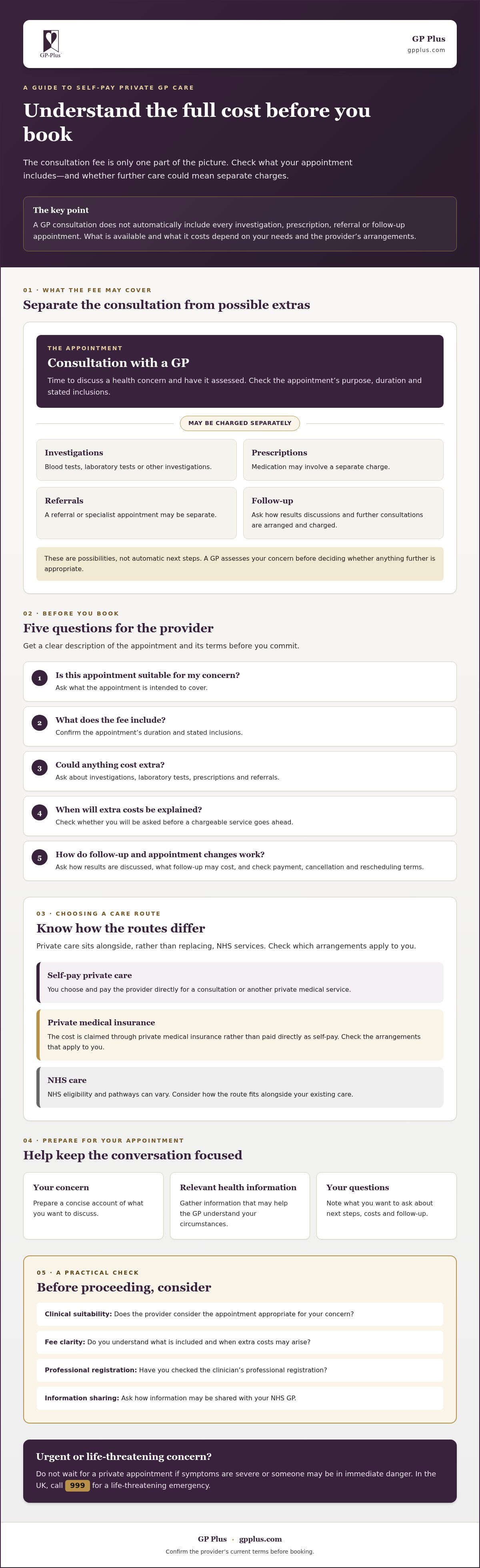
Distinguish the consultation from other services. A blood test or other investigation, a prescription, a medical or health screening appointment, and an appointment with a specialist may each be separate. Their availability, suitability and charges depend on the provider. Check the current terms rather than assuming they’re included in the consultation fee.
When might paying directly be worth considering?
Paying directly may suit someone who values choosing an appointment option or wants time to discuss a concern in detail. A longer consultation can allow more time for questions and a careful discussion of possible next steps. GP Plus offers longer appointment times, although the appropriate appointment and any further care depend on the individual concern.
Self-pay isn’t automatically the right route for everyone. Consider the nature of the problem, your existing care and whether the service can assess it appropriately. Ask the provider whether the appointment is suitable and what may happen if further investigation or a referral is considered. Confirm any additional fees before proceeding.
If symptoms are severe or you believe someone may be in immediate danger, don’t wait for a private appointment. Use the appropriate emergency service; in the UK, call 999 for a life-threatening emergency.
What should a self-pay GP fee include, and what might be extra?
A clear fee should come with a clear description of the appointment. Before booking a self pay private gp consultation, check its purpose, duration and stated inclusions. A fee for speaking with a GP doesn’t necessarily cover investigations, laboratory tests, medication or another appointment. Check the provider’s current terms instead of assuming a particular service is included.
Questions to ask before paying for an appointment
Ask whether the appointment is suitable for your concern and what the fee covers. Clarify how follow-up consultations are arranged and charged, who will discuss results with you, and whether an additional service requires separate payment. Check the provider’s payment arrangements and terms for cancelling or rescheduling too. These questions can help you understand the likely costs before you commit.
Use this checklist when contacting a provider:
- Appointment: What is its purpose and duration, and what does the fee include?
- Possible extras: Could investigations, laboratory tests, prescriptions or referrals incur separate charges?
- Costs and consent: When will additional costs be explained, and will you be asked before a chargeable service goes ahead?
- Follow-up: How are results discussions and further consultations organised, and what might they cost?
- Terms: What are the payment, cancellation and rescheduling arrangements?
Clear communication matters when discussing your care and proposed next steps. The GMC’s Good medical practice standards set out professional expectations for doctors. You can also ask the provider directly how its fees and processes work.
Why tests, prescriptions and referrals may be separate
A GP will assess your concern before considering what, if anything, should happen next. An investigation, prescription or referral is a separate clinical decision, not an automatic part of every consultation. Its suitability and cost may not be clear in advance. Ask the provider to explain the recommendation and any charge before agreeing to proceed. For more detail about prescriptions, read this guide to private prescription services.
If you’re considering a consultation, review GP consultation information and confirm the current appointment scope, fees and terms directly before booking.
Self-pay private GP, NHS care or insurance: how do the routes differ?
The main differences are who pays and how you arrange care. With self-pay, you pay the private provider directly for the consultation or service. With insured private care, costs are handled according to your policy, which may require you to use eligible providers or obtain authorisation. NHS care follows NHS pathways, and eligibility and access arrangements can vary across the UK. Check current official NHS guidance for where you live.
| Route | Who pays? | How is care accessed? | What should you confirm? |
|---|---|---|---|
| Self-pay private care | You pay the provider directly. | Contact a private provider and book an available service. | Appointment scope, fee, possible additional charges and payment terms. |
| Insured private care | Your insurer may contribute or pay, subject to your policy. | Follow your insurer’s process, which may involve approval or an eligible provider. | Whether the service is covered, any excess, authorisation requirements and provider eligibility. |
| NHS care | NHS-funded care is generally provided without direct payment at the point of use for eligible patients, subject to the relevant rules and pathway. | Use the appropriate NHS route for your location and concern. | Eligibility, referral requirements and the relevant official guidance. |
How self-pay differs from using private medical insurance
Booking a self pay private gp appointment means you’re responsible for paying the provider, even if you also hold insurance. Don’t assume your insurer will reimburse an appointment you pay for yourself. Before booking, ask your insurer whether the consultation is covered, whether you need approval in advance, which providers are eligible and whether an excess or other policy conditions apply. Confirm the payment arrangements with the provider as well.
How private GP care can sit alongside NHS care
Private and NHS care are separate routes, but you may use both as part of your healthcare. Help clinicians make informed decisions by sharing relevant information, such as medicines, test results or advice you’ve received, with the appropriate care team. Ask how information can be shared and whether proposed follow-up or a referral will use a private or NHS route. Don’t assume one provider automatically has access to another’s records or that a private appointment changes your NHS pathway.
For an overview of the provider’s private services, see GP Plus private medical care. Check the details of any specific service and how it fits your circumstances before deciding which route to use.
How to prepare for a self-pay private GP appointment
A little preparation can help you explain what’s troubling you and make good use of the consultation. Before your self pay private gp appointment, organise the key information you want to share and check the practical details with the provider.
- Define your main concern. Note what you most want help with and mention any other issues you hope to raise. If there are several, decide which feels most important to discuss first.
- Gather relevant information. Write down your current medicines, including doses if known, and any allergies. Bring relevant medical history, previous test results or records if available.
- Confirm the appointment details. Check the appointment format, duration, fee and what it covers. Ask whether you need to bring anything specific or provide records beforehand.
- Plan your questions. Consider asking what the assessment may involve, what possible next steps could be, and how results or follow-up will be handled.
What information should you bring to the consultation?
A concise timeline can help: note when symptoms began, how they have changed and whether anything seems to make them better or worse. Where relevant, describe how they affect everyday activities, such as sleep or work. You don’t need to arrive with a medical explanation. A clear account of what you’ve noticed gives the clinician a useful starting point.
Bring information about your medicines and allergies, together with relevant records or previous results if you have them. If you also receive NHS care, sharing pertinent information with the private GP can help inform the discussion. Ask how information can be shared with other clinicians if coordination is needed.
What happens during and after the appointment?
The GP will listen to your concerns, ask questions and assess the information you provide. You can discuss what the assessment suggests and whether any next steps may be appropriate. An investigation, prescription or referral depends on clinical judgement and your individual needs; a particular outcome can’t be promised in advance.
Before the appointment ends, make sure you know what happens next. Ask how results will be communicated, who to contact with questions, whether another consultation may be needed and whether proposed follow-up or an investigation has a separate charge. If an explanation is unclear, ask the GP to go through it again in plain language.
For a fee-for-service GP consultation, review GP consultation information and confirm the current appointment details directly with the provider before booking.
Choosing a self-pay private GP: how to decide with confidence
Choosing a self pay private gp involves more than finding a convenient appointment. The provider should be able to assess your concern, explain the service clearly and help you understand what may happen if your needs fall outside the appointment’s scope. Reviews and ease of booking can be useful, but they’re only part of the decision.
What to check when comparing private GP providers
Use this checklist to compare providers and clarify anything that isn’t clear before you book:
- Clinical suitability: Ask whether the service can assess your concern and what the clinician will do if it requires care beyond the provider’s scope.
- Clinician credentials: Check the clinician’s relevant experience and, where applicable, their registration on the General Medical Council’s online register.
- Appointment details: Confirm the format, length, purpose and fee inclusions. Ask how follow-up consultations are arranged and charged.
- Records and next steps: Find out how relevant records and test results are handled, and how any proposed referral would be managed.
- Practical fit: Consider whether the appointment arrangements suit you, but weigh convenience alongside clinical suitability and clear service terms.
A reassuring review can tell you about another patient’s experience, but it can’t establish whether a particular service is right for your concern. If you’re unsure, ask the provider direct questions before booking and take time to consider the answers.
How GP Plus supports a considered consultation
GP Plus provides fee-for-service private GP consultations, not NHS-funded appointments. Longer appointment times support thorough discussions, allowing clinicians to explore concerns and develop personalised care plans where appropriate. The consultation is a starting point for considering your needs. Any investigations, prescriptions or referrals depend on clinical judgement and should be confirmed separately with the provider.
To make an informed choice, check the current appointment details, fees and inclusions before proceeding. You can explore GP Plus private GP services and review the information relevant to your needs.
Take your next step with clear expectations
Choosing a self pay private gp appointment is easier when you look beyond the booking itself. Check that the service suits your concern, understand the fee and any possible additional charges, and ask how follow-up and communication with other clinicians will work. Private care can sit alongside NHS care, but clarify the arrangements rather than assuming records or next steps are shared automatically.
At GP Plus, fee-for-service GP consultations have longer appointment times to support thorough discussions and personalised care plans tailored to individual health needs. Investigations, prescriptions and specialist referrals are also available as services. Check what’s appropriate and whether separate fees apply before proceeding.
If this approach may suit you, explore GP Plus private GP services and review the current appointment details before booking. Preparing your questions and understanding the care pathway can help you feel ready for the conversation.
Frequently Asked Questions
What is a self-pay private GP?
A self pay private GP appointment is a consultation that you pay for directly to the provider, rather than claiming the cost through private medical insurance. It gives you an opportunity to discuss a health concern with a GP. Before booking, check what the fee covers and whether follow-up appointments are charged separately. Ask how recommended tests or prescriptions are arranged and whether they involve additional costs.
Can I see a private GP without using health insurance?
Yes. You can book a private GP appointment and pay the provider directly without using health insurance. Before booking, confirm the appointment type, fee, payment terms and any possible additional charges. If you have insurance, check your policy separately for cover, eligible providers and authorisation requirements. Don’t assume your insurer will reimburse an appointment you’ve already paid for yourself.
What does a self-pay private GP consultation include?
A consultation generally gives you time to discuss your concern, have it assessed by a GP and consider appropriate next steps. The precise scope and inclusions vary by provider and appointment type. Ask whether investigations, laboratory tests, prescriptions, referrals, results discussions or follow-up appointments are charged separately. Before agreeing to an additional service, make sure you understand what it involves and any associated fee.
How do I know what a self-pay GP appointment will cost?
Check the provider’s current fee information for the specific appointment you need, rather than relying on general online estimates. Ask what the fee includes and whether follow-up appointments, investigations or treatments may cost extra. If the GP recommends an additional service, request its cost before agreeing to proceed. Fees and inclusions can change, so confirm them directly with the provider before booking.
Can a private GP refer me to a specialist?
A private GP may discuss a specialist referral after assessing your concern, but whether one is appropriate depends on clinical judgement and your needs. Ask how referrals are arranged, what information may be sent and whether related appointments or investigations involve separate charges. If you plan to use private medical insurance, check with your insurer whether the referral needs approval and which specialists or providers your policy covers.
Can I use a private GP and the NHS for the same health concern?
It may be possible to receive care through both private and NHS routes, depending on your circumstances and the relevant processes. Tell the clinicians involved about relevant assessments, medicines and test results, and ask how information should be shared. Don’t assume records are automatically available across providers. NHS eligibility and pathways can vary, so check current official guidance for the part of the UK where you live.
What should I bring to a self-pay GP appointment?
Bring a concise summary of your concern, including when it began, how it has changed and how it affects you. A current list of medicines and allergies, relevant medical history, and previous results or records may also help the GP understand your situation. Prepare questions about possible next steps, follow-up and fees. Check the provider’s appointment instructions beforehand, as requirements can differ between services.


