

If you're searching for a private cholesterol test, the most convenient option isn't always the one that gives you the clearest next step. It's understandable to wonder whether a finger-prick sample is reliable, how it's processed and what to do if the result is unexpected.
At-home testing can be useful, but the collection method is only part of the picture. Check what the test measures, whether a laboratory analyses the sample and whether clinical interpretation is available. A result shows cholesterol levels, but it needs to be considered alongside your wider health and risk factors.
This guide compares at-home kits with clinician-led testing, explains what different results can and can't tell you, and outlines questions to ask before choosing. If you'd value a discussion of your results in context, a GP consultation, such as those offered by GP Plus, may help you understand appropriate follow-up. The aim is to help you choose a practical, reliable and supported option, rather than make sense of a number alone.
Key Takeaways
- When comparing private at-home cholesterol tests in the UK, look beyond convenience. Check what the test measures, how the sample is handled and what support is available.
- Cholesterol panels can include different lipid markers, so check the report’s contents before choosing a test.
- At-home results can be useful, but reliability depends on the collection method, sample quality and laboratory process.
- Review the provider’s instructions before testing and plan how you’ll discuss results that are unclear or concerning.
- A cholesterol result is one part of the picture. A clinician can help consider it alongside your health history and other risk factors.
What does a private cholesterol test at home measure?
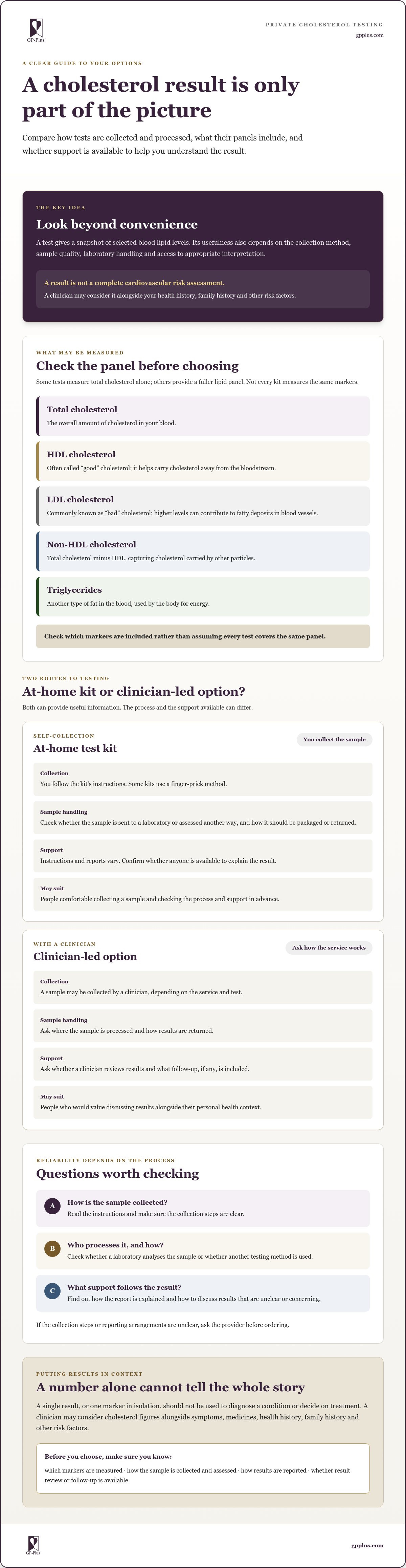
A cholesterol test is a blood test that measures fats, known as lipids, in your blood. The markers included depend on the test: some measure total cholesterol alone, whilst others provide a fuller lipid panel. Before choosing a private test, check which markers are included and how the sample will be assessed.
A cholesterol result is a snapshot of selected blood lipid levels, not a complete cardiovascular risk assessment. A clinician may consider the figures alongside your health history, family history and other risk factors to understand what they mean for you. One result, or one marker in isolation, cannot provide that wider context.
Which cholesterol markers may appear on a test?
Panels can include several measures, each describing a different part of the picture:
- Total cholesterol is the overall amount of cholesterol in your blood.
- HDL cholesterol is often called “good” cholesterol because it helps carry cholesterol away from the bloodstream.
- LDL cholesterol is commonly known as “bad” cholesterol; higher levels can contribute to fatty deposits in blood vessels.
- Non-HDL cholesterol is total cholesterol minus HDL, capturing cholesterol carried by other particles.
- Triglycerides are another type of fat in the blood, used by the body for energy.
Markers vary between tests, so check the panel before purchase rather than assuming every kit measures the same things. A single figure shouldn’t be used on its own to diagnose a condition or decide on treatment.
Why might someone choose a private cholesterol test?
Some people want convenient access to information or are taking a proactive interest in their health. A test can provide a result to discuss, but it cannot promise a diagnosis or predict an individual’s future health. When comparing private testing options, focus on the markers measured and the support available afterwards, not just how the sample is collected.
A standalone cholesterol test focuses on lipid markers. Broader health screening may consider other aspects of health, whilst a GP consultation offers an opportunity to discuss concerns and personal health context. GP Plus offers private GP consultations and health screening. Confirm directly whether a cholesterol test, its sample method and result-review arrangements are currently available. For a wider overview of screening, see our proactive health screening guide.
At-home cholesterol test or clinician-led test: how do they compare?
Both routes can provide useful information, but they differ in how samples are collected, processed and explained. A self-collection kit may suit someone who values convenience; a clinician-led option may be preferable if they want to discuss their health context as part of the process. Convenience alone doesn’t determine a test’s clinical usefulness. Sample quality, laboratory handling and access to appropriate interpretation matter too.
| What to compare | At-home self-collection kit | Clinician-led option |
|---|---|---|
| Collection | You collect the sample yourself, following the kit’s instructions. Some use a finger-prick method. | A sample may be collected by a clinician, depending on the service and test. |
| Sample handling | Check whether you send the sample to a laboratory or use another testing method, and how to package or return it. | Ask where the sample is processed and how results are returned. |
| Support | Instructions and result formats vary. Confirm whether anyone is available to explain the report. | Ask whether a clinician reviews results and what follow-up, if any, is included. |
| Best suited to | People comfortable collecting a sample and checking the process and support in advance. | People who would value discussion of results alongside their personal health context. |
How do home cholesterol test kits work?
Some kits ask you to prick a fingertip and collect a small blood sample, but methods and instructions differ. Depending on the service, the sample may be sent to a laboratory for analysis or assessed another way. Follow the kit’s instructions carefully, and check who processes the sample, which markers are measured and how you’ll receive the result. If the collection steps or reporting arrangements aren’t clear, ask the provider before ordering.
When could a clinician-led test be more suitable?
A conversation with a clinician can help put a result in context, including relevant symptoms, health history, medicines and family history. Interpretation and follow-up aren’t automatically included in every clinician-led service, so confirm what’s provided before booking. A clinician can discuss whether the result or your wider circumstances suggest further assessment may be appropriate. The NHS cholesterol level guidelines explain how cholesterol measures are described, but personal interpretation still depends on individual context.
GP Plus offers private GP consultations and longer appointments for thorough discussion. To explore whether a consultation could help you consider results in context, see private GP consultations. Confirm directly whether cholesterol testing, sample collection or result review is currently available.
Can you trust an at-home cholesterol test result?
An at-home result may be useful, but its reliability depends on the test, how well the sample is collected and handled, and the analysis process. A kit isn’t automatically dependable because it’s sold for home use, nor should all home tests be dismissed. Look for clear information about what is measured and how the result is produced.
For a private cholesterol test, check whether the sample is sent to a laboratory or assessed using another method. If laboratory analysis is involved, ask which laboratory processes it and whether its credentials, such as UKAS accreditation, can be confirmed. The provider should also explain what happens if a sample is unsuitable or cannot be processed.
What can affect a home test result?
Collection matters. A sample that’s too small, contaminated or collected contrary to the kit’s instructions may affect whether it can be analysed reliably. Packaging, storage and return steps can matter too, particularly for samples sent away. Read the full instructions before starting and contact the provider if any step is unclear. Avoid relying on generic accuracy figures: performance can vary by test method, so ask for information relevant to the specific kit you’re considering.
- Check how the sample is collected and what amount is required.
- Find out how and where it’s processed, and what quality information the provider supplies.
- Confirm how results are delivered and who can answer questions about them.
What does a cholesterol result not tell you on its own?
A result reports the measurements included in that test; it doesn’t, by itself, diagnose a condition or provide a personalised assessment of cardiovascular risk. A clinician may need to consider the figures alongside medical and family history, medicines and other relevant health information. Even a result that appears reassuring shouldn’t be treated as a complete picture of health.
If a result is unexpected, concerning or difficult to interpret, discuss it with an appropriate healthcare professional. They can help clarify what the report means and whether further assessment is appropriate. Keep a copy of the result and note the test method and date, as these details may help inform the conversation.
Don’t start, stop or change prescribed treatment based only on a home-kit result. If you’re already taking medicine, speak to the prescriber or another suitable healthcare professional before making any changes. This helps ensure a result informs decisions without being asked to show more than the test can establish.
How to choose and prepare for a private cholesterol test
A little preparation makes it easier to compare tests and understand what happens after you receive a result. Use this checklist to look beyond the collection method, from the markers measured to the support available afterwards.
- Check which markers are included. Confirm whether the test measures total cholesterol alone or includes HDL, LDL, non-HDL cholesterol and triglycerides. Panels differ, so make sure the report provides the information you’re looking for.
- Understand the sample method and process. Check whether you’ll collect a sample at home or attend a clinic, and whether it will be analysed by a laboratory. If a laboratory is involved, look for clear details about who processes the sample and how it’s handled.
- Review the result format and support. Find out how results are delivered, whether they include an explanation and who you can contact with questions. Ask what follow-up is available rather than assuming a clinician’s review is included.
- Read the preparation and suitability instructions. Follow the provider’s guidance for collecting and returning a sample, and check whether the test is suitable for your circumstances. If anything is unclear, ask the provider before proceeding.
- Plan how you’ll discuss the result. Keep your confirmation and report, along with relevant information about your health history and medicines. If you’d value help considering results in context, a GP consultation may allow time for a thorough discussion. Confirm the exact testing and result-review arrangements with any provider before booking.
Preparation requirements vary. Don’t assume you need to fast, or that you can eat beforehand: follow the provider’s instructions and check with them or a clinician if you’re unsure. Ask whether medicines or existing health conditions affect preparation, and don’t change prescribed medicines unless the prescriber advises you to.
GP Plus offers private GP consultations and longer appointments that allow time for thorough discussion. To explore whether a consultation could help you consider testing options and next steps, Discuss the right testing route with GP Plus. Confirm directly whether a cholesterol test, sample method or result review is currently available.
What happens after a private cholesterol test?
When your report arrives, check which markers were measured, the units used and any explanation supplied by the provider. If something is unclear, ask the testing service how to get clarification and whether clinical interpretation is included. A result is a starting point for understanding your health, not a diagnosis or complete assessment on its own.
How should you respond to an unexpected result?
If a finding is abnormal, concerning or difficult to understand, seek advice from an appropriate healthcare professional. They can consider the result alongside your health history, medicines and other relevant information, and advise whether further assessment may be appropriate. Don’t assume that a single figure tells the whole story, and don’t start, stop or change prescribed treatment based only on a test report.
Keep a copy of the report and note how and when the sample was collected. If you have symptoms that feel urgent, contact the appropriate local urgent health service rather than waiting for a routine discussion about test results.
When could a GP consultation help?
A GP consultation provides time to discuss what the report says, raise questions and explain relevant details about your health. It may be particularly helpful if the result surprises you, the test measured only some lipid markers or you’re unsure what to do next. A clinician can advise whether additional assessment is suitable, but confirm the scope of any testing or follow-up with the provider.
GP Plus offers private GP consultations, health screening, clinical investigations and laboratory tests. Confirm directly whether a cholesterol test or result-review pathway is currently available before making plans. If you’re exploring in-clinic investigations and diagnostics, check which investigations are offered and how results can be discussed rather than assuming a particular service is included.
If your private cholesterol test edinburgh search has brought you here, the useful next step is to choose a provider that explains both the result and the route to appropriate follow-up. Contact GP Plus to discuss your testing options.
Choose a test with a clear next step
The right cholesterol test isn’t simply the one that’s easiest to arrange. Check which lipid markers it measures, how the sample is processed and whether you’ll have help understanding the report. A result offers useful information, but it isn’t a diagnosis or a complete picture of your cardiovascular health.
If you receive an unexpected or unclear finding, seek qualified clinical advice rather than trying to interpret it alone or changing prescribed treatment. A clinician can consider the result alongside your health history and discuss whether further assessment may be appropriate.
GP Plus provides private GP consultations, health screening and clinical investigations. Longer appointments allow time to discuss individual health concerns and consider personalised care plans. Confirm directly whether a specific cholesterol test, sample method and result-review arrangement are available.
Contact GP Plus to discuss your cholesterol testing options and explore what kind of support may suit your circumstances. Clear information and an appropriate conversation can help you take your next step with greater confidence.
Frequently Asked Questions
Can I get a reliable cholesterol test at home in the UK?
An at-home cholesterol test can provide useful information, but reliability depends on the specific method, sample quality and testing process. Follow the kit instructions carefully and check whether the sample is analysed by a laboratory, who processes it and how results are explained. If a private cholesterol test edinburgh search has helped you find a provider, compare the full testing and follow-up arrangements, not just the convenience of collecting a sample at home.
Do I need to fast before a cholesterol test?
Not necessarily. Fasting requirements can vary according to the test and provider, so don’t assume you need to fast or that you can eat beforehand. Check the instructions supplied with your test and ask the provider or a clinician if they’re unclear. If you take medicines or have a health condition that could affect preparation, get tailored advice before changing your usual routine.
What does a cholesterol test check?
A cholesterol test measures lipid markers in a blood sample. Depending on the panel, it may include total cholesterol, HDL cholesterol, LDL cholesterol, non-HDL cholesterol and triglycerides. Some tests measure fewer markers than others, so check what’s included before choosing one. The result gives information about the markers tested, but it isn’t a diagnosis or a complete assessment of cardiovascular risk on its own.
Is a finger-prick cholesterol test as accurate as a blood test at a clinic?
There isn’t a single answer for every test. Results depend on the specific method, how the sample is collected and handled, and the analysis process. Some finger-prick services send samples to a laboratory, whilst other kits may use a different method. Compare the markers measured, sample instructions and processing details. If a result seems unexpected or unclear, ask a healthcare professional whether further assessment is appropriate.
What should I do if my home cholesterol test result is high?
Discuss the result with an appropriate healthcare professional, who can consider it alongside your health history, medicines and other relevant information. Check which markers the test measured and keep a copy of the report to share. A home result alone doesn’t establish a diagnosis or determine what treatment you need. Don’t start, stop or change prescribed medicines based solely on the kit result; seek advice first.
Can a private GP help explain my cholesterol test results?
A private GP consultation can provide time to discuss what the report means in the context of your health and ask whether further assessment may be appropriate. GP Plus offers GP consultations with longer appointment times, but confirm directly whether a clinician can review your particular result and what follow-up is available. Check the clinic’s specific cholesterol testing arrangements before making plans.


