

What if a health concern at work could lead to a clearer, more supportive plan rather than simply a decision about absence? An occupational health referral can help clarify how an employee’s health relates to their role and what practical support may help.
Employees may have questions about why they’re being referred and who will see information about their health. A respectful assessment focuses on work, listens to the employee’s perspective and offers relevant recommendations without sharing unnecessary clinical detail.
This guide explains when a referral may be appropriate, what happens during an assessment and how its advice can inform fair workplace decisions. It also covers confidentiality and how to turn recommendations into practical next steps. GP Plus provides occupational health assessments, with attentive consultations and time for thorough clinical consideration.
Key Takeaways
- An occupational health referral can clarify how a health concern relates to someone’s role and what support may help at work.
- A focused referral question helps the assessment address the workplace issue that needs guidance.
- Understand how consent, report access and confidentiality are handled before sharing health information.
- Use clinical recommendations to guide a practical discussion about adjustments, responsibilities and review dates.
- GP Plus occupational health assessments provide time for attentive listening and a thorough, work-focused clinical assessment.
What is an occupational health referral, and when can it help?
An occupational health referral is a request for clinical advice about how a person’s health relates to their work. ACAS describes occupational health as a service that can help employers support staff, manage health-related absence and consider workplace risks. Unlike a routine appointment focused on diagnosis or treatment, an occupational health assessment considers the work context and offers advice to help the employee and employer explore practical options.
Occupational health focuses on the relationship between health and work. An assessment may help identify duties someone can manage, adjustments that could support them, or steps towards a sustainable return after illness or injury. For example, advice may help a manager consider a phased return or changes to a role in light of the employee’s experience and the demands of the job.
A management referral is not a sick note, a disciplinary process or a way to challenge someone’s absence. It doesn’t replace clinical care for diagnosis or treatment, and it isn’t emergency care. Instead, it seeks work-focused guidance to inform a conversation and support fair planning. The advice should address the workplace question in the employee’s circumstances, rather than make a general judgement about their health.
When might an occupational health referral be considered?
A referral may be useful when an employee has recurring or extended absence, when a health condition is affecting their work, or when they’re preparing to return after illness or injury. It can address physical health, mental wellbeing, potential workplace risks and whether particular duties can be performed safely and sustainably. Start with a defined workplace question, such as what support may help someone manage a core task. Avoid seeking personal medical details that aren’t relevant to that question.
A clear question turns a broad concern into a more useful discussion. Instead of asking for a complete account of someone’s health, an employer might ask whether a temporary change to working hours could support a return, or whether aspects of the working environment may be affecting wellbeing. The employee’s perspective matters: work demands and health needs can look different from the person’s experience than they do from a manager’s desk.
Who is involved in the referral?
The employee shares information about their health and experience at work. A manager or HR contact explains the workplace concern and provides relevant details about the role. The occupational health clinician considers this information, listens to the employee and gives work-focused advice. The clinician informs the discussion; the employer remains responsible for decisions about workplace arrangements. For a wider explanation of what an assessment may involve, see Occupational Health Referral: A Comprehensive Guide to Professional Assessments.
A good referral leaves room for a constructive conversation. When the question is clear and the employee understands why advice is being sought, recommendations are more likely to address the practical issue and provide a useful basis for deciding what happens next.
How does an occupational health referral work from start to finish?
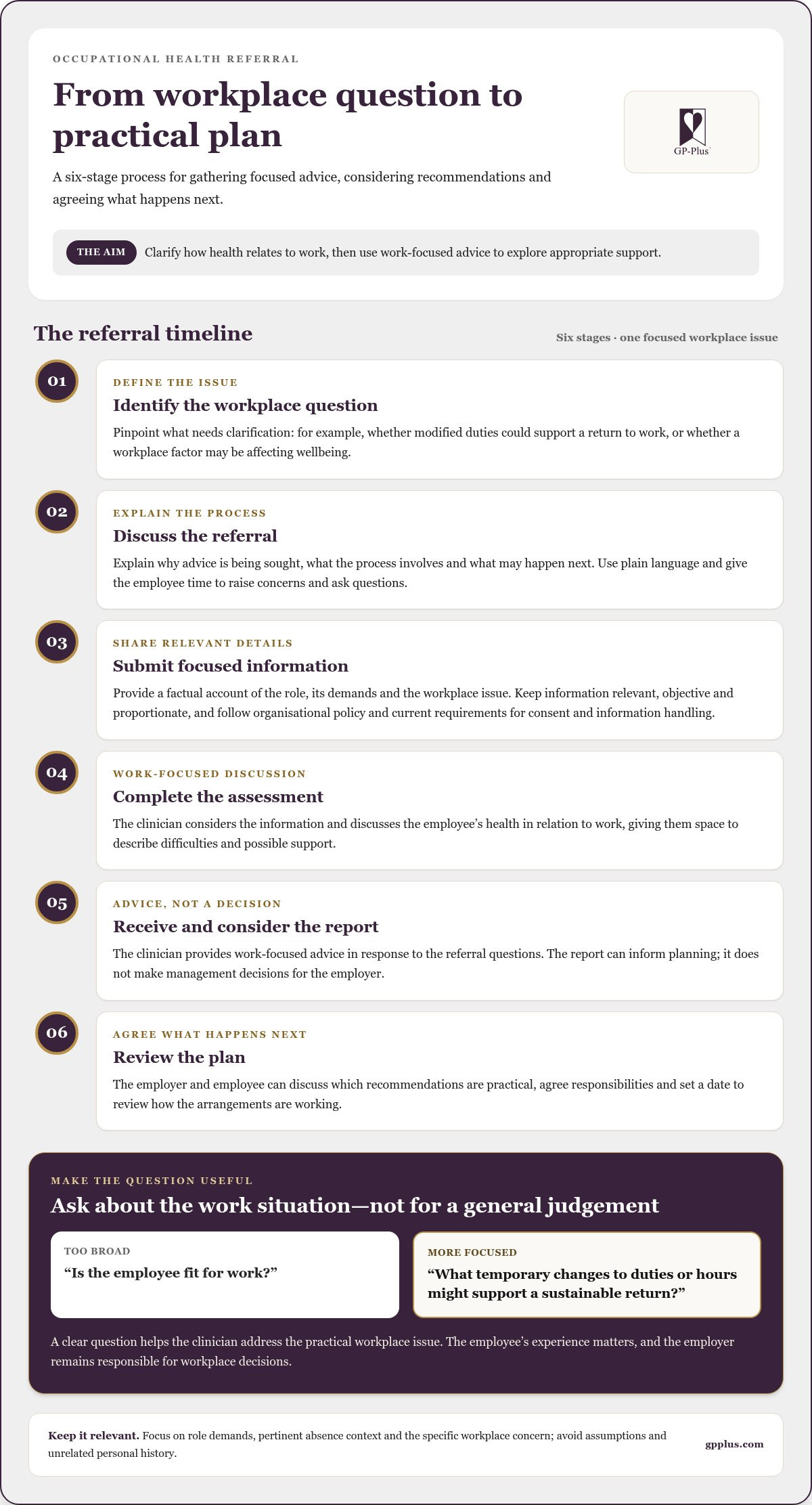
A clear process helps everyone understand why advice is being sought, what information is needed and how recommendations will be considered. Arrangements vary between organisations, but an occupational health referral commonly follows these six stages:
- Identify the workplace question. Pinpoint what needs clarification, such as whether modified duties could support a return to work or whether a workplace factor may be affecting an employee’s wellbeing.
- Discuss the referral. Explain the reason for seeking advice, the expected process and possible next steps in plain language. Give the employee time to raise concerns and ask questions.
- Submit relevant information. Provide a focused account of the role, its demands and the workplace issue. Follow organisational policy and current requirements for consent and information handling.
- Complete the assessment. The clinician considers the information and discusses the employee’s health in relation to work, allowing them to describe difficulties and possible support.
- Receive and consider the report. The clinician provides work-focused advice in response to the referral questions. The report can inform planning, but it doesn’t make management decisions for the employer.
- Review the plan. The employer and employee can discuss which recommendations are practical, agree responsibilities and set a date to review how the arrangements are working.
The referral question shapes the value of the advice. “Is the employee fit for work?” may be too broad to guide a useful conversation. A more focused question could ask what temporary changes to duties or hours might support a sustainable return, or whether particular tasks appear to be contributing to difficulty. This gives the clinician a specific issue to address instead of asking for a general judgement about the person.
What should an employer include in a referral?
Give a factual picture of the work: the employee’s main duties, relevant role demands, pertinent absence context and specific workplace concerns. State the questions that need clinical advice. Keep the information objective and job-related. Avoid assumptions about a diagnosis, judgements about motivation or personal history that won’t help answer the referral question. Useful information is relevant, factual and proportionate. Follow organisational policy and verify current consent and information-handling requirements before sending personal information.
Before proceeding, make time for the employee’s questions and explain what is known about the process, including how the report is intended to inform workplace planning. Clear communication can reduce uncertainty and help the employee prepare without feeling that an outcome has already been decided.
What can an employee do before an assessment?
It may help to note which tasks feel manageable, which parts of work are difficult, what support has helped and what questions to raise with the clinician. Employees can also ask how their information will be used and who may receive the report. Describing specific work situations can keep the discussion practical. There’s no need to prepare a complete account of unrelated health matters.
GP Plus provides occupational health assessments with attentive consultations and time for thorough clinical consideration.
Will an occupational health referral expose private medical details?
It’s understandable to wonder what an employer will learn. An occupational health referral is intended to inform work-related support, not automatically disclose every detail of an employee’s medical history. However, confidentiality shouldn’t be treated as an absolute promise. What a report contains, who can access it and whether it may be shared further depend on the assessment, the information requested, consent and applicable rules.
Occupational health advice is usually directed towards the workplace question. A report might describe how a health concern affects particular tasks and suggest adjustments or support. It may also include clinical information when that’s relevant to the advice. Before or during the process, the employee can ask what information is being sought, how it will be used and who is expected to receive the report.
Health information is sensitive personal data. Employers should handle it carefully and follow their organisation’s procedures, taking account of current data-protection requirements. Consent and access arrangements can depend on the circumstances and the type of report. For guidance on data protection, consult the Information Commissioner’s Office (ICO). For questions about medical reports, check current official guidance on the Access to Medical Reports Act 1988. Avoid relying on general assurances when an individual’s circumstances may affect the answer.
What might an occupational health report cover?
Reports vary according to the referral question and assessment. A clinician may comment on functional impact, relevant work activities, fitness for particular duties where clinically appropriate, and possible support needs. For example, advice might say a task could be manageable with a temporary adjustment, or that further discussion is needed before duties are changed. A report isn’t necessarily a full medical record, and it may not provide a definitive answer to every workplace question. Its value lies in considered, work-focused guidance.
It helps to distinguish clinical findings from recommendations. The clinician may explain the health-related factors informing their opinion, then set out practical options for the workplace. An employer may need enough information to understand and consider the advice, but that doesn’t make every private detail relevant to the decision. Employees can raise questions about the report’s scope and handling as part of the process.
What should employers avoid assuming?
A report shouldn’t be treated as an automatic decision about capability, absence or employment. Recommendations need to be considered alongside the actual role, the employee’s perspective and relevant workplace procedures. If advice proposes an adjustment, the employer still needs to consider whether and how it can be put into practice. The recommendation is not a decision already made.
Occupational health advice also differs from medical certification. A fit note addresses medical certification for work absence; an occupational health report offers work-focused advice. Understanding the difference helps employers use each appropriately when considering absence and workplace support. Clinical advice can support a fair discussion without replacing the responsibilities of either the employer or employee.
How can employers act on occupational health recommendations?
An occupational health report is most useful when its recommendations lead to a clear, respectful workplace plan. The clinician provides work-focused advice; the employer considers how it applies to the role and makes decisions about workplace arrangements. Discuss the options with the employee rather than treating the report as an instruction or a decision in itself.
Start by identifying which recommendations are relevant and what each would mean in practice. If advice suggests temporary changes to duties, discuss which tasks could be adjusted, who will organise the change and how the employee can raise any difficulties. A staged return or another temporary arrangement may suit some circumstances, but there’s no single approach that works for every role or person.
How can a workplace support plan be made practical?
Turn each agreed measure into an action, name the person responsible and set a review point. Explain the plan to the employee, invite their input and record the decision in line with workplace policy. Keep notes focused on relevant actions, and avoid circulating sensitive health details more widely than necessary. A review is an opportunity to see whether support is working, not a test of the employee.
At the review, consider whether agreed changes have been put in place, whether they’re helping with the work-related difficulty and whether anything needs to change. If the plan isn’t working as hoped, discuss what’s getting in the way before choosing a next step. This keeps the plan responsive to the employee’s needs and the realities of the role.
Manager’s checklist after receiving a report:
- Identify recommendations relevant to the role and referral question.
- Discuss practical options with the employee and invite their perspective.
- Agree actions, responsibilities and a suitable review point.
- Record decisions and share relevant information appropriately, following workplace policy.
- At review, assess what is helping and whether the plan needs to change.
What if the report does not answer the referral question?
Identify the specific work-related question that remains unanswered. Before seeking more information, consider whether a focused clarification or review could address it, and follow applicable consent and information-handling procedures. Avoid requesting a broader report by default. If the employee needs a wider clinical discussion beyond the workplace question, a Private GP Consultations: Unhurried Care for Your Health consultation may be relevant to that separate need.
If further occupational health advice would help clarify practical support, GP Plus provides attentive assessments with time for thorough clinical consideration. Explore GP Plus occupational health assessments for work-focused advice.
How can GP Plus support an occupational health referral?
When a workplace health question needs careful consideration, a thorough clinical assessment can help bring the relevant details into focus. GP Plus provides occupational health assessments and work-focused advice. Attentive consultations allow time to hear the employee’s account and understand the context of their role.
An assessment can explore how health concerns and work demands intersect. An employee may describe which tasks are difficult, what they can manage and what support they feel could help. The clinician can consider this alongside relevant information about the role and develop practical recommendations where appropriate. The aim is to offer a thoughtful clinical perspective, not to assume a particular diagnosis, adjustment or outcome in advance.
Recommendations inform discussion and workplace decisions, but they don’t make those decisions for the employer or replace a conversation with the employee. Employers can consider the clinical advice alongside the responsibilities and practical requirements of the role, then discuss possible next steps respectfully. The employee’s experience remains an important part of that discussion.
What can people expect from a considered assessment?
Every referral is individual. The clinician listens to the employee’s account, considers the health concerns relevant to the referral and seeks to understand the work demands that matter to the question. A thorough assessment may help shape tailored, practical recommendations, but its focus and format depend on the circumstances. Not every referral requires the same tests, report or appointment structure. The assessment should be guided by the information needed to address the workplace question.
GP Plus places emphasis on unhurried, attentive consultations. Longer appointment times allow for thorough investigations and personalised care planning, giving space to consider relevant details rather than relying on a rushed impression. This helps keep advice grounded in the person’s circumstances and work context, while focused on what the assessment can reasonably inform.
What is a sensible next step after reading this guide?
Employers can begin by clarifying the workplace question that needs clinical advice, then explain the purpose of the referral to the employee in plain, respectful language. Employees may find it useful to note the work situations they’d like to discuss, the support that could help and any questions about the assessment or report. These steps can help everyone approach the process with greater clarity.
If a considered assessment would help inform a work-related discussion, explore occupational health support from GP Plus.
Take the next step towards a workable plan
A workplace health concern doesn’t have to be resolved in one conversation. A well-considered occupational health referral can provide a starting point for further discussion, with room to review what is working as circumstances change. Begin by defining the question that needs answering and approaching the process with openness, respect and a shared focus on sustainable support.
Employers should consider clinical advice alongside the practical needs of the role. Employees need space to explain what work feels like from their perspective and raise questions about possible support. Neither needs to have every answer before beginning. A clear, work-focused assessment can help bring the important considerations into view.
GP Plus provides occupational health assessments, with longer consultation times supporting thorough investigations and personalised care plans. To take a considered approach to workplace health, explore occupational health support from GP Plus.
Frequently Asked Questions
Can an employee refuse an occupational health referral?
An employee can choose not to take part and shouldn’t be forced to attend an assessment. They may want to understand why the referral is being suggested, what questions will be asked and how information may be used before deciding. If they decline, the employer may have less clinical advice to inform workplace planning. Handle any next steps fairly, with reference to relevant workplace procedures and current guidance.
Can an employee bring someone to an occupational health assessment?
Possibly, but arrangements can vary according to the assessment and provider. An employee who would feel more comfortable with support can raise this before the appointment and explain what assistance they need, such as help understanding questions or communicating their views. The clinician may need to consider how a companion’s presence affects the discussion and confidentiality. The employee can also ask about other ways to make the assessment accessible.
Does an occupational health referral mean an employee is unfit for work?
No. A referral is a request for advice, not a finding that someone cannot work. An employee may be able to continue their usual duties or benefit from changes to particular tasks or hours. For example, a clinician might advise that a specific activity needs further consideration while other responsibilities remain manageable. The employer should consider the individual advice and discuss its practical implications rather than infer a conclusion from the referral itself.
Can an occupational health clinician contact an employee’s GP?
An occupational health clinician may need information from an employee’s GP in some cases, but this shouldn’t be assumed to happen automatically. The employee can ask what information is being sought, why it’s relevant and how permission will be handled. Medical information should be requested and shared in line with applicable consent, confidentiality and data-protection requirements. If the employee doesn’t understand a request, they can ask for an explanation before deciding how to respond.
How long does an occupational health referral take?
There isn’t one fixed timescale for every referral. The overall process can depend on arranging the assessment, the complexity of the workplace question and whether relevant information is available. A question about a particular task may need less consideration than several health and role-related issues. Employers can help avoid unnecessary delays by setting out the question clearly, explaining the expected process and keeping the employee informed if arrangements change.
Can an employee see the occupational health report before their employer?
Access arrangements depend on the type of report and the rules that apply. Employees should ask at the outset whether they can see the report before it is sent, how to request access and whether any exceptions may apply. Don’t assume every occupational health report follows the same procedure. The employer and clinician should explain how the report will be shared and handled. Employees can consult current official guidance if they’re unsure about their rights.
Is an occupational health referral the same as a fit note?
No. A fit note is issued by an appropriate healthcare professional to provide evidence about a person’s fitness for work and may indicate they could work with changes. An occupational health referral asks for advice about health in relation to a role. The two serve different purposes, and one doesn’t automatically replace the other. An employer should consider each document in context and follow relevant absence and workplace procedures.


