

Could a longer list of tests leave you with less certainty, rather than more? A full body MOT health check can offer a useful snapshot, but no screening can detect every condition or confirm that you’re entirely healthy. Tests need to be chosen and interpreted in context, so an unexpected result doesn’t automatically mean something is wrong.
It’s understandable to want a clear picture of what’s included, whether anything important could be missed and what an abnormal result might mean. The most helpful assessment isn’t necessarily the one with the most tests. Your symptoms, medical and family history, age and other risk factors all help determine which checks may be relevant.
This guide explains what a health MOT may involve, how to choose tests and how it differs from the NHS Health Check in England. You’ll also learn what screening can and can’t tell you, why results need careful interpretation, and how a clinician-led conversation can help turn findings into sensible next steps and follow-up.
Key Takeaways
- A full body MOT health check can vary between providers, so check its scope rather than assuming it includes every test.
- Use your medical and family history, medicines and current concerns to help identify which assessment components may be relevant.
- Compare a broad test list with a clinician-guided assessment, including the limits of each approach.
- Before your appointment, clarify your aims, prepare your health information and follow the provider’s instructions about preparation.
- Ask who will explain your results, what follow-up is available and whether further investigations may involve separate charges.
What is a full body MOT health check, and what can it tell you?
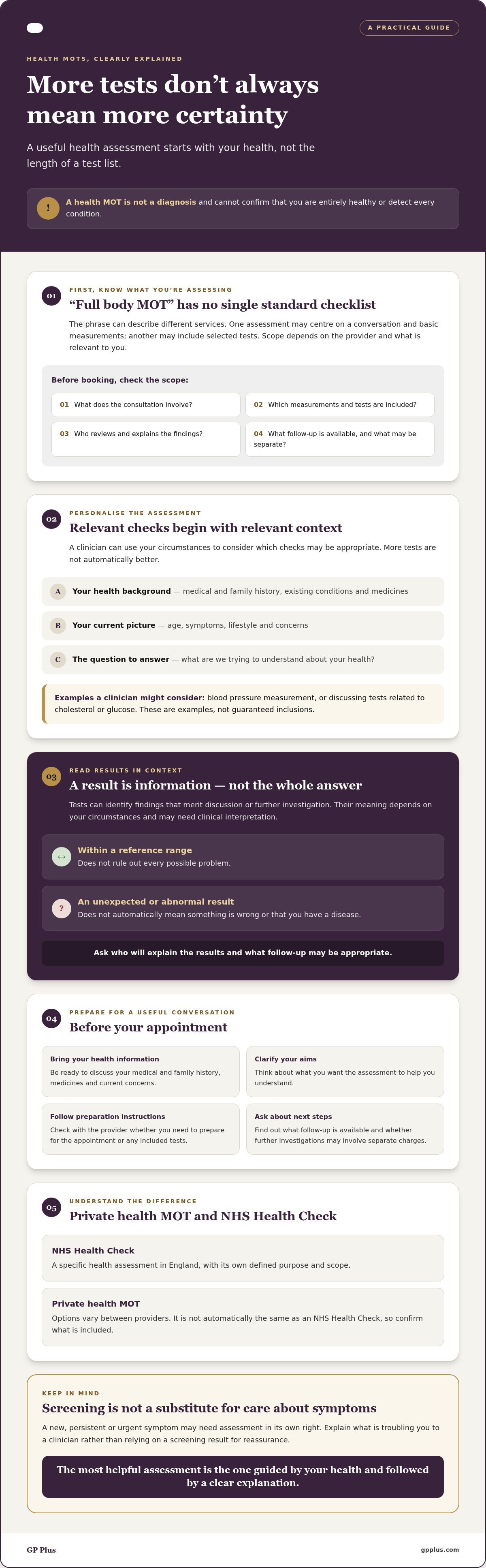
“Full body MOT” can sound like one standard, all-inclusive medical test. In practice, it’s a broad phrase for a health assessment, and its scope depends on the service and on what’s relevant to the person having it. One assessment may focus on a conversation and basic measurements; another may include selected tests. Don’t assume every check includes the same blood tests, scans or investigations.
A health MOT is an assessment that looks for selected health risks or signs of particular conditions; it isn’t a diagnosis or a guarantee that you’re completely healthy. Screening can identify findings that merit discussion or further investigation, but it can’t check for every possible condition. A result within a reference range doesn’t rule out every problem, and an abnormal result doesn’t automatically mean you have a disease. Its meaning depends on your circumstances and may need clinical interpretation.
The idea is related to a general medical examination, but “full body MOT” isn’t a single, universally defined medical test. A useful assessment combines appropriate checks with a conversation about your health, rather than relying on a long list of numbers in isolation.
Is a full body MOT one standard test?
No. The phrase can describe different assessments, so check precisely what a provider offers before booking. Ask what the consultation involves, which measurements and tests are included, who reviews the findings and how results will be explained. Clarify what follow-up is available, too. This helps you understand what the assessment can address and what may require a separate appointment or investigation.
Who might consider a health MOT?
Adults who want a proactive review, or who would value time to discuss health concerns and possible next steps, may consider one. Your age, medical and family history, lifestyle and symptoms can help a clinician decide what is relevant. At GP Plus, longer appointments give clinicians time to explore individual concerns and discuss personalised care planning. Confirm current screening options and included tests with the clinic.
A health MOT isn’t a substitute for seeking care about a new, persistent or urgent symptom. Screening looks for selected risks in a particular context, whereas symptoms may need assessment in their own right. If something is troubling you, explain it to a clinician rather than relying on a screening result for reassurance. For a broader introduction to prevention-focused assessments, read this guide to proactive health screening.
What might a full body health MOT include?
There isn’t one fixed checklist. A full body MOT health check may involve a clinician-led discussion, selected measurements or investigations, depending on the service and your circumstances. A useful starting point is not “Which tests can I have?” but “What are we trying to understand about my health?”
Each test should help answer a relevant clinical question, not simply add another result to a list. Your medical history, medicines, lifestyle, family history and current concerns can all influence which checks may be appropriate. A clinician can also explain what a proposed test may show and where its limits lie.
What happens during the consultation?
You may be asked about your medical history, ongoing concerns, medicines and aspects of your lifestyle, such as activity, smoking or alcohol. Bring questions you’d like answered so the discussion reflects what matters to you. The clinician may then consider whether an examination or measurements are appropriate for the appointment and your circumstances.
The assessment should be guided by clinical judgement, not an assumption that everyone needs the same checks. Longer appointments, such as those offered by GP Plus, can provide time to explore individual concerns and discuss possible next steps or a personalised care plan.
Which checks or blood tests might be considered?
Depending on the reason for the assessment, a clinician might consider measuring blood pressure or discussing tests related to cholesterol or glucose. These are examples, not guaranteed inclusions. Whether they’re suitable can depend on your health history, symptoms, existing conditions and other relevant factors. A blood test or measurement can provide useful information, but may not explain a concern on its own.
For comparison, the NHS Health Check is a specific health assessment in England with its own defined purpose and scope. It isn’t the same as every private health MOT. Private screening options also vary, so confirm exactly what the appointment includes before booking. Don’t assume a scan, particular test panel or same-day result is part of the service unless the provider confirms it.
If you’re considering a clinician-led discussion about your health, you can explore GP Plus health screening and GP consultations and check which options are currently available.
Why a personalised health MOT is better than a one-size-fits-all test list
A longer list of tests can look more thorough, but more results don’t automatically provide a clearer or more useful picture. A test may detect something that needs explanation without identifying its cause, and unexpected findings can lead to further discussion or investigations. A well-chosen assessment focuses on what is relevant to you and how the results will be interpreted.
| Approach | Potential value | Limitations |
|---|---|---|
| Broad test list | May cover a range of measurements or health markers in one assessment. | Tests may not match your needs, and an abnormal result may not explain what is happening. |
| Clinician-guided assessment | Uses your health context to help prioritise relevant questions and investigations. | It still has limits: it can’t assess every condition or predict every future health problem. |
How do personal history and risk factors affect the assessment?
Age, medical and family history, medicines, lifestyle and symptoms can all help a clinician decide what to explore. For example, a family history or a particular concern may prompt a more focused discussion about whether an investigation is appropriate. Screening someone without symptoms is different from assessing a current problem, which may call for a separate clinical evaluation. A full body MOT health check shouldn’t be treated as a way to identify every hidden or future condition. A discussion of the evidence for general health checks also highlights why potential benefits and limitations deserve consideration, particularly for people without symptoms.
Does a normal result mean everything is fine?
A result relates to the particular test and the time it was taken. It can be reassuring, but it can’t rule out every condition, including problems the assessment wasn’t designed to look for. Equally, an unexpected result doesn’t necessarily mean there’s a serious illness. It may need context, repeat testing or further investigation to understand its significance.
If symptoms persist or change, discuss them with a clinician even if screening results were normal. The clinician can consider the symptoms alongside your history and explain whether another assessment is appropriate. At GP Plus, longer appointments allow time to explore individual concerns and discuss personalised care planning, helping results inform a considered next step rather than being viewed in isolation.
How to prepare for a health MOT and understand your results
A little preparation can make your appointment more focused and help ensure important details aren’t overlooked. Before your full body MOT health check, clarify what you hope to discuss and check the provider’s instructions. Don’t assume you need to fast or change your usual routine; preparation depends on the tests planned.
What should you bring or ask at the appointment?
Use this simple sequence to get ready:
- Clarify your aims. Note what you’d like to understand or discuss, such as a general review or a particular concern.
- Gather relevant history. Make a note of existing conditions, significant past health issues and relevant family history. Bring previous results if you have them.
- List your medicines. Include prescribed medicines and any supplements you take, so the clinician can consider them in context.
- Prepare questions. Write down symptoms, when they began and how they affect you, along with anything you want clarified about proposed tests.
- Check instructions. Ask the provider directly whether you need to fast or take any other steps before the appointment.
You don’t need to arrive with every detail memorised. A short written note can help you explain what matters, particularly if you have several concerns. GP Plus offers longer appointment times for clinicians to explore individual concerns and discuss personalised care planning.
What happens after the results are reviewed?
Ask who will explain your results, when and how you’ll receive them, and who to contact with questions. A result should be considered alongside your medical history, symptoms and the reason the test was arranged. If anything needs further attention, ask what it means and what the recommended next step is.
Depending on the findings and clinical judgement, next steps may include reassurance, further investigation, monitoring or a referral. Some results may need repeating or interpreting alongside other information. An unexpected finding doesn’t automatically indicate a serious problem, but it’s reasonable to ask for a clear explanation and confirm whether follow-up is planned.
If you have symptoms that are urgent or getting worse, don’t wait for a routine screening appointment or its results. Seek appropriate medical advice promptly. For other questions, ask the provider how follow-up will be arranged and whether you’ll need to book another consultation or investigation.
If you’d like time to discuss your concerns and possible next steps with a clinician, you can explore GP Plus consultations and health screening.
Choosing a full body MOT health check with clinician-led follow-up
A provider’s test list is only part of the decision. Before choosing a full body MOT health check, find out how the assessment is tailored, who will review the findings and what support is available afterwards. Clear answers help you judge whether the service suits your concerns and how any results will be put into context.
Questions to ask before booking a health MOT
Use these questions to understand what’s included and what happens next:
- What does the assessment cover? Ask which consultation, measurements and tests are included, and which may be considered after discussing your circumstances.
- Who reviews and explains the results? Check whether you’ll have an opportunity to discuss what findings mean for you.
- How is follow-up arranged? Ask what happens if a result needs repeating, further investigation or a referral.
- Are there additional charges? Check whether investigations or appointments beyond the stated assessment are charged separately.
- Is this suitable for my needs? Explain your concerns and any existing care, and ask whether the assessment is appropriate.
These conversations can also clarify whether a screening appointment is the right route or whether a current symptom or existing health concern needs a separate consultation. Avoid choosing on the length of the test list alone. Consider how the provider will help you understand the results and decide on sensible next steps.
How GP Plus can support a considered assessment
GP Plus provides private health screening, GP consultations, investigations and specialist referrals. Longer appointment times allow clinicians to explore individual concerns and discuss personalised care planning. This gives space for a thorough conversation, although the checks or next steps considered will depend on clinical judgement and your circumstances.
If an investigation or referral may be appropriate, it can be discussed as part of considering the next step. Before proceeding, ask what it involves, how results will be reviewed and how follow-up will be arranged. Confirm current screening options and included tests directly with the clinic, as these details can vary.
For more context on the clinic’s approach, read this guide to GP Plus private medical care. If you’re considering a health screening appointment, you can explore health screening with GP Plus and discuss what may be relevant to your individual needs.
Choose a health assessment that fits your needs
A full body MOT health check isn’t a single standard test, and a longer list of investigations doesn’t necessarily offer a clearer answer. The most useful assessment considers your health history, concerns and risk factors, with a clinician explaining what results do and don’t show.
Before booking, check what’s included, who will review your results and how follow-up is arranged. If a finding needs attention, you should understand the options, whether that means reassurance, further investigation or a referral. If you have symptoms, raise them directly rather than relying on screening alone.
At GP Plus, health screening, investigations and specialist referrals are available. Longer appointment times give clinicians room to discuss individual concerns and consider personalised care planning. To explore whether this approach may suit you, explore health screening with GP Plus.
A thoughtful conversation can be a constructive first step towards clearer, more personal decisions about your health.
Frequently Asked Questions
What is included in a full body MOT health check?
There’s no universal list of tests included in a full body MOT health check. Depending on the provider and your circumstances, it may involve a consultation, measurements such as blood pressure, or selected tests, for example cholesterol or glucose testing. Ask what’s specifically included, who reviews the findings and what follow-up is offered. Your medical history, medicines, family history and concerns can help a clinician decide which checks may be relevant.
Is a full body MOT health check worth having?
It may be useful if you want a proactive review or time to discuss health concerns, provided the assessment is relevant to you and its limits are clear. Consider whether a clinician will discuss your history, explain why tests are suggested and help interpret the results. A larger panel isn’t automatically more valuable. Before booking, check what the service covers and whether it suits your needs and existing care.
Can a full body health check detect every health problem?
No. A health check looks for selected risks or signs of particular conditions; it can’t assess every illness or guarantee that no health problem is present. Results relate to the specific tests performed and the time they were taken. A normal finding may be reassuring without ruling everything out, while an unexpected result may need explanation. If you have persistent symptoms, discuss them with a clinician even after screening.
How long does a full body MOT appointment take?
Appointment length varies according to the provider, the assessment and whether tests or a detailed discussion are involved. Check the expected duration when arranging your appointment, and ask whether result discussions or follow-up happen separately. GP Plus offers longer appointment times to allow clinicians to explore individual concerns and discuss personalised care planning. Confirm the exact appointment format and time directly with the provider.
Do I need to fast before a full body health check?
Not necessarily. Whether fasting or another preparation step is needed depends on the tests planned and the provider’s instructions, so don’t assume it’s required. Check your appointment information or contact the clinic beforehand if anything is unclear. Follow the advice you’re given, including any instructions about medicines, and ask before changing your usual routine. If you haven’t received preparation guidance, seek clarification before the appointment.
What happens if a health MOT finds an abnormal result?
An abnormal result doesn’t automatically mean you have a serious condition. A clinician should explain what the finding may mean in context and whether it needs a repeat test, further investigation, monitoring or referral. Ask who will discuss the result with you, what the next step involves and how follow-up will be arranged. If you develop urgent or worsening symptoms, seek appropriate medical advice rather than waiting for routine follow-up.
Is a private health MOT a replacement for NHS care or screening?
No. A private health MOT doesn’t replace NHS care, assessment of symptoms or screening programmes for which you may be eligible. The scope of a private check depends on the provider, and it may not cover the same purpose as an NHS service. Continue to use NHS services for appropriate care and follow their screening invitations or guidance. If you’re unsure where a concern should be assessed, ask a healthcare professional.


