

If persistent joint pain is affecting your movement, sleep or everyday routines, you may be wondering whether an injection is the right next step. A search for a joint pain consultation can bring up confident claims about injections, but they are one option within a diagnosis-led plan, not a guaranteed cure.
It’s natural to have questions about alternatives, possible benefits and risks, or which clinician to see. A considered consultation can put these questions in context by exploring your symptoms, health history and how the pain affects your life. At GP Plus, longer appointments allow time for a thorough discussion and personalised care planning, with investigations or a specialist referral considered where appropriate.
This guide explains when joint injections may be considered, what they can and can’t do, and how they compare with options such as exercise and physiotherapy. You’ll also learn what a joint pain consultation can cover, so you can understand your choices and leave with a clearer plan for what to do next.
Key Takeaways
- Learn what an injection into a joint means and how it differs from an injection into nearby tissues.
- Understand why suitability depends on your diagnosis, symptoms, health history and treatment goals, and why an injection may ease symptoms without addressing the underlying cause.
- Compare injection therapy with physiotherapy, activity changes and clinician-guided medicines to understand how each might fit into a care plan.
- Prepare for a joint pain consultation edinburgh by noting your symptoms, when they began, affected activities, previous care, medicines and questions.
- See how a thorough GP consultation can help shape personalised next steps, which may include advice, investigation, treatment planning or referral.
Joint injection therapy: what it is and what it may help
Persistent joint pain can make ordinary movement harder and leave you wondering whether an injection might help. The answer depends on what is causing the pain, which joint is affected and what you hope to achieve. A careful assessment helps put injections in context, rather than treating them as a guaranteed fix.
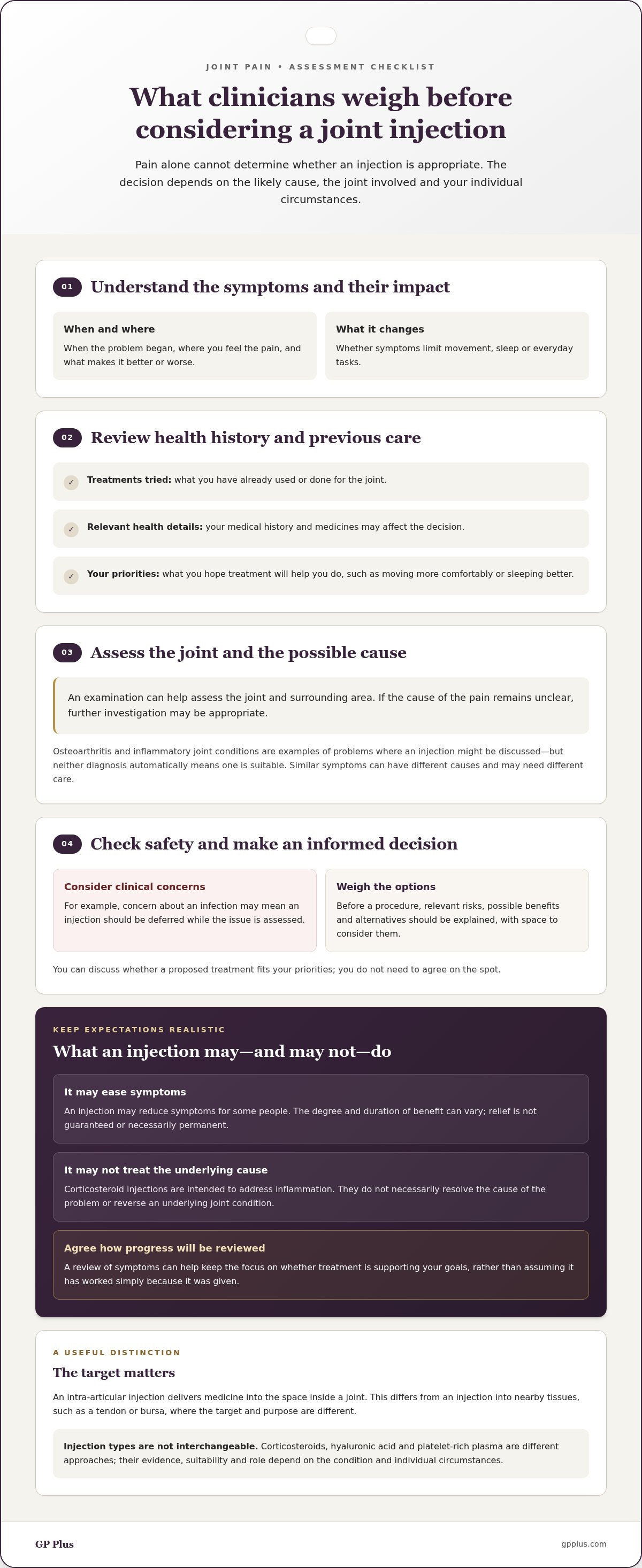
An intra-articular injection delivers medicine into the space inside a joint to help manage symptoms. It may ease pain or inflammation, but it does not necessarily treat or cure the underlying condition. This differs from an injection into tissues around a joint, such as a tendon or bursa, where the target and purpose are different. The term joint injection therapy covers a range of procedures, so the name alone doesn’t explain which medicine or approach is appropriate.
What medicines may be used in a joint injection?
Corticosteroids are anti-inflammatory medicines. In selected circumstances, a clinician may consider injecting one into a joint to reduce inflammation and help relieve symptoms. Suitability depends on the assessment, and the degree and duration of benefit can vary.
Other approaches, including injections using hyaluronic acid or platelet-rich plasma, are different from corticosteroid injections. They are not interchangeable, and their evidence, suitability and role depend on the condition and individual circumstances. A discussion should explain what is being proposed, why it may be considered and what its limitations are, rather than implying that every injection works in the same way.
Which joint problems might prompt a discussion?
Osteoarthritis and inflammatory joint conditions are examples of problems where injection therapy might be discussed, but neither diagnosis automatically means an injection is appropriate. Joint pain can also relate to injury or other causes, and similar symptoms may call for different investigation and care.
A clinician will consider the pattern of your symptoms, the affected joint, your health history and previous treatment before discussing options. A condition name or a painful, swollen joint on its own isn’t enough to determine whether an injection is suitable. General information can help you prepare, but an individual assessment is needed to put it in context.
At GP Plus, a GP consultation provides time to explore your symptoms and health history, then consider appropriate next steps. Depending on the findings, these may include advice, investigation, treatment planning or a specialist referral. The aim is a clear, personalised plan, not an assumption that an injection must follow.
Who may be suitable for joint injection therapy, and what are its limits?
Whether an injection is appropriate can’t be decided by pain alone. A clinician needs to understand the likely cause, the joint involved, how symptoms affect your life and what you hope treatment will help you do. Your health history and previous care also matter. For one person, an injection might be considered as part of a wider plan; for another, further assessment or a different approach may make more sense.
What should a clinician assess before recommending an injection?
Assessment usually starts with your account of the problem: when it began, where you feel pain, what makes it better or worse, and whether it limits movement, sleep or everyday tasks. The clinician may ask what treatments you’ve tried and review relevant medical history and medicines. An examination can help assess the joint and surrounding area. If the cause remains unclear, further investigation may be appropriate.
Other clinical factors can affect the decision. For example, concern about an infection may mean an injection should be deferred while the issue is assessed. Before any procedure, the clinician should explain relevant risks, possible benefits and alternatives, and give you space to consider them. You can discuss whether the proposed treatment fits your priorities without feeling that you need to agree on the spot.
What can an injection realistically achieve?
An injection may reduce symptoms for some people, but relief isn’t guaranteed, permanent or the same for everyone. The response can depend on the affected joint and the underlying condition. Corticosteroid injections are intended to address inflammation; they don’t necessarily resolve the cause of the problem or reverse an underlying joint condition. The NHS explains what to expect from hydrocortisone injections, including that the effects and how long they last can vary.
A useful discussion sets realistic goals. You might want to move more comfortably, sleep better or take part in rehabilitation. The clinician can help clarify whether an injection is likely to support those aims and what other care may still be needed. Agreeing how to review your symptoms keeps the focus on your progress, rather than assuming the treatment has worked simply because it was given.
If you’re unsure which step is right, a private GP consultation gives you time to discuss your symptoms, history and concerns, then consider personalised next steps such as advice, investigation or referral where appropriate. A joint pain consultation edinburgh should help you understand your options, including when not to proceed with an injection.
Joint injections compared with physiotherapy, medicines and other care
An injection is one possible part of joint pain management, not automatically an alternative to movement-based care or medicines. Different approaches have different aims. A clinician can help weigh them against your diagnosis, health history and priorities. Depending on your situation, more than one approach may form part of a considered plan.
| Option | Purpose and potential role | Limitations | Who guides it? |
|---|---|---|---|
| Joint injection | May target symptoms within or around a particular joint, depending on the medicine and injection site. | Relief isn’t guaranteed and may not address the underlying cause. | A suitably qualified clinician following assessment. |
| Physiotherapy | Can support movement, strength, function and confidence through an individually tailored rehabilitation approach. | Exercises and progression need to suit the person and their symptoms; improvement may take time. | A physiotherapist, with the plan informed by the clinical picture. |
| Activity adaptation | Adjusting how or when you do certain tasks may help manage demands on a painful joint whilst preserving movement. | There’s no single approach for everyone, and avoiding movement altogether may not be helpful. | You and your clinician, considering symptoms and daily needs. |
| Medicines | Depending on the medicine, treatment may act throughout the body or be applied to a particular area to manage symptoms. | Benefits, risks and interactions vary; medicines don’t necessarily resolve the cause. | A clinician who can review your health and current medicines. |
Treatment choice depends on the diagnosis, your goals and what is clinically suitable. An injection, physiotherapy, activity changes and medicines may complement one another rather than compete. For inflammatory joint conditions, injections may be considered within a wider plan, as described in this overview of a treatment plan for inflammatory joint conditions.
When might physiotherapy or activity changes be discussed?
Tailored movement and rehabilitation may help maintain or improve function and build confidence using an affected joint. Activity adaptation doesn’t mean you have to stop moving. It might involve discussing how to pace, modify or gradually return to particular tasks. The right approach depends on the cause of pain, how it affects you and your wider circumstances, so advice should be individualised.
How do medicines and injections differ?
Some medicines are taken by mouth or applied to the skin and may have effects beyond one joint. An injection delivers medicine to a specific site, with its purpose depending on the medicine and assessment. Neither route is automatically preferable. Don’t start, stop or combine medicines based on general information; discuss potential benefits, interactions and risks with a clinician who knows your health history.
A joint pain consultation edinburgh can help you consider these choices in context. At GP Plus, a longer GP appointment provides time to explore your symptoms, history and treatment goals, then consider appropriate advice, investigation or referral as part of a personalised plan.
How to prepare for a joint pain consultation and discuss injection therapy
A little preparation can make it easier to explain what you’re experiencing and leave time for the questions that matter to you. You don’t need to arrive with a diagnosis or decide in advance whether you want an injection. The purpose of the consultation is to understand the problem and consider appropriate next steps together.
What details about joint pain are useful to bring?
Before your appointment, note details that may help build a clear picture. Include medicines you take, relevant medical history, and any previous investigation results or referral information you can share.
- Describe the symptoms: note where the pain is, whether it has changed, and any stiffness, swelling or other symptoms you’ve noticed.
- Set out the timeline: record when it began and whether it came on gradually or after a particular event.
- Notice patterns: consider what seems to ease or worsen the pain, such as particular movements or times of day.
- Explain the impact: think about effects on sleep, mobility, work, hobbies and everyday activities.
- Summarise previous care and priorities: list treatments you’ve tried, what helped or didn’t, and what you most want to improve.
Brief notes are enough. If you already have investigation results or information from another clinician, bringing them can help provide context. You can also mention any concerns about injections, including worries about possible risks or what treatment might involve.
Which questions can help clarify treatment choices?
Consider writing down questions so you don’t have to remember them all during the appointment. You might ask:
- What diagnosis are you considering, and is any further assessment or investigation needed?
- If an injection is being discussed, what is it intended to help with, and what benefits and risks are relevant to me?
- What alternatives could suit my situation, and how might they fit alongside an injection?
- How will we review whether the plan is helping, and what should I do if symptoms persist or change?
These questions can support a shared decision, rather than making an injection seem like the expected outcome. If you’re searching for a joint pain consultation edinburgh, this preparation can help you have a more focused discussion about your symptoms and options.
At GP Plus, longer GP appointments allow time to explore your concerns, health history and goals, then consider a personalised plan that may include advice, investigation or referral where appropriate. Arrange a GP consultation to discuss your joint pain and clarify your next steps.
How a GP Plus consultation can clarify your next steps
Persistent joint pain can leave you weighing conflicting advice and wondering whether an injection, further tests or a different approach might help. A GP consultation offers time to look at the whole picture: your symptoms, health history, concerns and what you’d like to manage or return to doing. That discussion can help turn uncertainty into a considered plan, without assuming a particular procedure is the answer.
At GP Plus, longer appointment times support a thorough conversation and personalised care planning. Depending on your situation, the next step may be practical advice, an investigation, treatment planning or referral to a specialist. A consultation helps you make informed decisions, but it doesn’t guarantee that you’ll need or be offered an injection.
What happens when the cause of joint pain needs further investigation?
If your symptoms or examination leave questions about the cause, the GP may consider whether further investigation or specialist input would be useful. The choice depends on the clinical findings; it doesn’t mean everyone with joint pain needs imaging. Referral isn’t automatic either. Where the assessment indicates that another area of expertise would help, a specialist referral can form part of the plan, with the reason explained to you.
This measured approach means the next step follows from what is found and what remains unclear. It avoids treating an injection as the default response before the problem has been properly considered.
How can a personalised plan support longer-term joint care?
A useful plan connects clinical advice with the things that matter in your daily life, such as walking more comfortably, sleeping better or managing work and home activities. It should reflect your symptoms, priorities and circumstances, and clarify what to do next. If symptoms persist, change or respond differently than expected, reviewing the plan can help determine whether advice, investigation or referral needs to be reconsidered.
If you’ve been searching for a joint pain consultation edinburgh, focus on understanding the decision-making process: what the clinician thinks may be causing your pain, which options could fit, and how progress will be reviewed. GP Plus’s personalised approach to private care centres on a careful discussion of your health needs and appropriate next steps.
Arrange a private GP consultation with GP Plus to discuss your joint pain, ask your questions and work towards a clear, personalised plan.
Take a considered next step for your joint health
Joint injections may help manage symptoms in some circumstances, but they aren’t guaranteed to work or cure the underlying cause. The right approach depends on a careful assessment and may involve physiotherapy, medicines, activity adjustments, further investigation or specialist input alongside other care.
If you’re considering a joint pain consultation edinburgh, notes on your symptoms, daily impact, medical history and questions can help make the discussion more useful. You don’t need to decide on a procedure beforehand. A consultation can help clarify what may be causing your pain and which next steps fit your needs.
At GP Plus, longer appointments create space to explore your concerns thoroughly, while personalised care planning reflects your individual health needs. Where appropriate, the GP can also facilitate a specialist referral. Arrange a GP consultation to discuss your joint pain and work towards a clearer plan.
Frequently Asked Questions
Can a joint injection help with joint pain?
It may ease pain or inflammation for some people, but it isn’t guaranteed to work or treat the underlying cause. Whether it could help depends on the diagnosis, the joint involved, your health history and your treatment goals. A clinician can discuss likely benefits alongside limitations and alternatives, so you can weigh an injection as one possible part of a wider care plan rather than a cure.
How long does a joint injection take to work?
The time before you notice a change varies according to the medicine used, the joint and the cause of your symptoms. Relief isn’t always immediate, and some people may notice little or no improvement. Ask the clinician what timeframe is realistic for the specific injection being considered and when to review the result. Avoid judging the treatment too early or arranging repeat treatment without personalised medical advice.
Are joint injections safe?
Joint injections can be considered when clinically appropriate, but, like other procedures, they have potential risks and aren’t suitable for everyone. Your clinician should review your health, medicines and relevant risk factors, explain possible side effects and discuss alternatives before you decide. If there’s concern about infection or another reason to defer treatment, the priority is assessing that issue first. Raise any concerns or questions during the consultation.
What conditions can joint injection therapy be used for?
Joint injections may be discussed for some people with osteoarthritis or inflammatory joint conditions, but a diagnosis alone doesn’t mean an injection is recommended. Pain can have different causes, and symptoms that feel similar may need different care. The clinician considers the affected joint, symptom pattern, examination findings and medical history before advising whether an injection, another treatment or further assessment is appropriate.
Is a joint injection better than physiotherapy?
Neither option is automatically better; each has a different potential role. An injection may be considered to manage symptoms in selected circumstances, while physiotherapy can support movement, function and confidence through tailored rehabilitation. Depending on your diagnosis and goals, the approaches may complement one another rather than compete. A clinician can help you consider suitable options, including activity changes and medicines, and explain their possible benefits and limitations.
What should I expect at a joint pain consultation?
Expect a discussion of your symptoms, when they began, how they affect daily life, your medical history and any treatment you’ve tried. In a joint pain consultation edinburgh, a GP can explore your concerns and goals, and consider whether examination, investigation, advice or referral may help. At GP Plus, longer appointments allow time for a thorough discussion and personalised planning. A consultation supports informed decisions, but doesn’t guarantee a particular procedure.


