

What if the most important part of a health check-up isn’t the list of tests, but what happens after them? If “checkup health” is the phrase that brought you here, you may be wondering which checks are relevant, what a normal result can tell you and whether anything needs follow-up. A test result is most useful when it’s interpreted in the context of your health and the reason for the test.
A check-up may involve a conversation about your concerns and medical history, alongside assessments or tests selected for your needs. No single set of results can rule out every condition, so findings should be discussed carefully rather than treated as a guarantee that all is well. Time to ask questions can help you understand what the results do and don’t show.
This article explains what to expect from an assessment, how a clinician may interpret findings and what appropriate next steps could look like. At GP Plus, longer private GP appointments support a thorough discussion, with health screening, clinical investigations, personalised care plans and specialist referrals where appropriate. The aim is to help you leave with a clearer understanding of your health and what, if anything, to do next.
Key Takeaways
- A check-up should reflect your health history, concerns and relevant risks, rather than follow a one-size-fits-all list of tests.
- Before a checkup health assessment, note your medicines, relevant family history and questions so you can use the appointment well.
- A result within a reference range may be reassuring, but it doesn’t rule out every health concern. Ask how the finding applies to you.
- Understand what each proposed test is intended to clarify and what follow-up may be appropriate for different results.
- Agree a practical next step based on the discussion and findings. This may involve monitoring, further investigation or a personalised care plan.
What does a health check-up assess, and who may find one useful?
A health check-up is a structured assessment shaped around your health history, current needs and relevant risks. It may include a conversation, physical measurements or specific tests, but there isn’t one fixed package that suits everyone. The purpose is to build a clearer picture of your health and decide whether further action is appropriate, not to provide a diagnosis or guarantee that illness will be found.
A useful check-up starts with a clinical question. A clinician might explore a family history of a particular condition, review a change in your wellbeing or discuss factors that could affect your future health. Tests should be selected for a reason and explained in context, rather than added automatically. For a broader introduction to preventive assessments, read our guide to proactive health screening.
What is the difference between screening and a diagnostic check?
Screening looks for selected conditions or risk factors before symptoms arise. It may be useful when a particular check suits someone’s circumstances, but screening tests have limits and don’t assess every aspect of health. A routine physical examination can include different elements depending on its purpose. The overview of periodic health evaluation describes how examinations can vary.
Diagnostic assessment investigates symptoms, an existing concern or a change in health. Before deciding whether an examination or investigation could help, the clinician may ask when the issue began, what affects it and how it relates to your medical history. The right approach depends on the person and the question being explored. If you already have a condition, a review may instead focus on how it’s being managed and whether your care plan remains suitable.
Who might consider a health check-up?
A check-up may be useful if you’d value a structured conversation about your wellbeing or want to understand relevant health risks. It can also provide space to discuss changes in how you feel, a family history that concerns you or lifestyle factors that may affect your health. These details help shape a relevant assessment, but don’t automatically mean a particular test is needed.
There’s no universal set of checks or schedule that applies to everyone. Age, personal history, symptoms and the reason for seeking an assessment all matter. If you’re searching for “checkup health” information because something has changed, explain what you’ve noticed and when it began. A private GP can take time to understand the concern, consider whether screening or investigation is more appropriate and discuss a considered next step.
What happens during a health check-up, from conversation to results?
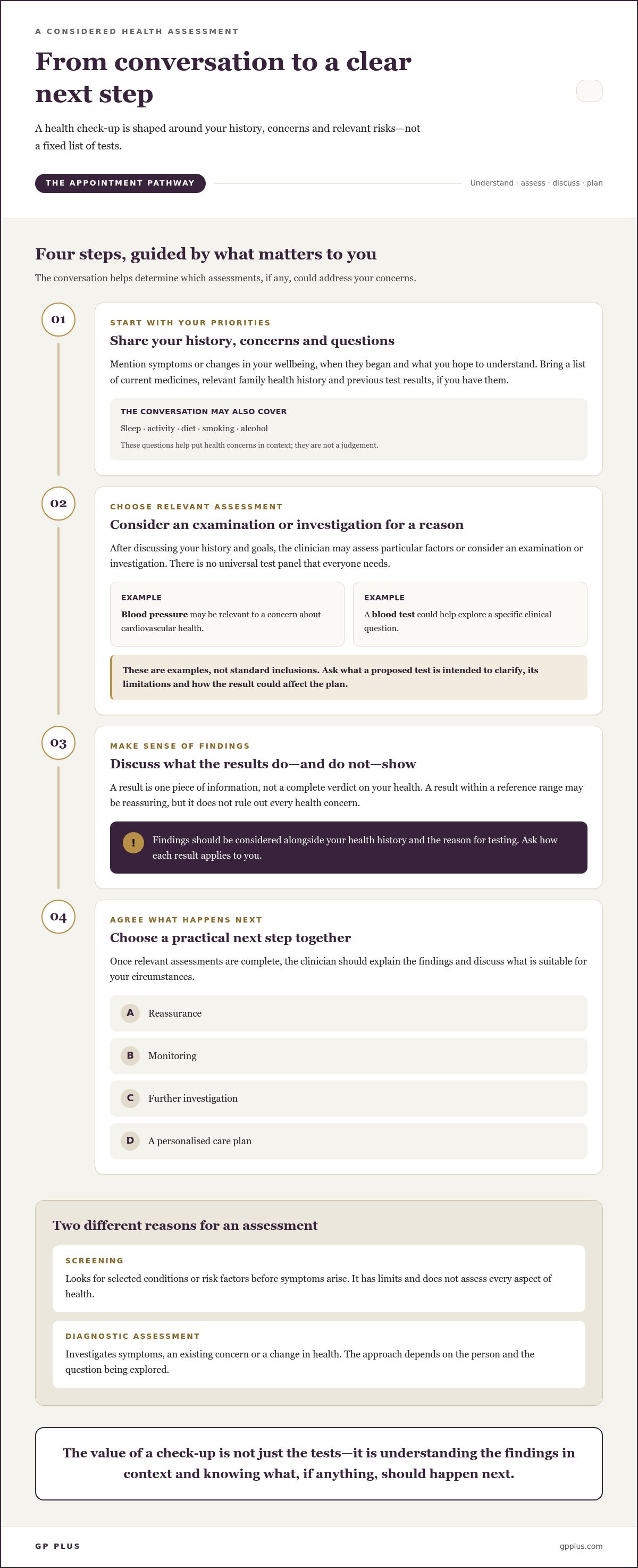
A well-considered health check-up moves from understanding what matters to you, to assessing relevant health factors and agreeing what should happen next. It isn’t simply a set of measurements. The conversation helps the clinician decide which assessments, if any, could address your concerns.
A health check-up moves from a conversation about your needs to relevant assessment, clear discussion of findings and an agreed plan.
What should you discuss with the clinician?
Start with your priorities. Mention any symptoms, changes in your wellbeing or questions you’d like the appointment to address. It can also help to bring a list of current medicines, relevant family health history and previous test results, if you have them. These details give the clinician a fuller picture and can affect which checks are appropriate.
You may be asked about sleep, activity, diet, smoking or alcohol. These questions aren’t a judgement; they help put health concerns in context and make any advice more relevant. Before a “checkup health” appointment, write down what you hope to understand so the discussion can start with what matters most to you.
When might an examination or investigation be considered?
After discussing your history and goals, the clinician may assess particular factors or consider an examination or investigation. For example, measuring blood pressure might be relevant to a concern about cardiovascular health, while a blood test could help explore a specific clinical question. These are examples, not standard inclusions. There’s no universal test panel that everyone needs.
Ask what a proposed investigation is intended to clarify, what its limitations may be and how the result could affect the plan. This helps you understand the reason for the test before deciding whether to proceed. If blood tests are arranged, understanding terms such as “reference range” can help you interpret health check-up results, but findings still need to be considered alongside your history and reason for testing.
Once any relevant assessment is complete, the clinician should explain the findings and discuss suitable next steps. Depending on the outcome, that may involve reassurance, monitoring, further investigation or a care plan. Longer private GP appointment times at GP Plus allow space for careful discussion and personalised care planning. Explore a private GP consultation to discuss your health concerns in a considered setting.
How should you interpret health check-up results without false reassurance?
A result is one piece of information, not a complete verdict on your health. A check-up can help guide decisions, but it can’t guarantee perfect health or rule out every condition. MedlinePlus describes the purpose of these visits as including screening and reviewing health risks. What a particular result means still depends on the test, why it was taken and your circumstances.
A result becomes meaningful when it’s interpreted alongside the reason for testing, your health history and any symptoms.
What can a normal result tell you, and what can it not tell you?
A result within the expected range can be reassuring about the specific measure tested at the time. It doesn’t show that every aspect of your health has been assessed, rule out all possible conditions or predict that your health won’t change. Reference ranges are useful guides, but they aren’t a substitute for clinical interpretation. If symptoms continue, change or develop after a reassuring result, raise them with an appropriate clinician rather than assuming the test has explained them.
What might borderline or unexpected findings mean?
A result outside the expected range doesn’t automatically mean you have a condition. It may reflect several factors, and the clinician can explain what it suggests in light of your history and the reason for testing. Depending on the finding, the next step might be repeat testing, further assessment or planned monitoring. Ask what the result means for you, whether follow-up is recommended and when it should happen.
| Type of result | What it may mean | Possible next step |
|---|---|---|
| Reassuring | The specific measure is within the expected range. | Understand what the result does, and doesn’t, tell you; discuss ongoing concerns. |
| Borderline | The finding may need interpretation in context. | Ask whether monitoring or a repeat test is appropriate. |
| Unexpected or outside range | The result needs clinical explanation and may warrant further assessment. | Discuss the significance and agree whether follow-up is needed. |
If you’re looking up “checkup health” results online, remember that a reference range is not, by itself, a diagnosis. Results can vary according to the test and the person, so avoid drawing conclusions from a number without its clinical context. A useful discussion explains what was found, what remains uncertain and what action, if any, is appropriate. If you’re unsure, ask the clinician to explain the result in plain language and confirm the agreed next step.
How can you prepare for a health check-up and act on the outcome?
A little preparation can help you make good use of the appointment and leave with a plan you understand. If you’re arranging a checkup health assessment, note what you most want to discuss, then gather information that may help the clinician see the wider picture.
What information is useful to bring?
A short written note can make it easier to cover your priorities, especially if you have several concerns. Consider including:
- Symptoms or changes: what you’ve noticed, when it began and anything that seems to improve or worsen it.
- Medicines and supplements: a current list, including how you take them if that’s relevant.
- Relevant health history: previous conditions, significant family history and earlier test results you have available.
- Questions: the points you most want answered, in order of importance.
You don’t need to prepare a perfect account. These notes are prompts, not a test, and the clinician can ask follow-up questions to clarify details. Sharing sensitive information helps build an accurate understanding of your circumstances; it isn’t a judgement.
What questions can help make the results clear?
If an examination or test is proposed, ask what it’s intended to clarify and how the result could influence your care. When findings are discussed, useful questions include: “What does this mean for me?”, “Do I need to take any action?” and “When should I follow up?” If repeat testing, further assessment or a referral is mentioned, clarify the reason, what happens next and whether there’s a timeframe you should follow.
Before the appointment ends, make sure you know which actions are agreed, who is responsible for arranging them and how you’ll review the outcome. If anything remains unclear, ask for it to be explained in plain language. A clear plan may involve monitoring or another assessment; the appropriate step depends on the findings and your health needs.
For wider context on the role and limits of screening, read the health screening guide. Longer private GP appointment times can give you room to talk through concerns and understand the next step. Book a private GP consultation to discuss your health in a considered appointment.
How does GP Plus connect a health check-up with personalised care?
A check-up is most useful when the findings lead to a clear conversation about what matters to you. GP Plus provides private GP consultations, health screening and clinical investigations, with longer appointment times to discuss your concerns and relevant history in detail. This connects the assessment with your priorities, rather than treating test results as the whole picture.
What makes an assessment feel personal rather than routine?
It begins with listening. Your symptoms, health history and reasons for seeking an assessment help shape what is discussed and whether an investigation may be relevant. A proposed test should relate to a clinical question and your agreed priorities, rather than be assumed to suit everyone. If you’re searching for “checkup health” because you want a more considered view of your wellbeing, the conversation is an important part of the assessment, not simply a prelude to testing.
An individual approach doesn’t mean every concern will lead to a test, diagnosis or particular outcome. It means there is space to explain the reasoning, consider what the findings can and can’t show, and agree what is appropriate for your circumstances.
What can happen after a check-up?
Next steps depend on the assessment. They may involve discussing the findings, arranging further investigation or creating a personalised care plan. If a concern would benefit from specialist input, a referral may be considered where clinically appropriate. Where treatment is discussed following clinical assessment, read more in the guide to private prescription services.
Before concluding, make sure you understand what has been agreed, whether follow-up is planned and what to do if your health changes. A careful explanation can help you distinguish between a finding that needs context and one that calls for further action. The aim is not to promise certainty, but to give you a considered route forward.
For a health check-up that brings consultation, screening and investigation into a personalised discussion, explore GP Plus consultation and screening services.
Make your next health decision with greater clarity
A health check-up is most valuable when it starts with your needs, uses clinically relevant assessment and ends with a clear next step. Tests can offer useful information, but a normal result isn’t a guarantee that every concern has been ruled out. Understanding findings alongside your health history helps you decide whether reassurance, monitoring or further assessment is appropriate.
If you’re considering a checkup health assessment, prepare the questions and details you’d like to discuss, then make sure you understand any follow-up plan. At GP Plus, longer appointment times support a thorough conversation, with health screening, investigations and personalised care plans shaped around individual circumstances. Specialist referrals may also form part of care when clinically appropriate.
You deserve to feel heard and understand what your results mean, without being rushed towards assumptions. Explore GP Plus health consultations and screening to discuss your health and take a considered step towards a clearer plan.
Frequently Asked Questions
Is a health check-up useful if I feel well?
It can offer a chance to discuss relevant health risks and preventive care, even when you feel well. Its usefulness depends on your circumstances and what you want to understand, rather than on having a standard set of tests. If you’re looking for information on “checkup health”, remember that an assessment can inform decisions but can’t guarantee every condition will be found. A clinician can help decide whether screening or another approach is appropriate.
What happens during a health check-up?
A health check-up may begin with a discussion of your health history, concerns, medicines and goals. The clinician can then consider whether relevant measurements, an examination or investigations may help. For example, measuring blood pressure or taking a blood test might be appropriate for a particular clinical question, but neither is automatically included for everyone. Findings should be explained in context, with time to discuss possible next steps and useful follow-up.
Which tests are included in a health check-up?
There isn’t one set of tests that’s right for everyone. Depending on your health history, concerns and relevant risk factors, an assessment may include measurements or investigations such as a blood pressure check or blood tests. Ask what each proposed test is intended to clarify, what its limitations are and how the result could affect your care. This helps keep checks relevant to your circumstances, rather than treating them as routine inclusions.
Can blood tests detect every health problem?
No. Blood tests provide information about specific aspects of health, but they can’t detect every condition or replace a clinical assessment. A clinician interprets results alongside your symptoms, medical history and other relevant findings. A result within its reference range doesn’t necessarily explain a persistent concern. If symptoms continue or change, discuss them with a clinician, even if an earlier blood test was reported as normal.
How often should I have a health check-up?
There’s no universal interval that suits everyone or every type of assessment. Appropriate timing depends on your health, relevant risk factors, previous results and the reason for the check-up. A clinician can discuss whether and when a review may be useful for you. Repeating tests frequently isn’t automatically beneficial; each investigation should have a clear purpose and be considered in the context of your circumstances.
What happens if a health check-up finds an unexpected result?
An unexpected result doesn’t automatically mean you have a diagnosed condition. The clinician can explain what the finding may mean alongside your health history and why the test was done. Depending on the result, the next step might be repeat testing, further investigation or another appropriate action. Ask what the finding means for you, whether follow-up is recommended, when it should happen and who will coordinate the next step.
Does a normal health check-up mean I am completely healthy?
No. A normal check-up can be reassuring about the specific areas assessed, but it can’t rule out every condition or predict future changes. Each test has a particular purpose and limitations, and its result needs to be understood in context. If symptoms appear, persist or change after your assessment, seek appropriate medical advice rather than relying on an earlier result as proof that nothing needs attention.


