
A work medical certificate should reflect careful clinical judgement and help you understand what to share with your employer. If you need a private medical certificate for work, arranging an appointment and getting clear documentation can feel difficult, particularly when you are already managing a health concern.
You may want reliable documentation without feeling pressured to disclose more about your health than necessary. A private assessment gives you time to discuss your symptoms and work circumstances with a doctor, who can consider the information before forming a clinical opinion.
This guide explains how to obtain a certificate, what information an employer may need and how private documentation differs from an NHS fit note. It also covers when a note may be required, what to consider before booking and how to prepare for an appointment. GP Plus offers unhurried consultations of 30 minutes or longer, giving you time to discuss your concerns and possible next steps.
Key Takeaways
- Understand when a private medical certificate for work may be appropriate and how it differs from a fit note or a detailed medical report.
- Check your employer’s documentation requirements before booking, so you can discuss the right type of assessment with the doctor.
- Prepare relevant health details and any previous records you have available to help the clinician understand your situation.
- An unhurried consultation gives you time to explain how your health affects your work and discuss what information to include.
- A careful clinical assessment can help you communicate clearly about your health and workplace needs.
Why Professionals Choose a Private Medical Certificate for Work
A workplace health concern can involve more than confirming that you are unwell. You may need to explain how symptoms affect your duties, whether adjustments could help or when a return to work might be appropriate. A private medical certificate for work is prepared following an assessment, with its content shaped by your health circumstances and the workplace information you need to address. The general purpose of a Medical certificate is to record a clinician’s assessment for a practical purpose. Its details should reflect what the clinician can reasonably assess.
A private appointment may suit you if you want more time to discuss a complex situation. A short consultation can be challenging when several symptoms, a chronic condition or workplace pressures need to be considered together. That does not mean a brief appointment is inadequate for every need, but a complex case may benefit from an unhurried discussion and closer investigation.
The Difference Between Speed and Thoroughness
A note may confirm an absence without explaining the clinical context an HR team needs. It may not address how a condition affects particular tasks or what questions still need further assessment. A careful clinician will hear your account, consider relevant medical history and clarify the purpose of the document, rather than treating the certificate as a formality.
At GP Plus, consultations of 30 minutes or longer can provide more time to explore these details and discuss an appropriate care plan. The aim is not to promise a particular outcome, but to reach a considered clinical view and communicate it clearly. This may help when you need to explain your health situation at work.
When a Private Certificate is Most Beneficial
A fuller assessment may be useful if a chronic condition is affecting your work, if you want another clinical perspective on fitness for work or if you need to discuss possible workplace adjustments. It may also help if the health issue is sensitive and you are unsure what your employer needs to know.
Before your appointment, ask HR what document or information they are requesting. Discuss this with the clinician so the assessment can focus on relevant work questions and you can agree what health information is appropriate to share. If you choose to provide a report to your employer, clarify its intended audience and content before it is prepared. Clear boundaries can help keep workplace communication focused on the information requested.
Distinguishing Between Sick Notes and Comprehensive Medical Reports
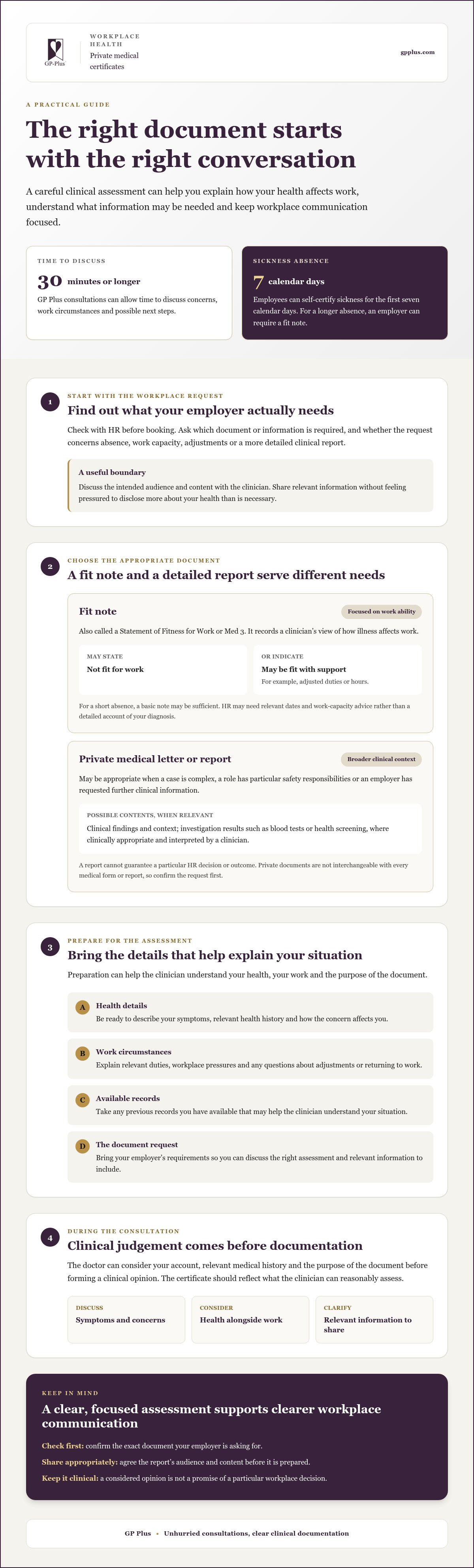
Different workplace health questions may call for different documents. A fit note, also known as a Statement of Fitness for Work or Med 3, addresses whether a health condition affects someone’s ability to work. A private medical letter or report can be broader, setting out relevant clinical findings and context when a more detailed assessment is needed. The official government guidance on fit notes explains their purpose and use.
Employees can self-certify sickness for the first seven calendar days. For a longer absence, an employer can require a fit note. A private certificate from a GMC-registered doctor can support workplace sickness absence, and employers are generally expected to treat it in the same way as an NHS fit note. However, a private document is not interchangeable with every medical form or report, so check exactly what your employer is asking for.
The Standard Private Sick Note
A fit note records the clinician’s view of how illness affects work. It may say that you are not fit for work or that you may be fit with support, such as adjusted duties or hours. HR may need relevant dates and advice about work capacity, rather than a detailed account of your diagnosis. A basic note may be sufficient for a short absence, but it may not answer broader questions about ongoing symptoms, work demands or longer-term support.
The Bespoke Medical Report
A more detailed report may be appropriate if your case is complex, your role has particular safety responsibilities or your employer has requested further clinical information. It can draw on a fuller consultation and, where clinically appropriate, investigation results such as blood tests or health screening. Findings should only be included when relevant and interpreted by a clinician. A report cannot guarantee a particular HR decision or outcome.
For ongoing health concerns, a more comprehensive assessment may help clarify what questions need addressing and whether further advice is appropriate. It can also inform an occupational health referral or a discussion about workplace adjustments. Before the assessment, ask HR what they need, who will read the document and whether they require a fit note or a fuller report. This helps keep the clinical information relevant and avoids sharing unnecessary detail.
If you are unsure which type of assessment fits your circumstances, explore private GP consultations and discuss your workplace requirements with a clinician.
The Step-by-Step Process of Obtaining Your Certificate
Start by clarifying what your employer needs, then arrange an assessment that gives the clinician time to consider your circumstances. A certificate should reflect clinical judgement, not simply repeat a requested phrase. The process may include a discussion of your symptoms, a relevant examination or investigations, and agreement about what information is appropriate to include.
1. Make an enquiry and choose the right appointment
When you contact a clinic, explain briefly why you need documentation and whether your employer has asked for a fit note or a more detailed report. Ask what consultation length is appropriate for your concerns. An unhurried appointment of 30 minutes or longer allows time to describe a complex health issue and its effects on your work.
Before booking, check what the appointment covers, whether further investigations may be considered and how the certificate or report is handled. If you are unsure about fit note requirements, consult the official government guidance for patients and employees. A fit note can be required for an absence lasting more than seven days.
2. Explain your health and work circumstances
During the consultation, describe when the problem began, how it has changed and which tasks are affected. For example, persistent pain may have different implications for a desk-based role than for work involving lifting. The clinician will ask questions, consider relevant medical history and explore details that may not be obvious at first. Be candid and mention concerns even if you are unsure whether they are relevant.
The clinician can then assess the information available. If further examination or tests are clinically appropriate, they may help clarify the picture. Testing is not automatic, and the next steps depend on your individual circumstances.
3. Discuss the document and its intended use
Before a certificate or report is prepared, explain what your employer has requested, who will receive it and which workplace questions it needs to address. The clinician can discuss the proposed content with you and seek your consent before sharing information. Ask how findings or recommendations will be expressed, especially if you have concerns about sensitive details.
Once the assessment is complete, the clinician can prepare documentation that reflects their clinical opinion and the information relevant to its purpose. If your needs are complex, GP Plus offers private GP consultations with unhurried time for careful assessment. Understanding the steps can help you approach the process with greater confidence.
How to Prepare for Your Private Medical Consultation
Preparation can help keep your consultation focused on your health, how it affects your work and what documentation your employer has requested. You do not need to arrive with every answer. Clear notes and relevant records give the doctor a fuller starting point for an assessment.
Gather relevant documents and health details
If available, bring previous NHS records, test results, specialist letters and a current list of medicines, including prescriptions. These details can help your private GP understand what has already been investigated or treated. Be open about your medical history, even if you are unsure whether a past issue is connected. This gives the clinician a fuller picture and supports a certificate based on your circumstances.
Prescriptions may form part of your ongoing care, but they do not replace an assessment of your fitness for work. You can read more about private prescriptions and their role in care planning. Bring details of any medication you take and mention its effects, including side effects that influence your day-to-day duties.
Be specific about symptoms and work
Before the appointment, note when your symptoms began, how they vary and what makes them better or worse. Describe their practical impact. For example, pain may affect lifting, fatigue may make concentration difficult, or anxiety may disrupt sleep and attendance. Concrete examples are often more useful than trying to remember everything during the consultation.
Ask HR what they need and bring the request or relevant form, if you have one. Clarify whether they want a private sick note, a fuller medical report or information about possible adjustments. Think about your aim too, whether that is time away to recover, a supported return, adjusted duties or a longer-term workplace health plan. The doctor can assess your health and discuss what may be clinically appropriate, but cannot promise a particular outcome.
Decide what you’re comfortable sharing
Consider what information is relevant to your employer and tell the doctor about any privacy concerns. Ask what the document is likely to include, who it is intended for and how it will be shared. This gives you an opportunity to discuss its wording and purpose before information is sent. Your clinician needs an accurate account to assess you, while workplace documentation should stay focused on the request.
GP Plus offers unhurried private GP consultations, including appointments of 30 minutes or longer, with time to explore your concerns. Arrange a private GP consultation to discuss your health and workplace documentation needs.
Why Detailed Clinical Assessment Matters for Your Career
Your health is part of the foundation of your working life. A certificate may address an immediate absence, but a careful assessment can also help clarify what is affecting your ability to work and what support may be worth discussing. A private medical certificate for work is most useful when it reflects a considered clinical opinion, rather than being treated simply as paperwork to obtain quickly.
Health screening can identify concerns that merit further discussion or investigation. Screening cannot guarantee the prevention of illness or improved productivity, but understanding relevant findings may help you make informed decisions about your health and seek appropriate care. If symptoms affect concentration, attendance or particular duties, explaining this clearly can support a more constructive conversation at work.
Advocacy and peace of mind
Discussing health with an employer can feel difficult, especially if you are worried about being misunderstood or revealing too much. A well-drafted report can set out relevant clinical findings and the clinician’s work-related opinion in clear language, helping keep communication focused on your circumstances. It cannot control how an employer responds, but clinical clarity may give you more confidence when discussing absence or possible adjustments.
Feeling heard matters too. An unhurried consultation of 30 minutes or longer gives you space to describe your concerns and ask questions. A GP who listens and considers whether further investigation is appropriate can offer reassurance through a thoughtful assessment, not simply a note. This time and attention can make the experience more supportive than a rushed administrative task.
Beyond the certificate: a personalised care plan
The consultation may also identify questions that deserve attention beyond the immediate workplace request. A clinician can discuss whether further investigation, treatment or a specialist referral is appropriate for your health needs. This does not mean every appointment will lead to tests or a care plan, but it can help you understand possible next steps instead of focusing solely on documentation.
GP Plus provides personalised care alongside a range of services beyond standard primary care. You can learn more about its whole-person approach to private medical care. With careful assessment and clear communication, the aim is to support your wellbeing as well as address the immediate question of work. That can help you make considered decisions about your health and professional life.
Take a Thoughtful Next Step for Your Health at Work
The right workplace medical document depends on what your employer needs and what your clinician can assess. Clarify whether you need a fit note or a more detailed report, then prepare relevant health records, symptom details and workplace requirements before your appointment. This helps the doctor focus on the questions that matter.
A private medical certificate for work can be part of a broader clinical assessment, not just a piece of paperwork. A GMC-registered doctor can provide a considered clinical opinion and, where appropriate, discuss further investigations or support for your health. GP Plus offers unhurried consultations of 30 minutes or longer in a calm setting, giving you space to explain your concerns.
Book a private GP consultation with GP Plus to discuss your health and workplace documentation with a clinician. A clearer understanding of your needs can help you decide what to do next.
Frequently Asked Questions
Is a private medical certificate for work legally valid in the UK?
A private medical certificate issued by a GMC-registered doctor can support a sickness absence from work. Employers are generally expected to accept it in the same way as an NHS fit note, and should not reject it solely because it came from a private provider. However, a private certificate is not suitable for every purpose. Government benefit claims may require a specific form, so check what your employer needs before arranging documentation.
Do I need to be registered with the NHS to see a private GP for a work note?
You do not generally need to be registered with the NHS to arrange a private GP consultation. The clinic may ask about your health, medicines and previous treatment so the doctor can assess you. If you have relevant NHS records or specialist letters, ask whether you can bring or provide them. The doctor will decide whether there is enough information to give a clinical opinion and prepare appropriate documentation.
Will my employer be able to see my full medical history if I provide a private certificate?
Providing a certificate does not automatically give your employer access to your full medical history. The document should contain information relevant to its purpose, and you can ask the clinician what it is likely to include and who will receive it. Your employer cannot contact your doctor for medical information without your explicit written consent. Discuss any privacy concerns before the report is prepared, particularly if the health matter is sensitive.
How long does a private medical consultation for a work certificate usually last?
Appointment length varies according to the clinic and the complexity of your concerns. At GP Plus, private consultations are unhurried, with appointments of 30 minutes or longer. This allows time to discuss symptoms, work duties and relevant medical history. A more complex situation may require further assessment or investigation. When booking, explain what your employer has requested and ask the clinic what appointment length may be appropriate.
Can a private GP provide a ‘Fit Note’ for an extended period of absence?
A doctor can issue a fit note following an assessment, but the period covered depends on their clinical judgement and the information available. If your absence continues, your health changes or your employer needs updated advice, you may need another assessment. Ask the clinic whether it can provide the specific fit note or report your employer requires. The clinician can explain what they are able to certify after considering your circumstances.
What happens if my employer refuses to accept a private medical certificate?
Ask your employer to explain the reason for refusal and confirm precisely what document or information they require. A certificate from a GMC-registered doctor can support workplace sickness absence, and an employer should not reject it simply because it is private. You could share relevant official guidance and discuss the issue with HR or an employee representative. If the disagreement continues, seek advice from an appropriate employment support service.
Can I get a private medical certificate for work on the same day as my appointment?
It may be possible, but it is not guaranteed. Timing depends on appointment availability, the clinician’s assessment and whether further information or investigations are needed before they can reach a view. A certificate should reflect the doctor’s clinical judgement, not be issued automatically. Contact the clinic to ask about its current arrangements, and bring any employer instructions and relevant health records to help the consultation address your needs.
Does a private medical certificate include recommendations for workplace adjustments?
It can include relevant advice about work capacity or possible adjustments if the clinician considers this appropriate and has enough information to make a recommendation. For example, the discussion might cover modified duties or hours, depending on your health and role. A certificate does not guarantee that an employer will make a particular change. Tell the doctor what your job involves and ask HR whether they need a fit note or a fuller report.


