

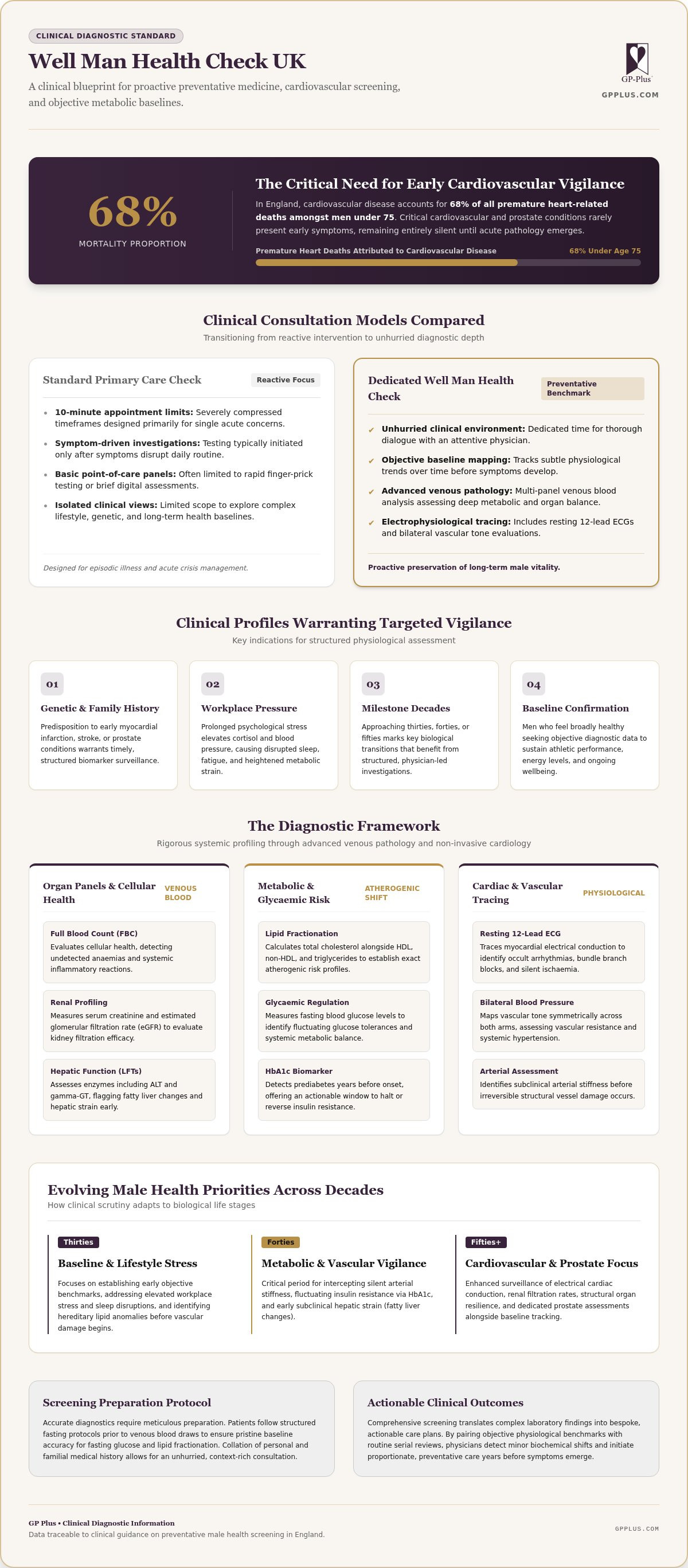
In England, cardiovascular disease accounts for 68% of all premature heart-related deaths amongst men under 75, yet critical cardiovascular and prostate risks rarely announce themselves with early symptoms. Scheduling a comprehensive well man health check UK assessment provides the dedicated time and clinical scrutiny that standard, ten-minute general practice appointments simply cannot offer.
You shouldn't have to compress complex questions into a hurried consultation or decipher conflicting online guidance on your own. Lasting peace of mind begins when an attentive physician takes the time to listen, exploring your individual health history within a calm, unhurried clinical environment.
In this guide, you'll discover what an exhaustive male health screening entails, which cardiovascular biomarkers and physiological checks matter most, and how early detection protects your future vitality. We'll examine the core diagnostics that define modern screening in 2026, helping you approach preventative medicine with absolute clarity and clinical confidence.
Key Takeaways
- Understand how an in-depth well man health check UK assessment identifies silent cardiovascular, metabolic, and hormonal changes before clinical symptoms emerge.
- Explore the core investigative components of comprehensive screening, from advanced venous pathology and vital organ panels to resting electrocardiograms (ECGs).
- Learn why unhurried, doctor-led consultations provide vital diagnostic depth and peace of mind that standard brief appointments cannot accommodate.
- Recognise how clinical priorities evolve across your thirties, forties, and fifties, allowing for targeted screening tailored to your life stage and family history.
- Master practical preparation protocols, including fasting guidelines and medical history collation, to turn clinical findings into actionable, bespoke care plans.
What Is a Well Man Health Check in the UK?
A well man health check UK assessment is an unhurried, proactive clinical evaluation designed to evaluate your current physiological state before overt symptoms appear. While conventional medical encounters occur in response to acute illness or injury, dedicated Health Screening takes an investigative approach to health maintenance. This comprehensive review blends rigorous diagnostic testing with detailed medical dialogue, allowing a physician to detect subtle, silent changes in cardiovascular markers, metabolic balance, and organ performance before they manifest as serious pathology.
Modern clinical practice firmly roots this process in the core principles of preventive medicine, shifting healthcare from reactive crisis management to early detection and preservation of long-term vitality. By identifying early arterial stiffness, fluctuating glycaemic control, or subclinical hepatic strain, you and your doctor can implement targeted clinical interventions long before emergency interventions ever become necessary.
The Clinical Philosophy of Preventative Men's Health
Men frequently defer visiting a doctor until physical symptoms interfere with daily routines. Unfortunately, conditions such as hypertension, hypercholesterolaemia, and early type 2 diabetes progress silently without pain or obvious disruption. A preventative male assessment establishes an objective physiological baseline. This benchmark allows your physician to track trends across subsequent reviews, ensuring minor biochemical shifts receive prompt, proportionate clinical attention over the course of your life.
Who Should Consider Booking a Male Medical Assessment?
While preventative screening benefits adult men across all age groups, certain clinical and lifestyle profiles warrant particular vigilance:
- Men with a family history of disease: A genetic predisposition to early myocardial infarction, stroke, or prostate conditions calls for timely, structured biomarker surveillance.
- Individuals under chronic workplace pressure: Prolonged psychological stress elevates cortisol and blood pressure, often leading to disrupted sleep patterns, persistent fatigue, and elevated metabolic risks.
- Men approaching milestone birthdays: Entering your thirties, forties, or fifties marks key biological transitions that benefit greatly from structured, physician-led investigations.
- Those establishing a clinical baseline: Men who feel broadly healthy often seek objective diagnostic confirmation to sustain their athletic performance, energy levels, and long-term wellbeing.
Core Clinical Components: What Does a Well Man Check Include?
A rigorous well man health check UK appointment moves far beyond rapid point-of-care finger-prick tests or brief digital assessments. It brings together advanced venous pathology, non-invasive cardiac diagnostics, and systemic physical examinations into an unhurried, doctor-led clinical consultation. Every biological parameter measured offers a window into your internal physiology, helping your doctor assemble a complete picture of your metabolic, organ, and vascular status.
Comprehensive Blood Biomarkers and Organ Function Panels
Venous blood profiling forms the analytical foundation of comprehensive screening. A full blood count evaluates cellular health, screening for undetected anaemias and inflammatory reactions. Renal profiles measure creatinine and estimated glomerular filtration rate (eGFR) to confirm how efficiently your kidneys filter waste. Liver function tests assess hepatic enzymes such as ALT and gamma-GT, identifying early fatty liver changes or metabolic strain before structural damage sets in.
Metabolic risk assessment relies on detailed lipid fractionation, measuring total cholesterol alongside HDL, non-HDL, and triglycerides to establish atherogenic risk. Paired with fasting glucose and HbA1c testing, this panel detects prediabetes years before symptoms arise, providing a vital opportunity to reverse insulin resistance.
Cardiovascular and Resting Electrocardiogram (ECG) Assessments
Because cardiovascular conditions represent a primary concern in men's health, mechanical and electrical cardiac evaluations are essential components of thorough screening:
- Resting 12-lead ECG: Traces myocardial electrical conduction to detect occult arrhythmias, bundle branch blocks, or subtle evidence of prior silent ischaemia.
- Bilateral brachial blood pressure mapping: Measures vascular tone across both arms, ruling out subclavian arterial discrepancies and persistent resting hypertension.
- Pulse oximetry and peripheral perfusion checks: Assesses resting oxygen saturation and microvascular circulation alongside a careful auscultation of heart sounds and carotids.
Targeted Urological, Hormonal, and Prostate Health Inquiries
Male health reviews place significant weight on endocrine and urological wellbeing. Discussing established screening guidelines for men in their 40s helps frame the nuanced role of Prostate-Specific Antigen (PSA) testing. PSA levels can fluctuate due to benign prostatic hyperplasia, recent exercise, or infection, meaning results always require careful clinical context rather than automated interpretation.
Similarly, measuring serum testosterone assists in distinguishing natural ageing from endocrine deficiency when investigating diminished stamina, loss of lean muscle mass, or brain fog. A dignified, unhurried physical examination complements these investigations. If you want to establish an exhaustive clinical baseline, booking dedicated Health Screening ensures every biomarker is assessed by an experienced physician who takes the time to listen.
Comparing Standard Primary Care Checks with In-Depth Private Screening
Routine state-funded healthcare plays a crucial role in population health, but its preventative offerings operate under strict parameters. In England, the standard NHS Health Check is offered once every five years to adults aged 40 to 74 without pre-existing conditions, focusing almost entirely on basic cardiovascular risk scoring. In contrast, an in-depth private well man health check UK assessment is available at any adult age, providing a comprehensive, whole-system investigation that prioritises individual clinical context over rigid statutory screening criteria.
Consultation Length and Clinical Investigation Depth
Standard general practice appointments are typically scheduled for ten minutes. That constrained timeframe forces clinicians to isolate and treat acute complaints rather than explore interconnected lifestyle, metabolic, and psychological factors. Attempting to discuss chronic fatigue, subtle libido changes, and family cardiac history within such brief limits frequently leaves men feeling hurried and unresolved.
Dedicated private assessments completely transform this dynamic through extended consultation times. An unhurried setting creates a sanctuary of thoroughness where an experienced physician listens attentively to your health narrative. This generous duration allows your doctor to investigate non-specific symptoms, probe sleep disruptions or workplace stressors, and conduct a detailed physical review without watching the clock.
Diagnostic Scope: Targeted Testing Versus Extensive Biomarker Profiling
The diagnostic scope differs fundamentally between basic public health checks and comprehensive male screenings. The distinctions can be seen across several key clinical dimensions:
- Consultation structure: Standard reviews often rely on brief questionnaires and point-of-care measurements taken by healthcare assistants. Private screenings centre on an extended GP Consultation led directly by an experienced doctor.
- Pathology breadth: Public checks measure total cholesterol and random or fasting glucose. Comprehensive screening incorporates broad venous panels covering renal health, liver enzymes, advanced lipid fractions, and relevant endocrine markers.
- Objective cardiac tracing: Routine checks record resting blood pressure alone, whereas detailed private assessments add multi-lead resting electrocardiograms (ECGs) to evaluate electrical heart conduction directly.
- Clinical follow-through: Basic evaluations categorise patients into broad population risk percentages. Dedicated assessments translate complex multi-organ data into tailored preventative strategies and seamless pathways to further Investigations & Treatments or Specialist Referrals whenever indicated.
Investing the time to pair deep laboratory pathology with clinical dialogue eliminates diagnostic ambiguity. Instead of generic advice, you leave with precise clinical clarity and an actionable strategy designed specifically around your biological reality.
Age-Specific Male Health Priorities: Screening Across the Decades
Biological risks evolve considerably as men mature. Rather than applying a rigid, one-size-fits-all framework, an effective well man health check UK assessment adjusts its clinical focus to mirror your life stage. Office for National Statistics data from 2025 shows that men in the UK die on average 3.7 years earlier than women, underscoring the necessity of proactive, decade-by-decade clinical surveillance. Aligning diagnostic investigations with age-specific physiological transitions ensures that emerging risks receive timely, focused intervention.
Men in Their 20s and 30s: Establishing Baselines and Mental Health
Younger men often view medical reviews as unnecessary, yet your twenties and thirties represent the ideal window to establish an accurate physiological baseline. Clinical priorities focus on identifying familial hypercholesterolaemia, early resting blood pressure elevations, and subclinical metabolic changes. Consultations provide dedicated clinical space to discuss sleep architecture, occupational burn-out, and testicular self-examination techniques, addressing subtle disruptions before they turn into chronic conditions. Where chronic anxiety or high workplace stress disrupts rest, exploring targeted therapeutic techniques can be transformative; to learn how tailored hypno-psychotherapy can assist with stress management and restorative habits, visit Brookhouse Hypnotherapy Manchester.
Men in Their 40s: Cardiovascular Vigilance and Metabolic Resilience
Cardiovascular disease is the leading cause of death among men in England, making the fourth decade a critical turning point for vascular protection. In this age bracket, investigations concentrate on central adiposity, fasting insulin sensitivity, and subclinical arterial changes. Extended consultations also explore endocrine fluctuations. Evaluating thyroid health and total testosterone alongside lifestyle factors helps doctors distinguish between normal professional fatigue and treatable endocrine decline.
Men in Their 50s and Beyond: Prostate Health and Cancer Vigilance
Crossing into your fifties warrants sharper surveillance for oncological and structural changes. In January 2025, prostate cancer became the most commonly diagnosed cancer in England, with 58,218 men diagnosed in 2024. Clinical priorities for this stage encompass:
- Informed PSA shared decision-making: Discussing individual risk profiles, particularly as Black men face double the average statistical risk of prostate cancer, to determine whether PSA tracking is clinically appropriate.
- Colorectal and gastrointestinal surveillance: Monitoring changes in bowel motility and reviewing uptake of the NHS Faecal Immunochemical Test (FIT) screening alongside targeted blood markers.
- Advanced cardiac rhythm mapping: Tracking arterial elasticity and resting myocardial conductivity via serial ECG tracings to safeguard against silent coronary artery changes.
Protecting your vitality across every stage of life requires an enduring partnership with an observant doctor. To establish your bespoke baseline, book a comprehensive GP Consultation and take proactive ownership of your health today.
How to Prepare for Your Assessment and Act Upon Your Results
Arriving thoroughly prepared ensures your well man health check UK assessment produces the most accurate diagnostic baseline possible. Diagnostic integrity depends heavily on pre-appointment discipline, as recent food intake, dehydration, or strenuous exercise can artificially distort metabolic and cardiovascular readings. By taking a few deliberate steps beforehand, you help your physician capture an authentic picture of your physiological health.
Practical Preparation for Accurate Clinical Diagnostics
To ensure laboratory precision, clinical staff will typically ask you to follow a clear preparation protocol:
- Observe fasting windows: Fast for 10 to 12 hours prior to your morning appointment. Water is actively encouraged, as proper hydration supports comfortable venous blood sampling and accurate renal profiling, but tea, coffee, and food must be avoided to prevent artificial spikes in fasting glucose and triglyceride levels.
- Maintain prescribed regimens: Continue taking essential morning medications with water, unless specifically instructed otherwise by your doctor. If you take blood pressure or thyroid medications, make a note of the exact doses and timing.
- Avoid intense exertion: Refrain from strenuous weightlifting or endurance training for 48 hours before your appointment. Heavy muscular breakdown can temporarily elevate liver enzymes and serum creatinine, skewing baseline organ evaluations.
- Collate personal and family records: Write down any instances of premature vascular disease, cancers, or metabolic disorders amongst first-degree relatives. Bringing a written summary of your own subtle symptoms ensures nothing gets overlooked.
From Medical Findings to a Personalised Long-Term Care Plan
Pathology data and ECG tracings are only as valuable as the clinical narrative that ties them together. Once your diagnostic results return, an extended follow-up consultation translates complex laboratory ranges into understandable insights. Rather than receiving an automated summary with red and green flags, you sit down with your physician to discuss what each value indicates about your cellular energy, vascular resilience, and organ function.
Your doctor then crafts a bespoke preventative strategy. This roadmap outlines evidence-based nutritional adjustments, tailored exercise prescriptions, and targeted recovery habits designed around your daily routine. If an assessment reveals unexpected findings, your doctor arranges timely Specialist Referrals for further investigations without unnecessary bureaucratic delays. Preventative health screening is not an isolated transaction; it represents an ongoing clinical alliance dedicated to protecting your health and longevity.
Protecting Your Vitality: Take Decisive Ownership of Your Health
True preventative medicine is rooted in proactive vigilance rather than reactive intervention. By pairing advanced venous pathology and resting ECG tracings with dedicated clinical dialogue, a thorough well man health check uk assessment transforms clinical uncertainty into enduring clarity. Establishing an objective biological baseline provides a clear, personalised roadmap to safeguard your cardiovascular, metabolic, and hormonal vitality across every decade.
As an independent, doctor-led medical practice delivering attentive patient care since 1999, GP Plus rejects the constraints of hurried healthcare. Our extended consultation times ensure your health is investigated with meticulous precision, supported by advanced pathology and direct access to Specialist Referrals whenever needed. Prioritising your wellbeing is the most valuable investment you can make. Schedule an unhurried Health Screening consultation with GP Plus to secure lasting peace of mind and protect your future vitality.
Frequently Asked Questions
How often should a man undergo a comprehensive health check in the UK?
Most men benefit from undergoing a full clinical review every one to two years, depending on their age and family medical history. In your twenties and thirties, attending every two or three years establishes a reliable biological baseline. Once you enter your forties, scheduling an annual well man health check uk review is strongly recommended to identify silent cardiovascular, metabolic, or hormonal changes early.
Do I need to fast before attending my male health screening appointment?
Yes, fasting for 10 to 12 hours prior to your morning appointment is necessary for accurate metabolic pathology. Eating or drinking anything other than water causes rapid fluctuations in serum glucose and circulating triglycerides, obscuring subtle signs of insulin resistance. Drinking plenty of plain water is actively encouraged, as proper hydration aids smooth venous blood collection and ensures accurate kidney function readings.
What is the difference between an NHS health check and a private assessment?
The distinction lies primarily in appointment duration, diagnostic breadth, and age eligibility. The standard NHS check occurs once every five years for adults aged 40 to 74, focusing on basic cardiovascular risk scoring via brief appointments. A private well man health check uk assessment is open to adults of any age, offering extended consultation time with a doctor, multi-lead resting ECGs, and extensive venous organ panels.
Is a PSA blood test always included in a male health check?
Prostate-Specific Antigen (PSA) testing is discussed and offered rather than carried out automatically without context. PSA levels can rise due to benign prostate enlargement, vigorous exercise, or low-grade infection, meaning an elevated result requires careful clinical evaluation. During your extended consultation, your doctor discusses your individual risk factors and family history, ensuring you make an informed clinical decision together.
Can a well man check detect underlying heart disease before symptoms occur?
Yes, comprehensive preventative screening is specifically designed to uncover early cardiovascular risks long before chest pain or breathlessness develop. Bilateral blood pressure mapping identifies early vascular resistance, while detailed lipid profiles assess circulating atherogenic particles. Paired with a resting 12-lead ECG, your physician can detect subtle electrical anomalies, silent ischaemic changes, or heart muscle strain at an early, highly treatable stage.
How quickly can I expect to receive my laboratory test results?
Venous pathology results and diagnostic tracings are typically processed within several working days. Because comprehensive assessments evaluate complex biochemistry rather than simple finger-prick readings, samples undergo precise laboratory analysis. Once the diagnostic profile is complete, your physician arranges an extended follow-up consultation to explain each biomarker thoroughly and provide you with a structured, bespoke preventative plan.
What happens if an unexpected abnormality is discovered during the medical examination?
Discovering an atypical finding leads to immediate, structured clinical care rather than uncertainty. Your doctor will explain the test results calmly, contextualising what the marker means for your long-term health. Through dedicated clinical pathways, your physician can coordinate targeted Investigations & Treatments, arrange repeat testing, or initiate seamless Specialist Referrals to leading hospital consultants without administrative delay.


