

What if an advanced health assessment meant asking better questions, not simply ordering more tests? It’s understandable to want a thorough picture of your health while wondering whether a check could miss something or lead to investigations you don’t need. The value of an advanced health assessment lies in a clinician-led discussion that considers your concerns and individual circumstances, rather than treating everyone as if they need the same package of tests.
This article explains how an advanced assessment differs from routine screening, what a clinician may consider and how to prepare for a useful, personalised conversation. You’ll find practical suggestions on what information to bring, what to ask about proposed investigations and how to clarify possible next steps. At GP Plus, a GP consultation gives you time to discuss whether a more detailed assessment may be suitable. Any health screening or investigations should be considered in light of your needs, not assumed to be automatic. The aim is to help you understand the findings and any appropriate follow-up.
Key Takeaways
- An advanced health assessment should reflect your circumstances, rather than follow a standard checklist of tests.
- Consider whether you want to discuss a current concern or learn about routine screening. They serve different purposes.
- Bring a current medicines list, relevant health records and a concise account of what’s concerning you.
- Ask why an investigation is being suggested and how its findings could affect your next steps.
- A more extensive assessment isn’t automatically more helpful. The aim is to understand what is relevant to you.
What Is an Advanced Health Assessment & How Does It Differ?
Wanting a fuller picture of your health can leave you wondering what to book: a routine check, screening or a longer conversation with a GP. The phrase advanced health assessment can sound like a set package, but it doesn’t describe one universally standardised clinical service.
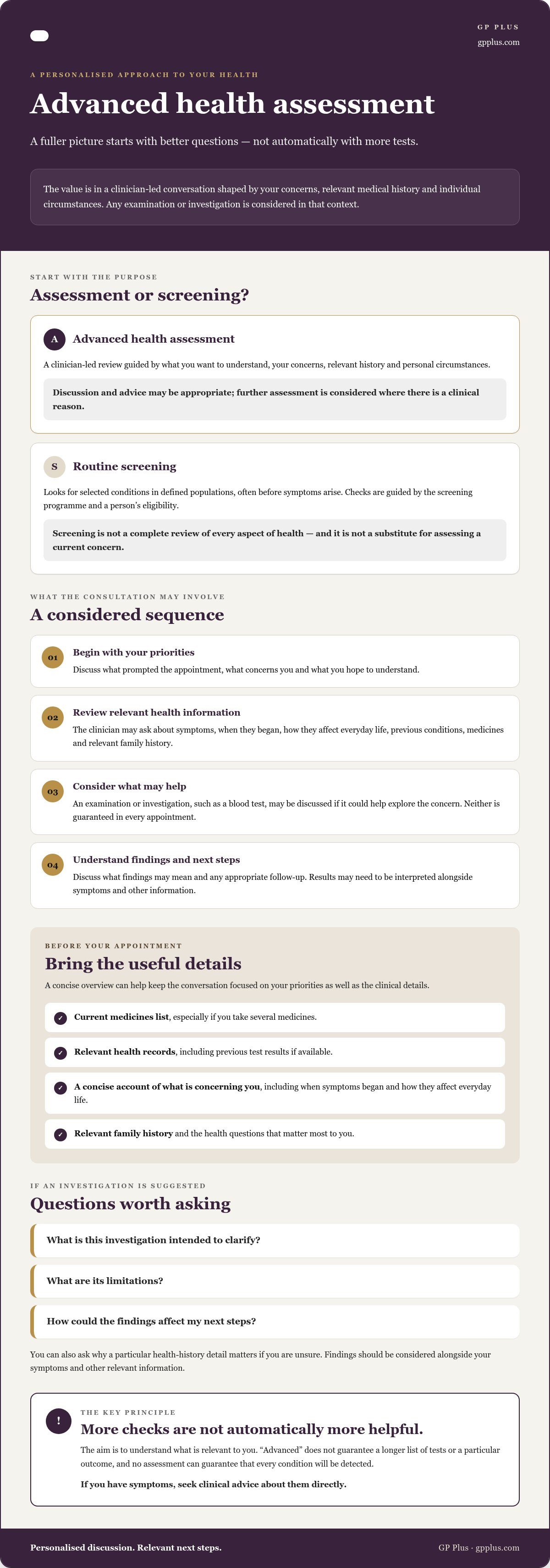
An advanced health assessment is a clinician-led review shaped by your concerns, relevant medical history and personal circumstances, with any examination or investigations considered in that context. Its purpose is to explore what may be relevant to you, not to automatically order more tests or produce a diagnosis. A clinician may decide that discussion and advice are appropriate, or consider further assessment where there is a clinical reason.
Screening has a different starting point. It looks for selected conditions in defined populations, often before symptoms arise. The checks offered are guided by the screening programme and a person’s eligibility, rather than providing a complete review of every aspect of their health. For more context, read this guide to proactive health screening.
How does an advanced assessment differ from a routine health check?
A routine health check generally offers a broad review. A more detailed assessment can give closer attention to particular symptoms, your medical and family history, and factors that may affect your health. The clinician will decide what is relevant during the consultation. A physical examination may be considered where appropriate, but it isn’t automatically required. The word “advanced” doesn’t guarantee a longer list of tests or a particular outcome.
Who might discuss a more detailed assessment with a GP?
You might raise the possibility if you have persistent concerns, several health questions to discuss, or a family history you’d like a clinician to consider alongside your own circumstances. These examples don’t mean an assessment is necessary. Age or a single risk factor alone doesn’t determine what you need. If you have symptoms, seek clinical advice about them directly. Screening isn’t a substitute for assessing a current concern.
The useful question isn’t simply how many checks are included, but whether the discussion can clarify your concerns and guide an appropriate next step. A GP consultation can help establish what you’re hoping to understand and whether a more detailed review may be suitable. The scope can then be considered carefully, without assuming that every possible test would add value.
What Happens During an Advanced Health Assessment?
An advanced health assessment usually follows a considered sequence, rather than a preset checklist. The clinician starts by listening to what prompted the appointment and what you hope to understand. They may then review relevant health information, assess your concerns, consider whether an examination or investigation could help, and discuss possible next steps with you.
Your clinical history helps the clinician decide which investigations, if any, may be relevant to the concern being explored. Previous results, medicines and family history can inform the conversation, but no single detail determines a diagnosis or automatically calls for a particular test.
Which parts of your health history may be discussed?
You may be asked about current symptoms, when they began and how they affect everyday life, as well as previous conditions and any medicines you take. The clinician may also ask about relevant family history and what matters most to you. This helps keep the discussion focused on your priorities, as well as clinical details.
Some questions can feel personal. Sharing relevant information is part of a confidential clinical conversation, and you can ask why a particular detail matters if you’re unsure. If you take several medicines or have previous test results, having a list or copies to hand can make it easier to review the full picture.
When might examination or investigations be considered?
An examination may be appropriate if it helps explore a symptom or concern. Investigations, such as a blood test, may be discussed if the clinician considers them useful in light of your history and assessment. Neither an examination nor a particular test is guaranteed to form part of every appointment. The appropriate approach depends on what is being investigated.
Before agreeing to an investigation, ask what it is intended to clarify, what its limitations are and what might happen after the result. A result may need to be interpreted alongside your symptoms and other information, and some findings can lead to further discussion or follow-up. No assessment can guarantee that every condition will be detected or predict every future health issue.
The conversation should end with a clear account of what the clinician has found, what remains uncertain and what options are available. Depending on the discussion, this might mean advice, an investigation considered in context, follow-up or a specialist referral where appropriate. To talk through your concerns with a clinician, find out more about a GP consultation.
Advanced Assessment or Routine Screening: Which Is Right for You?
These options serve different purposes, and neither is automatically the better choice. Screening checks for selected conditions in a defined group, often when someone has no symptoms. A clinical assessment starts with an individual’s concerns and circumstances. The right starting point depends on what you want to understand, your health history and the relevant guidance.
| Consideration | Routine screening | Individual assessment |
|---|---|---|
| Purpose | Look for selected conditions in a defined population. | Explore a person’s concerns or health questions. |
| Starting point | Eligibility and the screening programme or offer. | Symptoms, history, personal circumstances and priorities. |
| Personalisation | Usually follows the scope of the relevant screening offer. | Shaped around the consultation and clinical judgement. |
| Possible follow-up | May involve further assessment if a result needs checking. | May lead to advice, investigation or follow-up, as appropriate. |
Screening recommendations can depend on the person and the guidance that applies to them. A screening offer isn’t a complete review of health, and an individual assessment doesn’t replace an established screening programme. If you’re weighing up the options, consider whether you have a current concern to discuss or want to ask about screening. A clinician can help relate the options to your circumstances.
Does a more advanced assessment mean more tests?
No. A more extensive assessment isn’t automatically more useful, and extra tests don’t guarantee reassurance or identify every health issue. The scope should reflect the concern being explored, your history and the clinician’s professional judgement. Tests also have limitations: a result may need interpreting alongside symptoms and other information, and an uncertain or unexpected finding may call for clarification or follow-up. Ask what a proposed test is intended to show and what may happen next.
When might a GP consultation be a better starting point?
If you have symptoms or several connected concerns, discuss them with a GP before choosing a screening package. A conversation can help clarify whether an individual assessment, screening or another route is appropriate. It can also help you decide which concern to prioritise if you have several questions. For more on what to expect from a consultation, see this private GP consultation guide.
How to Prepare for an Advanced Health Assessment and Follow Up
You don’t need to prepare a complete medical history before an advanced health assessment. A few clear notes can help you make the most of the conversation and ensure the issues that matter to you are discussed. There’s no need to arrange tests or change your usual routine unless the clinic gives you specific instructions.
What information should you bring to the appointment?
Before you go, organise the information you already have. A short written summary can be easier to refer to than trying to remember every detail during the appointment. Consider bringing:
- A concise account of your concerns, including what you’ve noticed and when it began.
- A current list of prescribed medicines and supplements, if applicable.
- Relevant previous results or health records that may not be available to the clinician.
- Questions you’d like answered, such as what you hope to understand or what is worrying you most.
If an investigation is suggested, ask the clinic whether that specific test needs any preparation. Requirements can vary, so don’t assume you need to fast or make another change unless you’ve been advised to do so.
What questions should you ask about results and next steps?
Before an investigation takes place, clarify its purpose and how and when you’ll receive the result. You can also ask who will explain it and who to contact if you haven’t heard back within the expected timeframe. Agreeing a follow-up plan in advance can make it easier to know what to expect.
When results are available, ask how they fit with your history, symptoms and any examination. If a result is unclear or unexpected, find out whether it needs repeat testing, monitoring or further discussion. A result is one part of the picture. The clinician can explain its meaning in context rather than leaving you to interpret it alone.
Bring a medicines list, relevant records, a brief symptom summary and your questions. Then agree how results and follow-up will be handled.
Depending on the findings, follow-up may involve a discussion, monitoring, further investigation or a specialist referral where clinically appropriate. Make sure you understand the reasoning and what action, if any, is recommended. To discuss your health concerns and how to prepare, arrange a GP consultation.
How GP Plus Can Support a Personalised Health Assessment
If you’re considering an assessment, you may want to talk through your concerns with a clinician. GP Plus provides private GP consultations and health screening, with longer appointment times to support a detailed discussion of your health needs. You can explain what has prompted your questions and what you hope to clarify before considering whether any further assessment may be suitable.
What can a personalised GP consultation help you clarify?
You can raise current concerns, relevant health history and your priorities with a GP, including questions that may feel difficult to fit into a brief conversation. The clinician can consider these details together and discuss whether health screening or an investigation may be appropriate. These are options to consider in context, not a fixed package or automatic next step.
If further investigation or a specialist referral is appropriate, the clinician can discuss this with you and explain how it relates to your circumstances. The aim is to build shared understanding: what is known, whether anything needs further attention and what practical next steps may be considered. A consultation can’t guarantee a diagnosis or a particular outcome, but it can help you understand the reasoning behind a plan.
Where follow-up is needed, a care plan can be tailored to your health needs. Discussing what the findings mean and what action is being suggested can make it easier to decide what to do next, rather than being left with results or recommendations that feel unclear.
How can you take the next step with GP Plus?
If you’re considering an advanced health assessment, review the services GP Plus provides and check the current appointment arrangements and assessment scope. When making an enquiry, briefly describe your main health questions and any particular concerns you’d like to discuss. You don’t need to decide in advance which tests you want. A GP consultation can help establish what may be relevant.
A useful starting point is to explain what you’re hoping to understand. A clinician can then discuss whether a consultation may suit your needs and what options might be appropriate. Take the time you need to review the information and ask questions about the process. To learn more, explore GP Plus medical services.
Take a Thoughtful Next Step for Your Health
An advanced health assessment isn’t defined by how many tests it includes. Its value comes from a clinician considering your concerns, relevant history and individual needs, then explaining what the findings mean and what may be appropriate next. Preparing your questions and agreeing how results will be followed up can help you leave with greater clarity.
GP Plus offers private GP consultations with longer appointment times for detailed discussions, alongside health screening and investigations where clinically appropriate. A personalised care plan can reflect your health needs, and a specialist referral may be considered if suitable. No particular test or outcome is guaranteed. The aim is to make the next steps easier to understand.
If you’d like to explore your options, contact GP Plus to discuss a consultation. You can begin by sharing the health questions you’d like to discuss. A clear, considered conversation can be a first step towards understanding your health and deciding what to do next.
Frequently Asked Questions
What is an advanced health assessment?
An advanced health assessment is a clinician-led review shaped around your health concerns, relevant history and individual circumstances. It may include discussion, examination or investigations if the clinician considers them appropriate, but there’s no universal package or checklist attached to the term. The aim is to understand what may be relevant and agree sensible next steps, not simply to perform as many tests as possible or guarantee a diagnosis.
Is an advanced health assessment the same as a health screening?
No. Health screening looks for selected conditions in defined groups, often before symptoms appear, and follows the scope of the screening offer. An individual assessment starts with your concerns and health history, helping a clinician consider what might be useful for you. Screening and assessment can complement one another, but one doesn’t automatically replace the other. If you’re unsure which is suitable, discuss your circumstances with a GP.
Can an advanced health assessment detect every health problem?
No assessment can detect every condition or predict every future health issue. Tests have limitations, and their results need to be interpreted alongside your symptoms, medical history and any examination. A normal result may not explain every concern, while an unexpected result may need further discussion to understand its significance. Ask the clinician what an investigation can and can’t show, and what follow-up may be appropriate.
How should I prepare for an advanced health assessment?
Make a brief note of your concerns, when symptoms began and what you hope to understand. Bring a current list of prescribed medicines and supplements, if applicable, along with any relevant previous results or health records. Write down questions you want answered so you can refer to them during the appointment. If an investigation is planned, ask the clinic whether that specific test requires any preparation.
What happens if an assessment finds something that needs further investigation?
The clinician can explain what the finding may mean in the context of your history and discuss suitable next steps. Depending on the circumstances, this could involve a further conversation, repeat testing, monitoring, another investigation or a specialist referral. Ask who will explain the results, how and when you’ll receive them, and who to contact if you still have questions. A finding doesn’t necessarily mean there is a serious condition.
Should I have an advanced assessment if I do not have symptoms?
Not necessarily. Having no symptoms doesn’t automatically mean you need an advanced assessment, and the usefulness of screening depends on your circumstances and the guidance that applies. If you’re considering a check for reassurance or because of relevant family history, a GP can help you weigh up the options. If symptoms develop, seek clinical advice about them directly rather than relying on screening as a substitute.


