
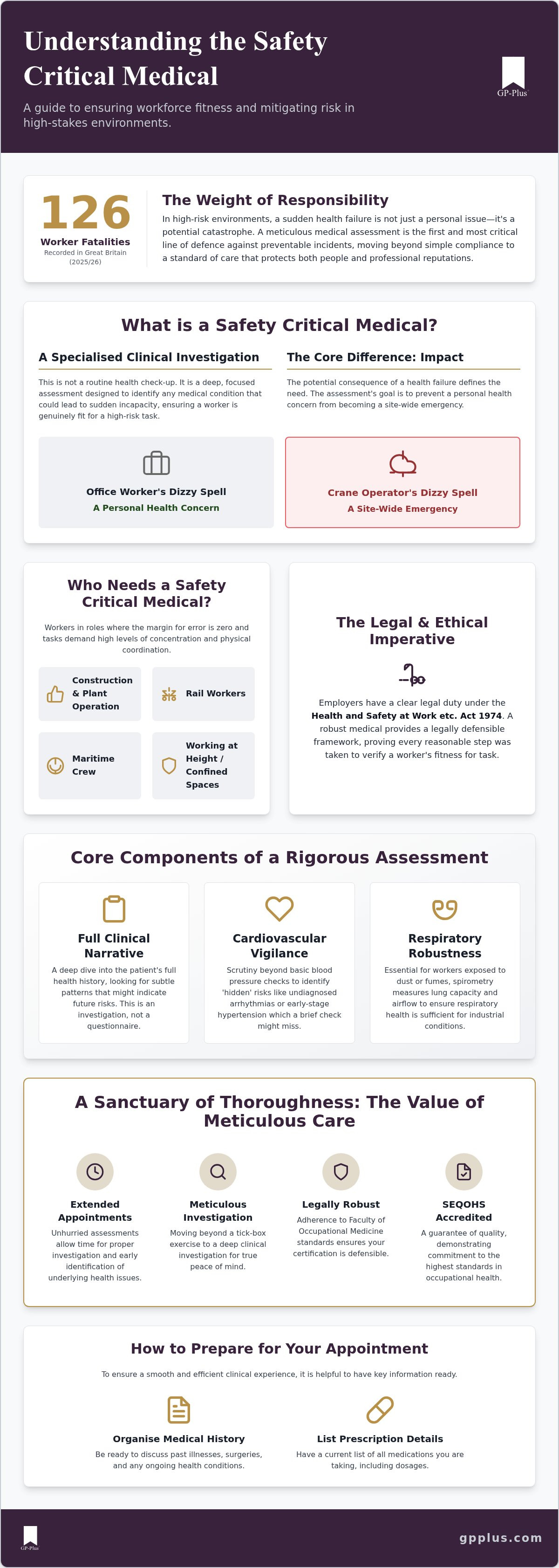
With 126 worker fatalities recorded across Great Britain in the 2025/26 period, the weight of responsibility on those managing high-risk environments has never felt more substantial. It is natural to feel a sense of unease when arranging the safety critical medical edinburgh based experts conduct, particularly when the fear of non-compliance with HSE standards looms large or when you worry that a rushed assessment might overlook a vital underlying health concern. You deserve the certainty that comes from a thorough clinical investigation rather than a hurried, tick-box administrative exercise.
This guide explores how a meticulous approach ensures your workforce is genuinely fit for task through a sanctuary of clinical excellence and patient-centred care. We'll examine the essential requirements for high-risk industries, the vital shift towards proactive mental health screening, and how an unhurried, professional assessment provides the legal robustness and peace of mind your organisation requires. By prioritising clarity and expert investigation, you can move beyond simple compliance to a standard of care that protects both your people and your professional reputation.
Key Takeaways
- Understand your legal obligations under the Health and Safety at Work Act and why identifying potential health failures is vital for high-risk roles.
- Discover why a safety critical medical edinburgh based assessment should be a deep clinical investigation of cardiovascular and musculoskeletal health, not just a tick-box exercise.
- Learn the importance of SEQOHS accreditation and how adhering to Faculty of Occupational Medicine standards ensures your certification is legally robust.
- Find out how to prepare for your appointment by organising your medical history and prescription details to ensure a smooth, unhurried clinical experience.
- Explore the benefits of choosing a sanctuary of thoroughness where extended appointment times allow for the early identification of underlying health concerns.
What is a Safety Critical Medical and Why is it Essential?
A safety critical medical is a specialised clinical investigation, distinct from a routine health check. It focuses on roles where a sudden impairment of health could result in a significant incident, potentially leading to injury or loss of life. Whilst a standard occupational health review might address general wellness or desk-based ergonomics, these assessments are designed to identify conditions that could lead to sudden incapacity. This level of clinical vigilance is the first line of defence in high-risk environments. It requires a meticulous approach to ensure that no underlying vulnerability is overlooked.
The core difference lies in the potential impact of a health failure. A sudden dizzy spell for an office worker is a personal health concern; the same event for a crane operator is a site-wide emergency. By choosing a safety critical medical edinburgh based assessment, employers ensure that their staff undergo a rigorous screening process that prioritises the safety of the collective workforce. It's about moving beyond a simple "pass or fail" mentality and towards a comprehensive understanding of an individual's physical and mental readiness for demanding tasks.
The Scope of Safety Critical Roles
Safety critical roles are found across various sectors, most notably in construction, rail, maritime, and plant operation. These positions often involve tasks that demand high levels of concentration and physical coordination, such as working at height, operating heavy machinery, or entering confined spaces. In these scenarios, the margin for error is zero. A higher standard of medical fitness is required because the physical environment doesn't allow for the slight delays in reaction time or the temporary lapses in judgement that certain health conditions might cause. These assessments provide the clarity needed to confirm that a worker can safely navigate these complex environments without putting themselves or their colleagues at risk.
The Legal and Ethical Imperative
Employers have a clear legal duty under the Health and Safety at Work etc. Act 1974 to ensure the safety of their employees and the public. Adhering to global Occupational safety and health standards is not just a regulatory hurdle; it's a moral commitment to the well-being of every person on site. A robust safety critical medical edinburgh service provides a legally defensible framework, proving that the employer has taken every reasonable step to verify that their workforce is fit for task. This process involves a delicate balance between respecting an employee's privacy and fulfilling the ethical obligation to maintain a safe working environment. A thorough medical assessment acts as a trusted bridge between these two priorities, offering peace of mind to both the business and the individual.
The Clinical Components of a Rigorous Medical Assessment
A rigorous assessment begins with a profound respect for the individual’s clinical narrative. It isn't merely a series of checkboxes; it's an investigative process that seeks to understand the patient’s full health history. When you attend a safety critical medical edinburgh clinic, the clinician takes the time to listen to your history, looking for subtle patterns that might indicate future risks. This exhaustive approach ensures that every physical examination is grounded in context, providing a level of detail that protects both the worker and the site. By prioritising clinical experience over speed, we move from a surface-level scan to a deep investigation of physical readiness.
Cardiovascular and Respiratory Vigilance
Heart health and lung function form the bedrock of physical readiness for high-stakes environments. Blood pressure monitoring and heart rate analysis are vital, yet they only tell part of the story. A truly thorough assessment looks for the 'hidden' risks, such as undiagnosed arrhythmias or early-stage hypertension, which a standard 10-minute check might miss. For those exposed to hazardous dust or fumes, spirometry is essential. It measures lung capacity and airflow, ensuring that respiratory health is robust enough to withstand industrial conditions. This level of scrutiny is required by the Health and Safety at Work etc. Act 1974, which mandates that employers protect the welfare of their people. Identifying these issues early allows for swift intervention, often preventing a minor concern from becoming a significant workplace incident.
Sensory and Neurological Integrity
The ability to perceive and react to one's surroundings is paramount. Vision screening must go beyond basic acuity to include colour vision and peripheral awareness, which are critical for interpreting safety signage and navigating complex machinery. Similarly, audiometry tests hearing capability in noisy environments, ensuring that verbal instructions or warning sirens aren't lost in the din. For those working at height, assessing balance and coordination is a neurological necessity. Even the urinalysis serves a deeper purpose, acting as an early indicator for glucose or protein levels that could signal underlying issues like diabetes or kidney dysfunction. This meticulous investigation provides the peace of mind that comes from being managed by experts. If you require a more unhurried clinical experience, choosing a partner who values thoroughness over speed is the first step towards long-term safety and compliance.
The architecture of workplace safety is built on a foundation of rigorous standards. Whilst some may view these as administrative hurdles, a professional clinic understands that they are the baseline for clinical excellence. Navigating the regulatory landscape requires a deep commitment to the benchmarks set by the Faculty of Occupational Medicine. These standards ensure that every safety critical medical edinburgh based assessment is conducted with the precision and ethical care that high-stakes roles demand. By embracing these frameworks, we move away from a "tick-box" mentality. We move towards a model of care that prioritises the individual’s long-term health and the collective safety of the site.SEQOHS and Clinical Governance
The Safe Effective Quality Occupational Health Service (SEQOHS) accreditation serves as the gold standard for clinical governance. For both the employer and the employee, this accreditation provides a profound sense of reassurance. It signifies that the clinic operates with extreme precision, particularly regarding data security and clinical confidentiality. In an era where personal health data is highly sensitive, robust governance ensures that medical reports are handled with the utmost discretion and accuracy. This isn't just about compliance. It's about building a sanctuary of thoroughness where patients feel heard and protected by a vigilant expert. When clinical governance is prioritised, medical reports become valuable clinical assets. They provide a clear, legally robust picture of a worker's health that can withstand professional scrutiny.
Industry-Specific Frameworks
Different sectors carry unique risks. The medical assessment must be adapted to meet these specific challenges. Whether complying with Constructing Better Health (CBH) standards or the requirements of other industry-specific bodies, the clinical approach remains the same: meticulous investigation. These frameworks allow for a consistent standard of health across a workforce, ensuring that every 'Fit to Work' certificate carries the weight of a detailed medical review. For instance, the specific physical demands of plant operation require a different focus than the respiratory risks of maritime work. By understanding these nuances, a clinician can provide a bespoke experience that looks beyond the obvious. This tailored approach ensures that the safety critical medical edinburgh professionals provide isn't a generic test. It's a targeted investigation into the specific stressors of the role. This level of detail creates genuine peace of mind for those managing complex, high-risk environments, and for those operating in international contexts, it can be beneficial to explore DOT Medical Examinations and Drug Testing Services to understand US-based safety requirements.
Preparing for a clinical assessment is a collaborative process that ensures the results are both accurate and reflective of your true health status. It isn't merely a logistical exercise; it's an opportunity to provide the clinician with the narrative context they need to act as your health advocate. When you're attending a safety critical medical edinburgh based clinic, arriving with the correct documentation and a calm mindset allows the investigation to proceed with the depth it deserves. Transparency is your most valuable tool during this process. Being open about your health history ensures that any bespoke care plans or specialist referrals can be tailored precisely to your needs, protecting your long-term well-being in a high-stakes environment.
On the day of your appointment, please ensure you bring a valid form of photographic identification. If you rely on corrective lenses or hearing aids, it's essential to have these with you, as they're required for the sensory components of the assessment. Arriving early to settle into the professional calm of the clinic environment helps mitigate the "white coat" effect, ensuring that baseline data like blood pressure and heart rate are recorded accurately whilst you're in a relaxed state.
Documentation and History
Your medical history is the foundation upon which a thorough investigation is built. Before your appointment, take the time to organise a list of any previous surgeries, chronic conditions, or ongoing treatments you're managing. It's particularly helpful to provide the names and contact details of any specialist consultants currently involved in your care. This level of detail allows the GP to look beyond the immediate results and understand the broader trajectory of your health. A clear history doesn't just satisfy a requirement; it empowers the clinician to provide a more personalised and exhaustive level of care, ensuring that no detail of your clinical journey is overlooked.
Physical and Mental Preparation
Small lifestyle choices in the 24 hours preceding your test can significantly impact the clarity of your results. We recommend avoiding excessive caffeine or stimulants on the morning of your assessment, as these can artificially elevate your heart rate and blood pressure. Similarly, it's wise to avoid exposure to loud noises, such as heavy machinery or loud music, for at least 16 hours before your audiometry test to ensure your hearing baseline is accurate. Adequate hydration is also vital for a successful urinalysis. If you feel anxious about the process, remember that our unhurried approach is designed to be a sanctuary of thoroughness. We provide ample time for every interaction, ensuring you never feel rushed or unheard. To experience this level of dedicated clinical care, you can book your unhurried medical assessment with our expert team today.
The GP Plus Approach: Meticulous Investigation for Peace of Mind
The philosophy at GP Plus is built upon the belief that clinical excellence cannot be rushed. Whilst many providers treat medical assessments as a volume-driven administrative task, we view every safety critical medical edinburgh based assessment as an essential investigative opportunity. Our clinic acts as a sanctuary of thoroughness, where the focus is on providing a level of care that feels personal and exhaustive. By prioritising quality over speed, we ensure that every worker leaves with more than just a certificate; they leave with the assurance that their health has been reviewed by a vigilant expert who values the human connection as much as the clinical data.
This patient-centred environment is designed to replace the sterile, hurried atmosphere of modern medical settings with a sense of professional calm. We act as a dedicated partner in long-term workforce health, offering a narrative-driven process that leads from a specific health need to a comprehensive, investigative solution. This methodical rhythm ensures that every patient feels heard and protected throughout their journey.
Quality Over Speed
A standard 10-minute check is simply insufficient for a safety critical assessment. These high-stakes roles demand a meticulous investigator who looks beyond the obvious to identify subtle health risks that could impact site safety. At GP Plus, we dedicate significantly longer appointment times to each patient, allowing for a reflective pace and a deep exploration of clinical history. This unhurried atmosphere is vital for producing accurate baseline data and ensuring that every detail is explored fully. To understand more about our commitment to this level of care, you may wish to read GP Plus: A Comprehensive Guide to Private Medical Excellence. This approach transforms the medical from a regulatory hurdle into a proactive health strategy.
Integrated Clinical Support
Our commitment to your health doesn't end when the assessment concludes. If a safety critical medical edinburgh session reveals a potential concern, we provide seamless access to in-clinic investigations and laboratory tests. This integrated support is a core component of our role as a trusted medical advisor. Rather than leaving the patient or employer with unanswered questions, we can fast-track specialist referrals to ensure that any identified issues are managed with extreme precision and patience. For a deeper look at how we manage these transitions, please see our Occupational Health Referral: A Comprehensive Guide. This ensures that the path from identifying a health concern to implementing a bespoke care plan is clear, methodical, and supportive, focusing on long-term outcomes for both the individual and the organisation.
Securing Workplace Safety Through Clinical Excellence
Ensuring the safety of a high-risk workforce requires more than a standard health check. It demands a dedicated partner who views the process as a meticulous clinical investigation. By prioritising unhurried consultation times and expert clinical oversight, you move beyond basic compliance towards a standard of care that genuinely protects lives. We understand that your reputation and the well-being of your staff rest on the quality of these assessments.
Choosing a provider for a safety critical medical edinburgh based ensures that your organisation benefits from comprehensive clinical reports and robust fit-to-work certification. This sanctuary of thoroughness allows for the early identification of health concerns, providing a clear path for specialist referrals and bespoke care plans when they're needed most. You deserve the peace of mind that comes from knowing every detail has been examined by an expert who prioritises precision over haste. Take the next step in securing your occupational health needs by choosing a professional, patient-centred approach to workplace safety.
Book a Meticulous Safety Critical Medical with GP Plus and discover the clinical benefit of an unhurried, expert-led assessment.
Frequently Asked Questions
What exactly is a safety critical medical certificate?
A safety critical medical certificate is a formal clinical document that confirms an individual is physically and mentally capable of performing high-risk tasks without endangering themselves or others. It serves as a legally robust record for employers, proving that a worker has undergone a meticulous investigation into their cardiovascular, respiratory, and sensory health—a process where comprehensive optometry from The Eye Centre can provide vital diagnostic clarity. This certification is essential for roles involving plant operation, working at height, or entering confined spaces.
Whilst some volume-based providers might rush through the process in under fifteen minutes, our unhurried approach typically requires between forty-five minutes and an hour. This extended duration is vital for a truly thorough investigation of your medical history and current physical status. Taking this extra time ensures that a safety critical medical edinburgh based assessment remains a sanctuary of thoroughness, where no subtle health indicators are overlooked.
What happens if an employee fails their safety critical medical?
If an assessment indicates a health concern that prevents immediate certification, the clinician acts as a trusted advisor to help manage the situation. We don't simply issue a failure; instead, we provide specialist referrals and bespoke care plans to address the underlying issue. The goal is to move towards a comprehensive solution that prioritises the individual's long-term well-being whilst keeping the employer informed of the current status.
Is a safety critical medical the same as a general health check?
No, these assessments are distinct clinical investigations rather than general wellness checks. A general health check focuses on long-term lifestyle goals, whereas a safety critical medical targets risks that could lead to sudden incapacity on site. The examination is specifically designed to meet the Health and Safety at Work etc. Act 1974 requirements, focusing on musculoskeletal integrity, respiratory function, and sensory perception during high-stakes tasks.
How often should safety critical medicals be renewed?
Renewal frequencies often depend on the specific industry and the age of the worker. Best practice guidelines suggest that those under fifty-four should be assessed every three years, whilst workers aged fifty-five to sixty-five require a check every two years. For individuals over the age of sixty-five, annual assessments are recommended. This methodical rhythm ensures that a worker's health is managed with extreme precision throughout their professional career.
Can my own GP perform a safety critical medical for my employer?
Whilst any registered GP can theoretically perform the examination, most NHS practices are not equipped to provide the specialised testing or the unhurried environment required for these assessments. Many employers specify that the medical must be conducted by an occupational health specialist or a clinic with SEQOHS accreditation. Choosing a private partner ensures you receive a level of care that prioritises quality and clinical experience over speed.
What industry standards do safety critical medicals follow in the UK?
These medicals follow the benchmarks set by the Faculty of Occupational Medicine and are often guided by the Safe Effective Quality Occupational Health Service standards. Depending on the sector, they may also align with Constructing Better Health or specific rail and maritime frameworks. This adherence to national standards ensures that every safety critical medical edinburgh clinic provides is legally defensible, clinically rigorous, and protective of all site personnel.
Do I need to fast before my safety critical medical assessment?
You don't usually need to fast before your assessment, but we do recommend specific preparations to ensure accurate results. Avoiding excessive caffeine for several hours beforehand helps produce a reliable blood pressure reading, and staying well-hydrated is essential for a successful urinalysis. If your specific role requires more specialised blood tests, we'll provide clear, unhurried instructions well in advance of your appointment to ensure your health is managed precisely.


