

Can a ten-minute consultation truly capture the intricate layers of a person's physical and mental wellbeing? For many, the experience of workplace medicine has become a hurried exercise in box-ticking. This often leaves employees feeling unheard and managers without the clinical clarity they need to make informed decisions. You likely understand the frustration of receiving a vague medical report that does little to resolve complex fitness-for-work dilemmas or ease the burden of regulatory compliance. It's a common pain point that creates unnecessary anxiety for everyone involved.
This guide demonstrates how a meticulous, unhurried occupational health assessment Edinburgh transforms these challenges into a foundation for long-term organisational health. By prioritising a deep clinical investigation over speed, we protect both the individual's dignity and the employer's integrity. We'll explore the necessity of thoroughness in meeting HSE and Equality Act standards, ensuring you gain the actionable insights required to support your team with confidence. From navigating medical confidentiality to interpreting complex adjustments, this comprehensive overview provides the reassurance that no detail is too small when it comes to human health.
Key Takeaways
- Learn why an unhurried, investigative approach is essential for uncovering the complex health triggers that standard, rushed consultations often miss.
- Understand how a professional occupational health assessment edinburgh provides the clinical clarity needed to meet Equality Act 2010 and HSE statutory requirements.
- Discover the strategic benefits of early intervention, from reducing long-term absenteeism to enhancing employee retention through proactive care.
- Gain insights into the rigorous medical standards required for safety-critical roles in sectors like construction, transport, and offshore environments.
- Explore how immediate access to specialist referrals and advanced diagnostics can accelerate an employee's safe and sustainable return to work.
Defining the Purpose of an Occupational Health Assessment
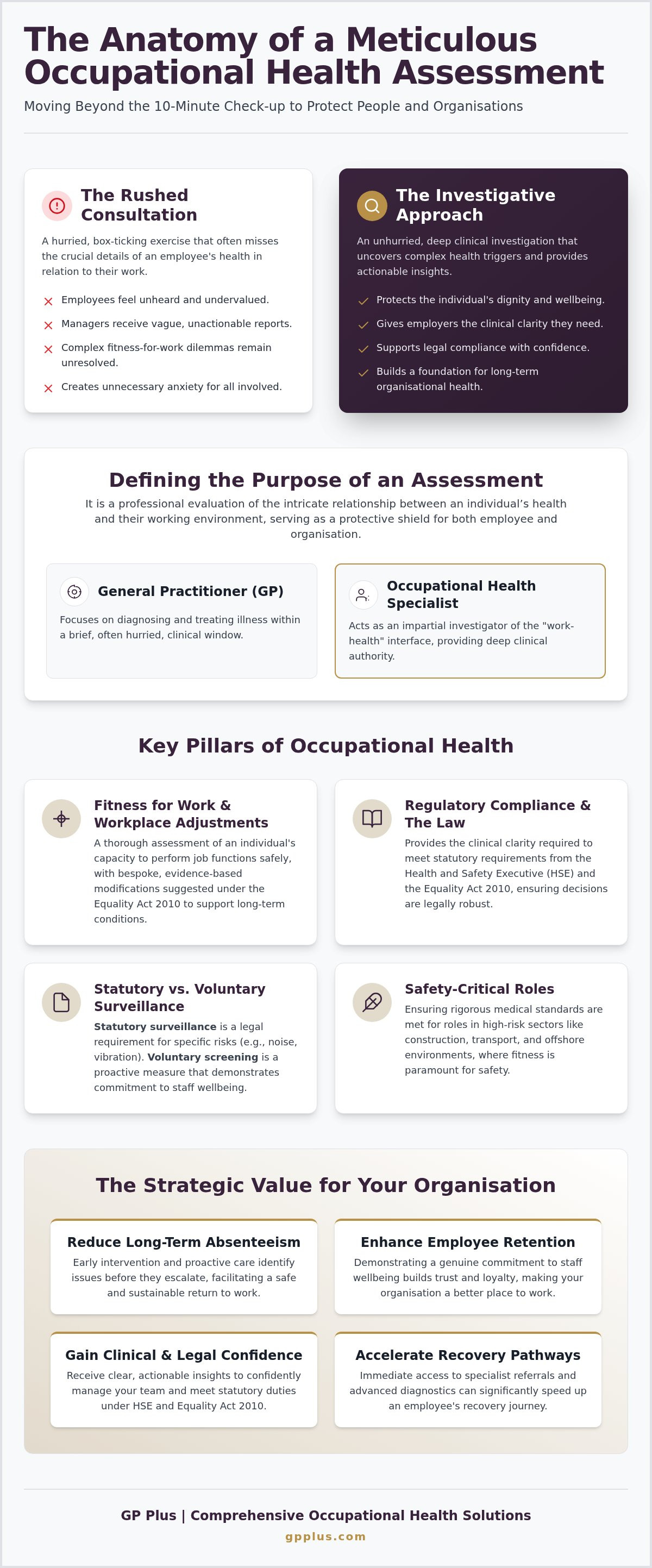
At its core, an occupational health assessment is a professional clinical evaluation that examines the intricate relationship between an individual’s health and their working environment. It isn't a standard medical check-up; rather, it's a meticulous investigation into how a person’s physical or mental condition interacts with their specific job role. The primary objective is twofold: ensuring that the workplace does not adversely affect an employee's wellbeing and confirming that an individual's health status does not compromise workplace safety. When arranging an occupational health assessment edinburgh, it's vital to understand that this process serves as a protective shield for both the organisation and the person performing the work.
A frequent point of confusion lies in the distinction between a standard GP consultation and a specialised occupational referral. While a GP focuses on diagnosing and treating illness within a brief, often hurried window, an occupational health specialist acts as a meticulous investigator of the "work-health" interface. This distinction is critical for achieving an independent medical perspective. The specialist provides an impartial bridge, offering clinical authority that protects the employee from being asked to perform unsafe tasks whilst giving the employer the clarity needed to manage their team effectively. This field of Occupational safety and health requires a deep understanding of both clinical medicine and the nuances of various industrial and corporate environments.
Fitness for Work and Workplace Adjustments
Determining fitness for work involves more than a simple "yes" or "no" answer. It requires a thorough assessment of an individual’s capacity to perform specific job functions safely and effectively. When a health condition is identified, the clinician’s role is to suggest "reasonable adjustments" as outlined under the Equality Act 2010. These aren't generic suggestions; they're bespoke, evidence-based modifications designed to support employees with long-term conditions. By acting as a calm and knowledgeable intermediary, the clinician translates complex medical needs into actionable operational requirements that maintain productivity without sacrificing health.
Statutory vs. Voluntary Health Surveillance
Understanding the difference between legal obligations and proactive care is essential for any responsible organisation. Statutory health surveillance is a mandatory requirement when employees are exposed to specific risks, such as noise, vibration, or respiratory sensitisers. According to HSE guidelines, statutory health surveillance is a scheme of repeated health checks which are a legal requirement when employees are exposed to specific health risks that could lead to identifiable diseases or adverse health effects. Beyond these legal mandates, voluntary health screening offers significant strategic value. It demonstrates a genuine commitment to staff wellbeing, often identifying early warning signs of stress or physical strain before they escalate into long-term absenteeism.
The Clinical Journey: A Meticulous Approach to Assessment
A truly effective clinical journey doesn't begin with a stethoscope; it starts with an attentive ear. Unlike the standard ten-minute window often found in overstretched services, a meticulous occupational health assessment edinburgh prioritises an unhurried atmosphere where the patient’s full medical history and specific job description are carefully unpicked. This deliberate pace is essential for uncovering the subtle health triggers that might otherwise remain hidden beneath the surface of a routine check-up. By taking the time to explore the human story behind the clinical data, we ensure that the resulting advice is both compassionate and medically robust.
Trust is the cornerstone of this process. We maintain the highest standards of medical confidentiality, ensuring that sensitive clinical details remain protected whilst providing the organisation with the clear, actionable feedback needed to manage workplace safety. This balance is vital for complying with the expectations set by the Health and Safety Executive. Our role is to act as a vigilant expert, protecting the individual's health while safeguarding the organisational integrity of the business.
Preparation and Initial Consultation
The journey begins long before the patient enters the room. We start by reviewing the initial referral form and the specific questions posed by the employer to ensure every area of concern is addressed. During the consultation, we place a high value on the patient’s own perspective. It's often through these quiet, reflective conversations that we identify the root causes of workplace strain. We intentionally set a professional and reassuring tone from the outset, as reducing patient anxiety is key to a successful investigative process. When employees feel heard and protected, they're more likely to engage openly with the assessment.
Diagnostic Testing and Physical Examination
Clinical intuition is supported by precise data. Depending on the requirements of the role, we utilise a range of in-clinic investigations, including blood tests, cardiovascular screenings, and lung function monitoring. These tests aren't mere formalities; they provide the empirical evidence required to form an accurate picture of workplace fitness. Identifying the need for an occupational health referral is often a key stage in fast-tracking a diagnosis, allowing for immediate specialist intervention when complex issues arise. This thoroughness ensures that every recommendation we make is grounded in clinical fact. If you're seeking a partner to manage these complexities, you can explore our bespoke occupational health services to see how we prioritise quality over speed.
Safety-Critical Requirements and Regulatory Compliance
In high-stakes environments, the margin for error is non-existent. When conducting an occupational health assessment edinburgh for safety-critical roles, clinicians must adhere to the rigorous standards set by the General Medical Council (GMC). This ensures that every evaluation is medically sound and ethically unassailable. In sectors such as transport, construction, or offshore energy, a single oversight can have devastating consequences. The role of the medical advisor is therefore one of profound responsibility, acting as a vigilant guardian for both the individual and the wider community. Every report we produce is designed to be robust enough to withstand the most intense legal scrutiny, providing peace of mind for employers who must defend their decisions in employment tribunals.
Meeting Industry-Specific Standards
Assessments for HGV drivers, pilots, or those working in hazardous environments demand specialised equipment and deep clinical expertise. These are not generic check-ups; they're targeted investigations into cardiovascular health, visual acuity, and cognitive function tailored to specific occupational risks. Safety-critical medicals serve a vital purpose by protecting the safety of the wider public whilst ensuring the individual remains fit to perform their duties without risk. By focusing on the unique hazards of a particular role, we provide a level of investigative depth that generic healthcare services simply cannot match. This meticulous approach ensures that the "fitness for work" certificate is a reliable indicator of safety.
The Legal Framework for Workplace Health
Navigating the Equality Act 2010 is one of the most complex challenges facing modern organisations. Expert medical guidance is essential to avoid the pitfalls of discrimination, ensuring that any suggested "reasonable adjustments" are grounded in clinical reality. As highlighted in the NHS guidance on occupational health, these professional services are designed to support both the worker and the organisational structure. A professional assessment acts as a robust shield against work-related ill health claims, mitigating legal risks whilst maintaining operational flow.
The Duty of Care is a heavy responsibility for any employer. Balancing this duty with the need for productivity requires reports that are detailed, clear, and legally defensible. Meticulous documentation is also required to navigate the complexities of GDPR in a clinical setting, where the handling of sensitive health data must be managed with extreme precision. By providing a sanctuary of thoroughness, we ensure that every assessment is an unassailable piece of clinical evidence that supports the long-term integrity of your organisation. We don't just tick boxes; we provide the clinical authority needed to lead your team with confidence.
The Strategic Value of Occupational Health for Organisations
Viewing workplace wellbeing as a mere cost of doing business is a perspective that modern, successful organisations are rapidly moving away from. Instead, a meticulous occupational health assessment edinburgh is increasingly recognised as a vital strategic tool that protects an organisation’s most valuable asset: its people. When clinical investigations are conducted with patience and precision, the resulting data allows for a transition from reactive crisis management to a stable, proactive health strategy. This shift is essential for reducing the 33.7 million working days lost annually in the UK due to work-related illness and injury, as reported by the Health and Safety Executive for the 2023/24 period.
Detailed medical reports provide the clarity needed to facilitate smoother returns to work after long-term sickness. Rather than providing vague advice, a thorough assessment offers a clear roadmap for reintegration, balancing the individual's clinical needs with operational realities. This level of detail doesn't just resolve immediate absence issues; it fosters a culture of trust and advocacy that significantly enhances employee retention. For instance, when managing neurodiversity in the workplace, evidence-based support from Collins Psychology can help tailor adjustments that benefit both the individual and the business. When staff feel that their health is being managed with genuine concern and clinical authority, their loyalty to the organisation grows.
The most effective way to manage workplace absence is to prevent it from occurring in the first place. By identifying health risks before they lead to a prolonged period of leave, organisations can implement support mechanisms that keep employees safe and productive. Incorporating regular health screening into your broader strategy ensures that subtle changes in wellbeing are caught early. This moves the dial from reactive sick-note management toward a model of proactive health advocacy where the clinician acts as a vigilant partner in the employee's journey.
Supporting Mental Health in the Workplace
A robust approach to workplace wellbeing often draws on specialised clinical expertise to address complex needs. For instance, acceptancepathwaypsychiatry.com offers comprehensive mental health care that prioritises thorough clinical investigation, mirroring the meticulous standards required in professional occupational health settings.
With 776,000 workers suffering from work-related stress, depression, or anxiety in 2023/24, the importance of psychological assessments has never been more apparent. Modern occupational health must address the human story behind these figures, providing professional medical support that goes beyond surface-level symptoms. Creating a culture of health that prioritises mental resilience is a powerful way to attract and retain top talent in a competitive market. It signals to your team that their wellbeing is valued with the same rigour as their output. If you're ready to enhance your organisation's resilience, you can discover our comprehensive occupational health solutions today.
Comprehensive Occupational Health Solutions at GP Plus
Since its inception in 1999 as Scotland’s first private general practice, GP Plus has built its reputation on a foundation of clinical excellence and unhurried care. We believe that a professional occupational health assessment edinburgh shouldn't be a transactional encounter. Instead, it's a dedicated partnership between the clinician, the employer, and the individual. Led by Dr Peter Copp, our clinic acts as a sanctuary of thoroughness where we take the time to look beyond immediate symptoms to understand the long-term trajectory of a person's health. Choosing GP Plus ensures that you're not just meeting a regulatory requirement; you're investing in a level of clinical authority that protects your organisation's integrity.
Specialist Referrals and Integrated Care
One of the most significant advantages of our model is the immediate access to a wide network of medical consultants. When an assessment identifies a complex medical issue, we don't leave the employee or the employer in a state of uncertainty. Our integrated approach allows for immediate specialist referrals and advanced diagnostics within the same practice. This seamless transition fast-tracks the path to recovery, ensuring that employees receive the precise treatment they need to return to work safely. Whether you require safety-critical medicals or bespoke examinations tailored to a specific industrial environment, our diagnostic investigations provide the empirical data needed to make confident decisions.
The Expert Guidance of Dr Peter Copp
Dr Peter Copp brings decades of experience to every consultation, embodying the role of a meticulous investigator and trusted medical advisor. His approach prioritises the act of listening, ensuring that every detail of the human story is captured before a clinical conclusion is reached. This depth of investigation is what sets us apart from high-volume, rushed services. He understands that clarity in a medical report is the result of patience and specialised knowledge, not speed. By focusing on the individual's unique health journey, we provide personalised care plans that facilitate sustainable workplace wellbeing.
Organising a professional occupational health assessment edinburgh for your workforce is a straightforward process designed to provide immediate peace of mind. We work closely with you to understand your specific operational requirements, ensuring that each referral is handled with the extreme precision and empathy that has defined our practice for over 25 years. By choosing a partner that values quality over haste, you ensure that your team's health is managed with the highest level of professional care.
Securing Your Organisation’s Future through Clinical Clarity
We've explored how moving beyond the rushed, ten-minute consultation model allows for a deeper, more empathetic understanding of the human story behind workplace health. By prioritising unhurried investigation, organisations can navigate the complexities of safety-critical roles and the Equality Act with quiet confidence. This proactive approach doesn't just meet statutory requirements; it fosters a culture of advocacy that protects both the employee's dignity and the employer's long-term interests. A thorough occupational health assessment edinburgh acts as a strategic shield, transforming clinical data into actionable insights that reduce absenteeism and enhance retention.
Under the expert guidance of Dr Peter Copp, a pioneer in private healthcare, GP Plus provides the sanctuary of thoroughness your workforce deserves. Our extended appointment times ensure no detail is overlooked, whilst our on-site diagnostics and fast-track specialist referrals accelerate the journey back to health. We invite you to Book a thorough occupational health assessment with GP Plus today and take the first step toward a more resilient, protected workplace. Taking these deliberate steps today ensures a safer and more productive environment for everyone involved.
Frequently Asked Questions
How long does a private occupational health assessment typically take?
An unhurried occupational health assessment Edinburgh typically lasts between 45 and 60 minutes, though complex cases may require longer to ensure a thorough investigation. Unlike standard ten-minute consultations, we provide ample time to explore your full medical history and the specific demands of your role. This methodical pace allows our clinicians to identify underlying health triggers and provide the clinical authority needed for a robust medical report.
Is the medical information shared with my employer during an assessment?
Your full medical records remain confidential and are not shared with your employer without your explicit consent. The resulting report focuses specifically on your fitness for work, the impact of your health on your duties, and any recommended workplace adjustments. We act as a vigilant protector of your privacy, ensuring that only relevant, work-focused information is disclosed to help your organisation support your wellbeing effectively.
What is the difference between a fit note and an occupational health report?
A standard fit note is a brief statement from a GP indicating whether you are fit for work or not. In contrast, an occupational health report is a meticulous clinical investigation into the relationship between your health and specific job tasks. It provides detailed, actionable advice on adjustments and long-term management. While a fit note manages immediate absence, our reports offer a comprehensive roadmap for a sustainable and safe return to work.
Can an occupational health assessment help me get workplace adjustments?
Yes, identifying reasonable adjustments is a primary goal of our assessments. Our clinicians evaluate your capacity to perform specific roles and suggest bespoke modifications, such as phased returns or equipment changes, to support you. These recommendations are grounded in the Equality Act 2010, providing your employer with the clinical clarity needed to implement support that protects your health whilst maintaining organisational productivity and legal compliance.
Do I need to see my own GP before an occupational health referral?
You don't need to see your own GP before attending an occupational health assessment Edinburgh. As an independent private clinic, we provide a specialised perspective that focuses specifically on the work-health interface. While we may request your consent to contact your GP for further clinical data in complex cases, the referral itself is usually initiated by your employer to resolve specific fitness-for-work questions or to support your long-term wellbeing.
What happens if the assessment finds I am not fit for my current role?
If a clinician determines you aren't currently fit for your role, the report will detail the specific reasons and suggest a clear path forward. This might include recommending a period of recovery, a phased return to work, or permanent adjustments to your duties. Our role is to act as a trusted medical advisor, ensuring that you aren't placed in a position that compromises your safety or worsens your health condition.
How quickly can I receive the final medical report after the consultation?
We aim to provide the final medical report within two to three working days following your consultation. This allows our clinicians the necessary time to reflect on the findings and ensure the report is robust and legally defensible. We understand that both employees and employers require clarity to make informed decisions, so we prioritise a thorough yet efficient turnaround that doesn't sacrifice the meticulous quality of our clinical investigation.
Are these assessments suitable for safety-critical roles like HGV driving?
Our clinic specialises in safety-critical medicals for roles such as HGV driving, aviation, and offshore work. These assessments involve rigorous testing of cardiovascular health, vision, and cognitive function to ensure you meet stringent industry standards. By adhering to the highest clinical standards, we protect both the individual worker and the wider public. Our reports provide the authoritative evidence required to confirm you can perform high-stakes duties safely and effectively.


