

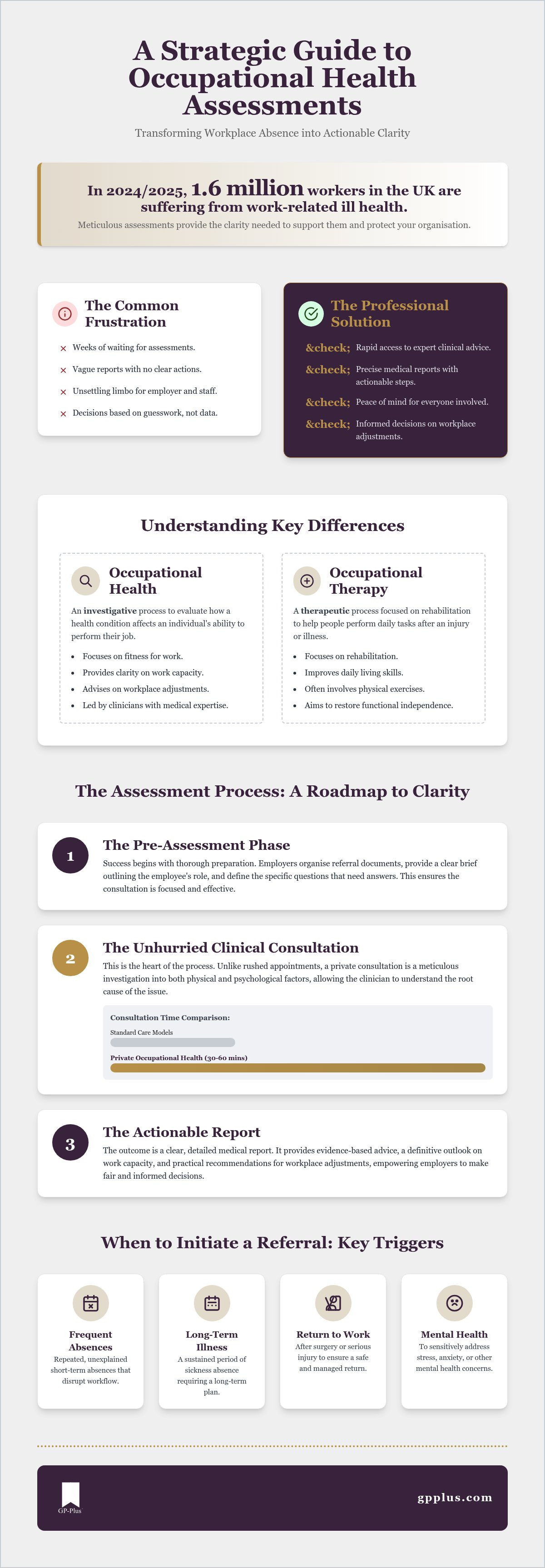
What if a medical report didn't just tick a compliance box, but actually solved the complex riddle of workplace absence? With 1.6 million workers in the UK suffering from work-related ill health in the 2024/2025 period, you likely feel a profound responsibility when a member of your team is struggling. The frustration of waiting weeks for a vague assessment that offers no actionable path forward is far too common, leaving both the employer and the individual in a state of unsettling limbo. This guide explores how a meticulously conducted occupational health assessment Edinburgh provides the clinical clarity you need to protect your organisation, alongside the unhurried, expert care your staff deserve.
We'll show you how a thorough investigation into health concerns leads to clear medical reports and practical workplace adjustments. You will learn exactly what to expect from a professional referral process that prioritises human connection and detailed evidence over haste. By looking beyond the obvious, we ensure that every assessment becomes a sanctuary of thoroughness, offering peace of mind for everyone involved.
Key Takeaways
- Understand how a professional referral acts as a strategic bridge between clinical medicine and workplace management to resolve complex fitness-for-work concerns.
- Discover why a private occupational health assessment edinburgh offers the unhurried environment necessary for a truly thorough investigation and precise medical advice.
- Learn how longer consultation times lead to more actionable reports, helping employers make informed decisions about essential workplace adjustments.
- Identify the key steps employees can take to prepare for their assessment, ensuring they feel supported and empowered throughout the clinical journey.
- Explore how rapid access to expert clinical heritage reduces business disruption by providing clarity where standard care models may feel rushed or vague.
The Strategic Role of an Occupational Health Referral in the Modern Workplace
An occupational health referral acts as a vital conduit between the clinical world and the practicalities of business management. It isn't merely a box-ticking exercise for HR departments. Instead, it serves as a formal investigation into how an individual's health interacts with their specific professional duties. By commissioning an occupational health assessment edinburgh, employers gain access to a level of clinical clarity that general practice often cannot provide. The focus shifts from general symptom management to the specific nuances of work capacity, ensuring that decisions are based on professional data rather than guesswork.
The broader field of Occupational safety and health is built upon the principle that work should not harm the worker, and conversely, that the worker’s health should be managed to ensure they can perform their role safely. Proactive referrals are essential for managing long-term sickness absence, moving away from a reactive model that only intervenes when a crisis occurs. A vigilant, expert-led approach protects the workforce, acting as an advocate for the employee's long-term well-being whilst providing the employer with actionable, evidence-based advice that respects the human element of the workplace.
Occupational Health vs. Occupational Therapy
Confusion often exists amongst HR professionals regarding these two distinct fields. Occupational therapy centres on rehabilitation and helping people perform daily tasks after an injury; for instance, specialists like Functional Movement Physio provide tailored rehabilitation to support physical recovery. Conversely, an occupational health assessment edinburgh evaluates how a specific health condition affects an individual's ability to perform their job. It's an investigative process rather than a therapeutic one. Using a GP-led model ensures that complex medical histories are interpreted with clinical precision, providing a definitive outlook on work capacity that standard medical notes often lack. This clarity is the foundation of a safe and productive workplace.
When to Initiate a Referral
Timely intervention prevents minor health issues from becoming permanent barriers to employment. Triggers for a referral include frequent, unexplained short-term absences or a sustained period of long-term illness. You should also consider a referral when an employee prepares to return to work after surgery or a serious injury. Addressing mental health and stress-related concerns with professional sensitivity is equally vital. A meticulous clinical review ensures that the return-to-work plan is realistic, safe, and tailored to the individual's recovery trajectory, fostering a culture of genuine care and professional support.
The Occupational Health Assessment Process: A Step-by-Step Roadmap
The roadmap to clinical clarity is built on a foundation of unhurried investigation. It's a journey that transforms uncertainty into a structured plan for both the employer and the employee. This process ensures that no detail is overlooked, creating a narrative of care that begins long before the patient enters the clinic. Success depends on a methodical approach that respects the complexity of human health within a professional setting.
The Pre-Assessment Phase
To ensure a successful occupational health assessment edinburgh, the pre-assessment phase is critical. Employers should meticulously organise the referral documentation, providing a clear brief that outlines the employee's role and the specific challenges they face. It's helpful to define the exact questions you need answered, such as the likelihood of a sustained return to work or the necessity of specific equipment. This aligns with broader workplace health needs assessments, which help establish a baseline for employee well-being. When the employee understands the purpose and benefits of the visit, they can engage more fully in the clinical dialogue.
The Clinical Consultation
The heart of the process is the clinical consultation. Unlike the rushed atmosphere of many modern medical settings, a private session typically lasts between 30 and 60 minutes. This generous time allocation allows the clinician to act as a meticulous investigator. They balance physical examinations with psychological screening, looking beyond the immediate symptoms to understand the root cause of the issue. Taking the time to listen isn't just a matter of courtesy; it's a clinical necessity. It leads to more accurate workplace recommendations because it captures the nuances of the individual's experience that a ten-minute appointment would simply miss.
Post-Assessment: The Medical Report
A professional occupational health assessment edinburgh concludes with the delivery of a bespoke medical report. This document translates complex clinical data into actionable workplace adjustments that an HR professional or business owner can actually implement. A professional report maintains strict patient confidentiality whilst providing the management clarity required to make informed decisions. It's about finding the balance between protecting the individual and supporting the organisation's operational goals. If you're looking for a partner to guide you through these complexities, professional Occupational Health support can provide the peace of mind you need to move forward with confidence.
Private Occupational Health vs. Standard Care Models
Choosing between standard care and a private model often comes down to the depth of the investigation required. Standard models frequently rely on high-volume, low-contact assessments that can leave both parties feeling unheard. An occupational health assessment edinburgh provided privately offers a significant shift in perspective. It prioritises rapid access to specialist knowledge, ensuring that business disruption is kept to an absolute minimum. When an employer can secure an appointment within days rather than weeks, the path to resolution becomes much clearer and more manageable.
The Investment in Quality
The most striking difference lies in the duration of the clinical encounter. Standard GP appointments are typically restricted to ten minutes, which is rarely sufficient to unpick the complexities of a workplace health issue. Private consultations offer a generous 30 to 60-minute window. This unhurried pace allows the clinician to perform a meticulous investigation into the root causes of an employee's condition. It's this level of detail that prevents the "revolving door" of sickness absence, where individuals return to work prematurely only to relapse. Investing in accurate clinical advice from the outset provides a clear long-term cost-benefit for the organisation.
Patient Experience and Reassurance
Employee anxiety is a common hurdle in the referral process. Many staff members feel a sense of trepidation, fearing that the assessment is a precursor to dismissal. A relaxed, professional setting helps to dismantle these fears, replacing them with a sense of clinical advocacy. The benefits of seeing the same experienced GP for follow-up care cannot be overstated. Continuity of care ensures that the clinician has a deep understanding of the patient's history and the specific demands of their role. This builds a culture of trust and health advocacy, showing the employee that their well-being is being managed with extreme precision and patience.
Bespoke reporting is the final pillar of the private model. Generic, automated assessments often produce reports filled with medical jargon that offers little practical utility for a manager. A private clinic produces bespoke medical reports that translate clinical findings into a language of workplace capacity. This ensures that every recommendation is grounded in the reality of the employee's daily tasks. It's a premium approach that prioritises the quality of the outcome over the speed of the transaction, providing the peace of mind that comes from knowing no detail has been overlooked.
Preparing for an Occupational Health Assessment
Preparation is the silent engine of a successful clinical outcome. It transforms a standard medical meeting into a collaborative investigation that empowers everyone involved. When an employee and employer arrive with the necessary context, they enable the clinician to move beyond surface-level observations. A well-prepared occupational health assessment edinburgh ensures that the final report is not just a summary of symptoms, but a strategic roadmap for the future. It's about fostering a spirit of health advocacy where the goal is clarity, protection, and a sustainable path forward.
Information for Employees
Many individuals feel a natural sense of trepidation when referred for a health assessment. It's vital to understand that this is a supportive, clinical process, not a disciplinary one. You're being heard by a vigilant expert whose goal is to protect your well-being within your professional environment. To get the most from your unhurried consultation, it's helpful to prepare a list of your symptoms and, specifically, how they impact your daily behaviour at work. This level of detail allows the GP to understand the nuances of your situation. Please ensure you bring the following items to the clinic for a thorough investigation:
- A complete list of your current prescriptions and any over-the-counter medications.
- Copies of recent specialist letters or diagnostic results from other medical professionals.
- A brief medical history, including any previous conditions that might be relevant.
- Any specific questions or concerns you wish to discuss with the clinician.
Information for Employers
For the employer, preparation involves providing the "terrain" on which the assessment will take place. The clinician needs to understand the specific physical or mental stressors of the role to provide accurate advice. Simply providing a job title is rarely enough; an accurate job description and details of current workplace demands are essential. You should also outline what adjustments have already been trialled and why they may or may not have been successful. This context prevents the clinician from suggesting solutions you've already explored, saving time and ensuring the advice is practical. Managing expectations is also key; the assessment provides clinical clarity, but the final decision on implementing adjustments remains a management responsibility based on the expert's findings.
By taking these steps, you ensure the process remains methodical and deliberate, leading to long-term outcomes that benefit the entire organisation. If you are ready to begin this process with an expert partner, you can book a professional Occupational Health consultation to gain the clarity your business needs.
Expert Occupational Health Solutions with GP Plus
GP Plus was established as Scotland's first private GP clinic, founded by Dr Peter Copp with a vision of providing a sanctuary of thoroughness in an often-hurried medical world. This clinical heritage informs every aspect of our work today. We understand that an effective occupational health assessment edinburgh requires more than just a surface-level review. It demands the keen eye of an experienced investigator who can unpick complex medical histories and translate them into a clear, strategic path for your business. Our commitment to professional excellence ensures that every report we produce is bespoke, actionable, and grounded in deep clinical insight.
Our Approach to Workplace Health
Our approach to workplace health is defined by a philosophy of patience and precision. We intentionally steer away from the sense of haste found in standard care models, instead offering 30 to 60-minute consultations. This time allows our GPs to build genuine trust with employees, which is essential for accurate health screenings and complex medicals. We act as a dedicated partner in your organisation's health journey, providing access to a wider network of specialist referrals and diagnostic investigations when needed. This comprehensive support helps you foster a resilient workforce where individuals feel heard and protected by a vigilant expert.
The value of clinical experience becomes particularly evident in cases involving long-term sickness absence or intricate mental health concerns. By looking beyond the obvious, our clinicians provide the peace of mind that comes from knowing no detail has been overlooked. We don't just identify problems; we provide the expert advice on workplace adjustments that helps people return to work safely and sustainably. This meticulous care is an investment in your company's most valuable asset: its people.
Next Steps for Your Organisation
Initiating a referral with our clinical team is a straightforward process designed to provide maximum insight with minimum disruption. We work closely with HR professionals and business owners to ensure the specific needs of your organisation are met from the very first interaction. Whether you require a single assessment or a broader health screening programme, our team is ready to provide the professional calm and clinical authority you expect. To secure the clarity your business deserves, you can Book an Occupational Health Consultation at GP Plus and begin the journey toward a healthier workplace today.
Securing Clarity and Confidence in Workplace Health
A professional occupational health referral is more than an administrative step; it's a strategic investment in the long-term resilience of your organisation. By prioritising a meticulous investigation over a rushed checklist, you ensure that employees feel heard and employers receive the actionable advice they need to manage complex fitness-for-work concerns. We've explored how thorough preparation and unhurried clinical dialogue transform uncertainty into a clear, supportive roadmap for recovery and workplace adjustment.
With over 25 years of clinical excellence as Scotland's first private GP practice, GP Plus provides a sanctuary of thoroughness for your occupational health assessment edinburgh. Our expert clinicians deliver reports with extreme precision and clarity, backed by unhurried consultations that last up to 60 minutes. This depth of care ensures that no detail is overlooked, protecting both the individual and the business. If you're ready to move beyond vague medical reports and long waiting times, you can Request a Professional Occupational Health Referral today. Building a healthier, more productive workforce starts with the right clinical partner by your side.
Frequently Asked Questions
What is the primary purpose of an occupational health referral?
The primary purpose is to evaluate the relationship between an individual's health and their work responsibilities. It provides an evidence-based perspective on whether an employee is fit for their specific role or requires support. This clinical investigation helps employers manage risks whilst ensuring the employee's well-being is protected. It moves beyond a simple diagnosis to offer practical advice on how a health condition might impact daily professional performance and safety.
How long does a private occupational health assessment typically take?
A private occupational health assessment edinburgh typically lasts between 30 and 60 minutes. This generous time allocation is central to our philosophy of unhurried, patient-centered care. It allows the clinician to perform a meticulous investigation into both physical and psychological factors. Unlike standard medical models that often feel rushed, this deliberate pace ensures that the employee feels heard and that no clinical detail is overlooked in the final analysis.
Is the medical report shared with my employer confidential?
The medical report is a professional document that balances the employer's need for clarity with the employee's right to privacy. It doesn't disclose sensitive clinical history or specific diagnoses without explicit consent. Instead, it focuses on work capacity, the likely duration of any illness, and recommended adjustments. This ensures that management receives the actionable advice they need to support their staff without compromising the confidential nature of the doctor-patient relationship.
Can an occupational health assessment prevent an employee from working?
A clinician provides an expert opinion on whether an individual is fit for work, but they don't have the legal power to dismiss or suspend an employee. However, if the assessment concludes that working poses a significant risk to the individual or their colleagues, the clinician will state this clearly. The employer then uses this professional data to make informed management decisions regarding the employee's safety and continued presence in the workplace.
What kind of workplace adjustments might a clinician recommend?
Recommendations are bespoke and depend entirely on the specific health needs and job requirements identified during the occupational health assessment edinburgh. Common adjustments include a phased return to work with reduced hours, the provision of ergonomic equipment, or a temporary change in responsibilities. The goal is to provide a supportive roadmap that allows the employee to perform their duties safely whilst managing their recovery or long-term health condition effectively.
How quickly can I receive the final occupational health report?
Final reports are typically delivered with clinical precision shortly after the consultation is completed. We understand that businesses need rapid answers to resolve uncertainty and reduce disruption. Whilst exact lead times can vary depending on the complexity of the case, the private model prioritises speed and efficiency. This ensures that both the organisation and the individual can move forward with a clear, evidence-based plan as soon as possible.
Do I need to be referred by my own NHS GP for this assessment?
You don't require a referral from an NHS GP to access these services. Employers can initiate the process directly with a private clinic to ensure a focused investigation into workplace health. This independent approach allows for a dedicated partner in the employee's health journey, providing specialist knowledge that is tailored to the professional environment. It bypasses standard waiting times and ensures the assessment is conducted by experts in occupational medicine.
What happens if an employee refuses to attend an occupational health assessment?
Attendance is generally a matter of consent, but refusal can have significant implications for the employee. If an individual chooses not to attend, the employer may be forced to make decisions about their fitness for work without the benefit of expert medical guidance. This often means adjustments or support plans cannot be properly informed. We encourage a collaborative spirit, helping employees understand that the assessment is a protective and supportive clinical process.


