

A second opinion is not an act of distrust in your doctor, but a profound commitment to your own clinical clarity. When you are navigating a complex health concern, the feeling of being just another number in a rushed system can be overwhelming. It's natural to feel a sense of anxiety that a standard, brief consultation might not have captured the full picture of your well-being. Learning how to get a second opinion on a diagnosis uk-wide is a vital step for those seeking to ensure their health is managed with the vigilance and detail it deserves.
We understand that true peace of mind comes from knowing no stone has been left unturned. In this guide, you will discover the precise steps to secure a second medical opinion in the UK, ensuring your health concerns are met with meticulous investigation and professional calm. We will walk you through the differences between NHS and private pathways, the importance of unhurried clinical reviews, and how to transition towards a personalised care plan that considers you as a whole person rather than just a set of symptoms.
Key Takeaways
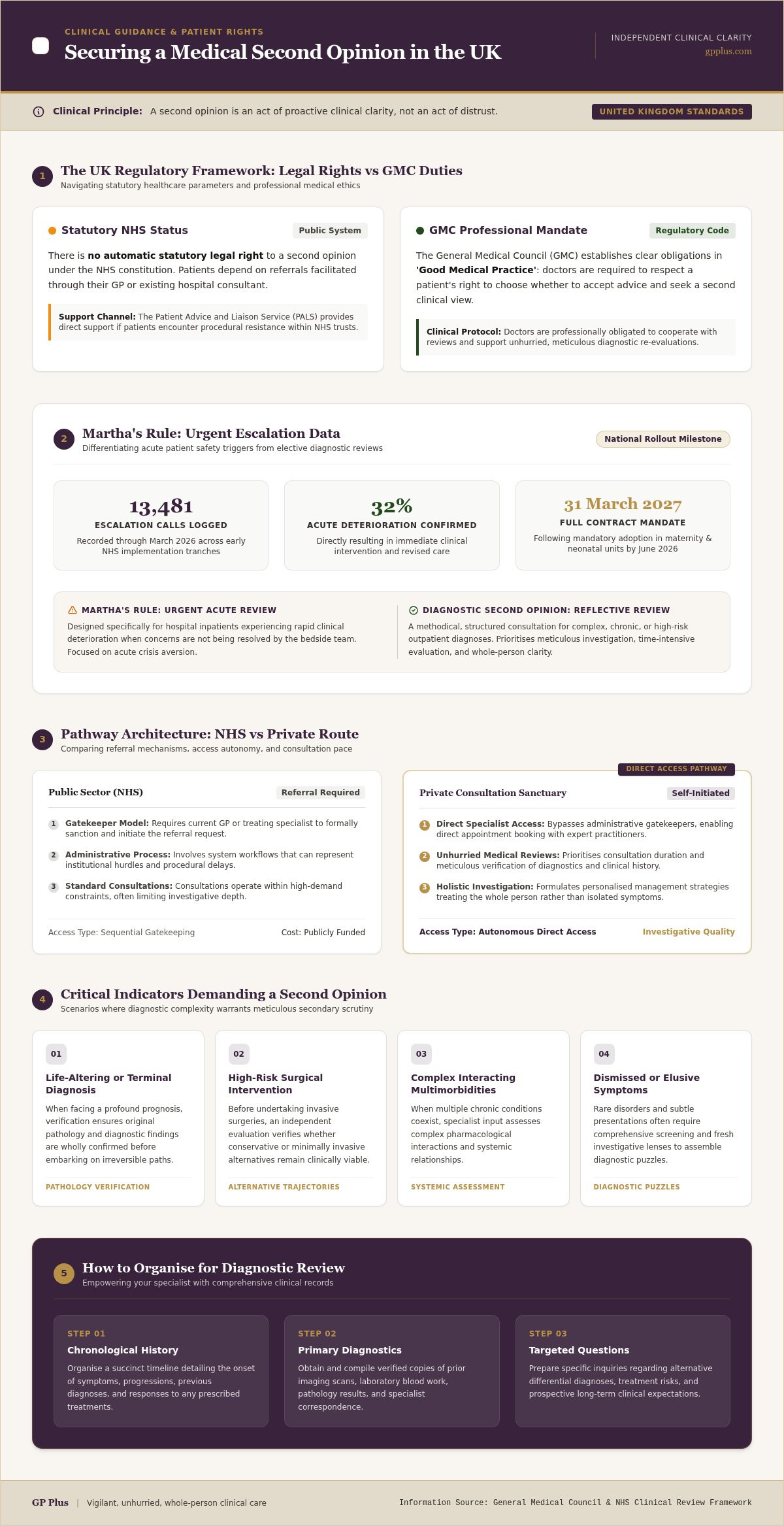
- Understand that whilst there is no statutory legal right under the NHS, GMC professional guidelines require doctors to respect your request for a second opinion.
- Discover how to get a second opinion on a diagnosis uk-wide by navigating the differences between NHS referral pathways and the direct access provided by private consultations.
- Identify the critical health scenarios, such as elusive symptoms or high-risk surgical advice, where a second clinical review is the most responsible path forward.
- Learn how to organise your medical history and test results to ensure your next specialist has the clarity needed for a thorough, investigative assessment.
- Recognise the value of an unhurried medical environment where clinical precision and patient empathy work together to provide definitive peace of mind.
Understanding Your Rights and Options for a Second Medical Opinion
Seeking clarity when your health feels uncertain is a sign of personal advocacy, not a lack of trust in your clinical team. A medical second opinion allows an independent specialist to review your original diagnosis, pathology results, and treatment trajectory from a fresh perspective. Whether you're looking to confirm a life-altering diagnosis or explore less invasive alternatives, the goal is always the same: achieving absolute clinical certainty. Understanding how to get a second opinion on a diagnosis uk patients can trust begins with knowing your rights within both the public and private sectors.
The distinction between an NHS pathway and a private consultation is significant. In the public system, you often depend on your current GP or consultant to facilitate a referral, which can sometimes feel like a hurdle. Private consultations remove these administrative barriers. They provide a sanctuary of thoroughness where an expert guide takes the lead to ensure no detail is overlooked. This route offers a direct path to investigative expertise, prioritising quality of time over the speed of the system.
The Regulatory Framework in the UK
The General Medical Council (GMC) sets clear expectations in their 'Good Medical Practice' guidelines. Doctors are expected to recognise a patient’s right to choose whether to accept their advice and should respect the right to seek a second opinion. If you find yourself encountering resistance within the NHS, the Patient Advice and Liaison Service (PALS) can offer support. Seeking further advice is a respected, standard part of modern medicine. It ensures that the patient is heard and that every diagnostic detail has been meticulously verified by a vigilant expert.
Martha’s Rule and Urgent Reviews
A significant development in patient safety is Martha's Rule. This initiative allows hospital inpatients and their families to trigger an urgent clinical review if they feel a condition is deteriorating and their concerns aren't being met. By June 2026, this was mandated across all maternity and neonatal settings, with full NHS implementation embedded in the standard contract by 31 March 2027. Data through March 2026 shows that out of 13,481 escalation calls made, 32% identified acute clinical deterioration, leading to direct treatment changes.
Whilst Martha's Rule is a vital tool for acute safety, it differs from a planned diagnostic review. If you want to get a second opinion on a diagnosis uk providers have already issued for a chronic or complex condition, a structured, unhurried consultation is the more effective route for long-term peace of mind. It allows for a reflective pace, ensuring your health is managed with extreme precision and a focus on long-term outcomes.
Recognising When a Second Opinion is the Right Path for Your Health
Your intuition is a powerful clinical tool. When a diagnosis feels incomplete or a treatment plan seems overly aggressive, the decision to get a second opinion on a diagnosis uk patients receive can be the most proactive step in your health journey. It is often the case that a fresh pair of eyes sees what a rushed system might overlook. This process is firmly supported by GMC guidance on patient rights, which ensures that your voice remains central to every clinical decision.
Seeking a second opinion is not about questioning a doctor's competence. It is about acknowledging the complexity of the human body. Certain health scenarios demand a higher level of scrutiny to ensure you are receiving the most appropriate care. These include:
- Receiving a life-altering or terminal diagnosis.
- Being recommended for high-risk surgical procedures.
- Dealing with multiple chronic conditions that interact in complex ways.
- Feeling that your symptoms have been dismissed or simplified.
Complex or Rare Diagnoses
Rare conditions often present a diagnostic puzzle that requires a specific investigative focus. Clinical experience varies widely amongst practitioners; what one doctor sees as a standard presentation, another might recognise as a subtle indicator of a more complex underlying issue. This is where a comprehensive health screening becomes invaluable. By taking the time to look beyond the obvious symptoms, a meticulous investigator can interpret diagnostic data through a broader lens, providing the clarity you need before committing to significant medical interventions.
When Treatment Outcomes Stall
It is deeply unsettling when symptoms persist despite following a prescribed programme. If you've been told to adopt a 'watchful waiting' approach but your subjective experience tells you something is wrong, it's time for a definitive clinical review. You shouldn't have to feel like a number in a queue. Deciding to get a second opinion on a diagnosis uk specialists have provided allows for an unhurried assessment where your concerns are met with genuine concern rather than administrative haste. If your current path has reached a plateau, you might consider booking a private GP consultation to explore more exhaustive investigative options.
Ultimately, the greatest benefit of a second opinion is the restoration of peace of mind. Knowing that no stone has been left unturned and every test result has been verified by an independent expert allows you to move forward with confidence. It transforms a period of medical anxiety into a structured, calm journey towards wellness, ensuring that your care plan truly considers the whole person.
Comparing NHS and Private Second Opinion Routes
Choosing the right path to get a second opinion on a diagnosis uk patients often find themselves at a crossroads between the traditional NHS route and the streamlined private alternative. Whilst the NHS provides a foundation of care, the process of requesting a second review within the system can sometimes feel like an uphill battle. It usually requires your current GP or consultant to facilitate a new referral. This can occasionally lead to a sense of professional friction or a feeling that you're questioning their clinical judgement, even though seeking clarity is a standard patient right.
The primary difference lies in the level of control and the pace of investigation. In a private setting, the administrative hurdles that often delay care are removed, replaced by a sanctuary of thoroughness where the patient's needs are the absolute priority. This route doesn't just offer a different name on a letter; it offers a fundamentally different clinical experience.
The NHS Referral Process
In the public sector, you're often bound by the standard referral-to-treatment milestones. As of July 2026, the NHS England waiting list stood at 7.33 million incomplete pathways, with only 65.3% of patients being seen within the 18-week target. This immense pressure on the system often means you have little choice regarding which consultant you see or where they are based. Additionally, obtaining a second opinion within the same hospital trust can be challenging, as clinical teams often work closely together. For those who need more detailed advice, the Patients Association guide to second opinions offers helpful steps on how to initiate these conversations within the NHS framework without damaging your existing clinical relationships.
The Private Healthcare Advantage
The private healthcare route offers a distinct departure from the sterile, rushed atmosphere found in many modern medical settings. Here, the "gatekeeper" delays are removed, providing a direct path to specialised expertise. A private GP acts as a dedicated partner in your health journey, offering the luxury of time that the public system simply cannot match. Instead of a standard ten-minute window, extended appointments of 30 to 45 minutes allow for a truly unhurried exploration of your medical history.
This methodical pace is essential for meticulous investigation. It ensures that every detail of your narrative is heard and protected. Beyond the consultation itself, a private setting allows for advanced diagnostic investigations to be fast-tracked, bypassing the diagnostic delays that affected 1.92 million patients in mid-2026. Once a review is complete, facilitating specialist referrals or obtaining private prescriptions becomes a seamless part of a bespoke care plan. This approach prioritises quality over speed, providing the clinical authority and peace of mind you deserve.
How to Organise and Prepare for Your Second Opinion Consultation
Preparation is the foundation of a successful medical review. When you decide to get a second opinion on a diagnosis uk providers have already issued, your goal is to transition from being a passive recipient of care to an active partner in your health journey. By organising your medical narrative, you empower your new advisor to focus on deep investigation rather than the administrative collection of data. This preparation is particularly crucial when moving from a rushed system to an unhurried, investigative environment where every detail matters.
A clear, chronological history helps identify patterns that may have been overlooked in standard, shorter sessions. It allows the clinician to see the evolution of your symptoms over time. This methodical approach ensures that the human connection is valued as much as the clinical data, creating a sanctuary of thoroughness where no detail is ignored.
Gathering Your Medical History
Under the UK Data Protection Act 2018 and UK GDPR, you have a legal right to request complete copies of your health records free of charge. This includes consultant letters, lab panels, and imaging reports. Standard requests must be fulfilled within one calendar month, though digital GP record access via the NHS App often makes this process significantly faster. Having these documents ready ensures your second opinion is based on the full clinical picture rather than a partial summary.
- Collate a chronological symptom timeline, noting when issues first appeared and what specific factors seem to trigger them.
- List all current medications, including dosages, durations, and any side effects you've experienced.
- Include a summary of previous treatments and how your body responded to them; this helps narrow down the investigative focus.
Formulating Your Key Questions
A second opinion is an opportunity to look beyond the obvious. Approaching the consultation with a calm, investigative mindset helps ensure your most pressing concerns are met with meticulous clarity. Instead of just accepting a diagnosis, you might ask, "What else could these symptoms indicate?" or "What is the specific evidence base for this proposed treatment?" These questions prompt a broader diagnostic view, considering the whole person rather than just the clinical data.
Clarifying long-term outcomes and potential side effects is also essential. It allows you to weigh the benefits of an intervention against its impact on your quality of life. This level of detail is often missed in standard 10-minute sessions, but it's the cornerstone of a truly personalised care plan. If you're ready to explore your health concerns with unhurried attentiveness, you can book a comprehensive GP consultation to begin your journey toward diagnostic clarity.
Comprehensive Clinical Investigation: The GP Plus Approach
At GP Plus, we believe that true clinical clarity is rarely achieved in a rush. When patients seek to get a second opinion on a diagnosis uk wide, they're often looking for more than just a different conclusion; they're seeking a process that values their narrative. Our approach is built on a foundation of unhurried attentiveness, where the doctor acts as a meticulous investigator rather than a gatekeeper. We provide a professional sanctuary where your health concerns are explored with a level of detail that modern medical settings often struggle to accommodate.
This commitment to thoroughness ensures that the patient is being heard and protected by a vigilant expert who values the human connection as much as clinical data. By creating a narrative environment that feels safe and exhaustive, we ensure your health is being managed with extreme precision, patience, and a focus on long-term outcomes.
Extended Consultations for Deeper Clarity
The cornerstone of our practice is the prioritisation of time. By offering appointments that range from 30 minutes to a full hour, we ensure that the investigative process is exhaustive. This extended duration allows our clinicians to identify complex medical interactions that might be missed in standard clinical windows. It fosters a collaborative partnership where you're heard and protected. This unhurried pace isn't a luxury; it's a clinical necessity for those dealing with elusive symptoms or multifaceted diagnoses. It ensures that every thread of your medical history is examined with quiet confidence and precision, allowing the clinician to look beyond the obvious to provide care that feels personal and exhaustive.
From Diagnosis to a Personalised Care Plan
A second opinion is only the beginning of a renewed health journey. Once we've achieved diagnostic clarity, our focus shifts to integrating these insights into a comprehensive, long-term health strategy. We don't just provide a report; we provide a path forward. This often involves facilitating fast-track specialist referrals or arranging further diagnostic investigations to confirm our findings. By acting as a dedicated partner in your care, we ensure that every patient leaves with a bespoke plan that considers the whole person.
Our commitment is to provide definitive peace of mind through clinical authority and a focus on long-term outcomes. Whether you require a new prescription or an onward referral to a trusted specialist, the transition is managed with the same meticulous care that defined your initial consultation. If you're seeking a higher level of clinical scrutiny, you can book an unhurried consultation to begin your path toward definitive clarity.
Empowering Your Health Journey Through Clinical Clarity
Reclaiming control over your health starts with the decision to seek absolute clarity. Whether you are navigating the complexities of the public system or choosing a direct private route, the goal is a definitive understanding of your well-being. Knowing how to get a second opinion on a diagnosis uk patients can trust allows you to move from a state of medical anxiety to a structured, calm path of recovery. It's a process that ensures every clinical detail has been verified by an independent, meticulous expert who prioritises your long-term outcomes.
At GP Plus, we provide a professional, unhurried clinical environment where your concerns are met with profound attentiveness and clinical precision. Through bespoke medical assessments and seamless specialist private referrals, we ensure that no aspect of your health is overlooked. You don't have to settle for a rushed experience. Book an unhurried consultation for a second opinion today and experience the peace of mind that comes from exhaustive investigation. Your health is too important to be managed in haste; let us help you find the answers you deserve.
Frequently Asked Questions
Can I get a second opinion on the NHS for free?
Yes, you can request a second opinion on the NHS for free. You don't have a statutory legal right to one, however. Usually, you must ask your current GP or consultant to refer you elsewhere. Whilst most doctors will respect this request in line with GMC guidelines, the final decision rests with the clinician. Wait times follow standard NHS targets, which are often lengthy due to current system pressures.
Do I have to tell my current doctor I am seeking a second opinion?
You aren't legally required to inform your current doctor if you choose to get a second opinion on a diagnosis uk patients often seek privately. It's usually beneficial to do so, however. This ensures a seamless transfer of your medical records and test results. Open communication helps your new consultant understand the full clinical context. This allows for a more thorough investigation. Meticulous care depends on having the complete picture.
How long does it typically take to arrange a private second opinion?
Arranging a private second opinion is significantly faster. It often takes only a few days to secure an appointment. Private clinics operate outside the standard NHS elective care backlog. They can fast-track diagnostic investigations and specialist reviews. This efficiency provides a sanctuary of thoroughness for those who need answers quickly. Clinical precision is maintained without the stress of waiting lists. It avoids the rushed atmosphere of ten-minute consultations.
Will a private second opinion be accepted by my NHS GP for future treatment?
Your NHS GP is not legally obligated to adopt the recommendations. They will often consider them if the advice is clinically sound, however. This is frequently managed through a Shared Care Agreement. You must provide your GP with the full report from your private review. This helps them integrate new findings into your long-term care plan. It is particularly important for ongoing prescriptions or specialist monitoring. Clarity is the ultimate goal.
What happens if the second opinion contradicts the initial diagnosis?
Discuss the discrepancy with both medical professionals. You need to understand the evidence behind each conclusion. A meticulous investigator will look beyond the obvious symptoms to find a definitive path forward. In complex cases, you might request a multi-disciplinary team review. This achieves absolute clarity. This investigative process ensures that your care plan is based on accurate data. It restores your peace of mind and clinical certainty.
Can I request a second opinion for a family member or child?
Yes, you can request a second opinion for a family member or child. You must have their consent or legal parental responsibility, however. This is a common step for parents seeking an unhurried clinical review. In acute hospital settings, Martha's Rule empowers families to trigger an urgent review. This applies if a relative's condition is deteriorating. It ensures your concerns are met with professional calm and immediate clinical attention.
Do I need a formal referral letter to see a private GP for a second opinion?
You don't need a formal referral letter to see a private GP to get a second opinion on a diagnosis uk wide. You can self-refer directly for an investigative consultation. Whilst a referral isn't mandatory, bringing your medical records is highly recommended. Include test results and a list of current medications. This allows the doctor to act as a dedicated partner. They can begin the process of meticulous investigation immediately. It ensures no diagnostic detail is overlooked.


