

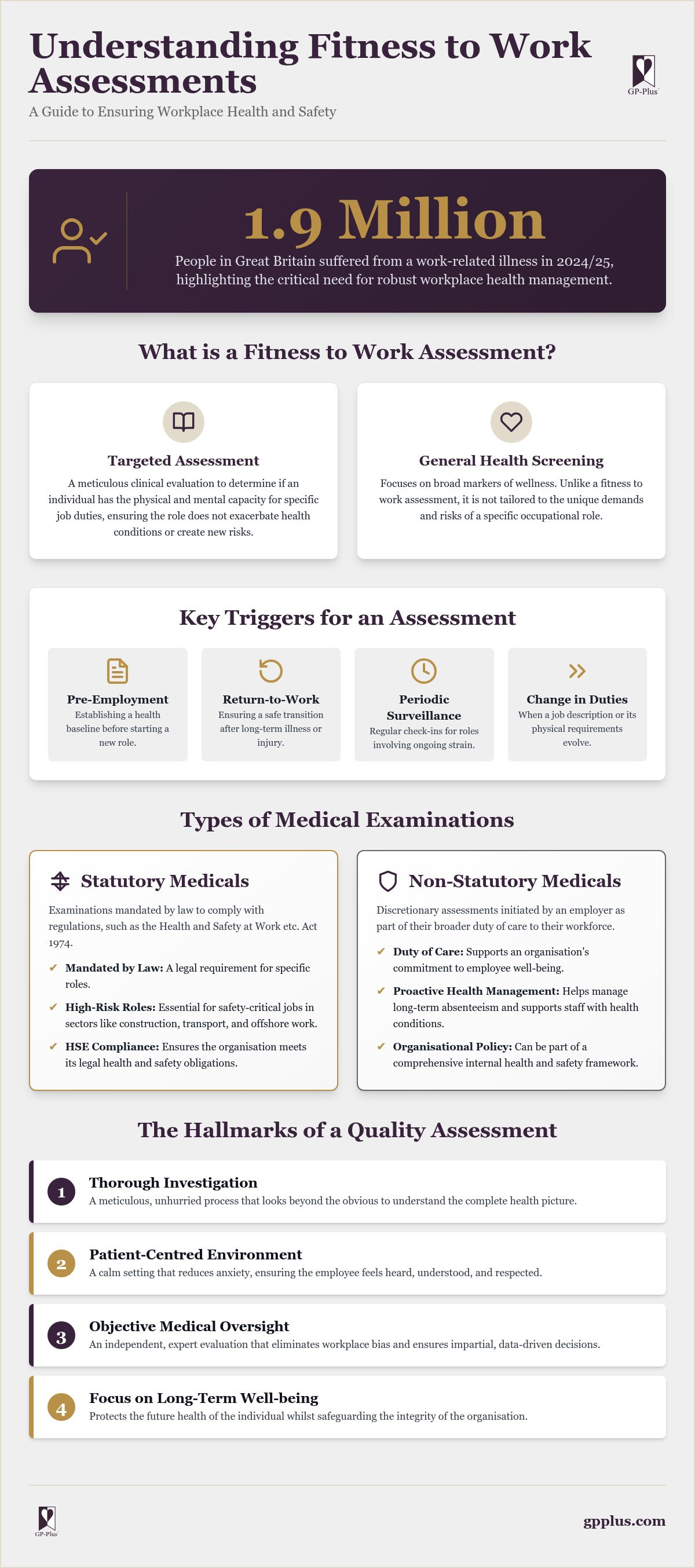
In 2024/25, an estimated 1.9 million people in Great Britain suffered from a work-related illness, a figure that underscores the profound impact of workplace health on our collective well-being. It's natural to feel a sense of unease when navigating the complexities of a fitness to work assessment, whether you're an employer concerned about HSE compliance or an employee anxious about the clinical process. We understand that these moments require more than just a signature; they demand a sanctuary of thoroughness where health is managed with precision and patience. This guide offers a comprehensive understanding of fitness to work standards, legal requirements, and the unhurried clinical process of professional health and safety testing. We'll examine the vital distinctions between statutory and discretionary medicals, providing a clear framework that replaces confusion with clinical clarity. By looking beyond the obvious, we'll explore how a meticulous investigation protects the long-term health of the individual and the integrity of the organisation.
Key Takeaways
- Understand how a fitness to work assessment edinburgh serves as a detailed clinical investigation into an individual's capacity, ensuring they can perform specific tasks safely and effectively.
- Learn to distinguish between statutory medicals mandated by law for high-risk roles and non-statutory assessments designed to support your organisation's broader duty of care.
- Discover the value of an unhurried clinical environment where medical history is explored with patience, reducing patient anxiety and ensuring no detail is overlooked.
- Recognise why professional medical oversight and thorough investigations are essential for reducing long-term absenteeism and maintaining a resilient, healthy workforce.
- Gain clarity on the clinical steps involved in health and safety testing, from initial screening to the development of personalised care plans that follow a formal assessment.
What is a Fitness to Work Assessment?
A fitness to work assessment is a meticulous clinical evaluation designed to determine whether an individual possesses the physical and mental capacity to perform their specific job duties without risk to themselves or others. Unlike a general health screening, which might focus on broad markers of wellness, a targeted occupational health assessment examines the delicate intersection between an individual's health and the unique demands of their role. The primary objective is to ensure that the workplace environment doesn't exacerbate existing conditions or create new vulnerabilities. Within this process, the General Practitioner acts as a neutral, expert investigator, looking beyond the obvious to provide a level of care that prioritises quality and long-term outcomes over speed.
The Purpose of Professional Clinical Oversight
Relying on self-certification is often insufficient, particularly for high-risk or safety-critical roles where the consequences of a health oversight can be severe. An independent medical perspective is essential to eliminate workplace bias and ensure that the evaluation remains strictly objective. This clinical oversight is deeply rooted in the professional standards of Fitness to Practise, a concept that ensures individuals remain suitable for their specific professional responsibilities. By engaging a vigilant expert, organisations create a sanctuary of thoroughness where the employee feels heard and protected, whilst the employer gains the clarity needed to make informed decisions. This unhurried approach fosters a sense of advocacy and peace of mind, ensuring that clinical data is always balanced with human connection.
When is an Assessment Required?
Identifying the appropriate moment for a fitness to work assessment edinburgh is a key component of a proactive health and safety strategy. These assessments are typically triggered by specific milestones or changes in circumstances, such as:
- Pre-employment screening: Establishing a clear health baseline before a candidate begins a new role.
- Return-to-work: Following a period of long-term illness or injury to ensure a safe and sustainable transition back to duties.
- Periodic surveillance: Regular check-ins for roles that involve ongoing physical or psychological strain.
Assessments are also vital when a job description evolves or when the physical requirements of a task change significantly. In high-consequence industries such as transport, construction, and offshore work, these evaluations are not just a formality but a fundamental safety measure. Taking the time to explore health concerns fully through a detailed investigation allows for the pursuit of clarity in complex situations, protecting both the individual's well-being and the organisation's integrity.
The Role of Health and Safety Testing in the Workplace
Effective health and safety testing functions as a sophisticated early-warning system. Rather than acting as a reactive response to an incident, it serves as a preventative measure that identifies potential vulnerabilities before they manifest as injuries or long-term illness. This approach is rooted in the Health and Safety at Work etc. Act 1974, which establishes a clear duty for employers to ensure the welfare of their staff. By moving away from a model that simply monitors illness, organisations can create a framework for proactively managing wellness. Choosing to undertake a fitness to work assessment edinburgh allows businesses to move beyond basic compliance, fostering a culture where every individual's health is managed with extreme precision and patience.
Mitigating Risk Through Clinical Data
Objective medical data is the cornerstone of any robust safety programme. Through detailed investigations like lung function tests or audiometry, a clinician can detect subtle physiological changes that an employee might not yet notice. This level of detail is especially critical for roles designated as "Safety Critical," where the physical or mental health of the operator directly impacts the safety of others. These positions require a higher threshold of clinical scrutiny to prevent catastrophic failures. For a deeper look at these specific requirements, you may find our article on Workplace Safety Critical Medicals: A Comprehensive Guide to Compliance and Care particularly useful. It's not just about passing a test; it's about the pursuit of clarity in complex environments.
Employer Obligations and Duty of Care
The legal landscape surrounding workplace health is intricate, requiring a dedicated partner who understands both clinical and regulatory demands. Under the Equality Act 2010, employers must consider "reasonable adjustments" for staff with health conditions, and medical data provides the evidence base for these decisions. While a standard fit note offers a starting point, the UK Government Guidance on Fit Notes emphasises that more detailed occupational advice is often necessary for complex cases. A formal assessment protects the business from future liability claims by demonstrating a thorough commitment to the duty of care. With an estimated 40.1 million working days lost to work-related illness in 2024/25, the economic value of expert-led oversight is clear. If you're seeking to strengthen your safety protocols, an unhurried occupational health consultation can provide the meticulous investigation your organisation requires.
Statutory vs. Non-Statutory Medical Examinations
Understanding the distinction between statutory and non-statutory examinations is essential for any organisation committed to a robust health and safety culture. Statutory medicals are those strictly mandated by UK law, typically for roles involving exposure to hazardous substances such as asbestos, lead, or ionising radiation. These assessments must be conducted by doctors approved by the Health and Safety Executive (HSE) to ensure compliance with specific regulatory protocols. In contrast, non-statutory medicals are discretionary assessments driven by a company's own risk assessments or internal policies. Whilst the law may not explicitly name every role that requires a check, an employer's duty of care often necessitates a formal fitness to work assessment edinburgh to manage risks effectively and protect individual well-being.
The depth of investigation varies between these categories, yet the clinical integrity remains constant. A statutory exam follows a rigid, prescribed set of tests, whereas a non-statutory assessment is often more bespoke, tailored to the specific physical or psychological pressures of a particular role. Regardless of the legal driver, every consultation should be a sanctuary of thoroughness. We believe that even discretionary medicals must adhere to the highest professional clinical standards, involving an unhurried dialogue that allows the clinician to look beyond the obvious data and understand the human being behind the employee record.
Safety Critical Medicals (SCM)
Safety Critical Medicals occupy a vital space within occupational health, focusing on roles where sudden incapacity could lead to catastrophic consequences for the individual or the public. These assessments go beyond a simple conversation; they require a physical, in-person clinical examination to evaluate vision, hearing, mobility, and cardiovascular health with extreme precision. A virtual chat cannot replace the meticulous investigation required to ensure a crane operator or a heavy machinery driver is truly fit for duty. By taking the time to explore these health markers fully, clinicians provide a level of reassurance that digital-only screenings simply cannot match.
Specialised Licensing and Professional Medicals
Certain professions require highly specific certifications that differ significantly from a standard GP consultation. This includes medicals for HGV/LGV drivers, taxi licensing, and offshore certifications such as OEUK. These assessments are rigorous, focusing on the specific legislative requirements of the licensing body rather than general wellness. Because these investigations are so specialised, they often require a deeper level of clinical experience and a dedicated partner in the patient's health journey. For those navigating these complex requirements for the first time, our Occupational Health Referral: A Comprehensive Guide to Professional Assessments provides a detailed roadmap for ensuring compliance and care.
The Clinical Process: What Happens During an Assessment?
Anxiety regarding medical testing often stems from a fear of the unknown or the worry that a consultation will feel rushed and impersonal. We replace that uncertainty with a profound sense of reassurance and professional calm. The journey through a fitness to work assessment edinburgh is designed to be a sanctuary of thoroughness, where the patient is heard and protected by a vigilant expert. Unlike the sterile atmosphere often associated with modern medicine, this process prioritises unhurried attentiveness, ensuring no detail is overlooked. Confidentiality remains a cornerstone of our practice. Whilst the employer receives a clear summary regarding fitness and recommended adjustments, the granular clinical data remains protected within the patient's private medical record.
Step 1: The Comprehensive Medical History
The investigation begins with a methodical review of the individual's medical narrative. This isn't a mere tick-box exercise; it's a deep exploration of past conditions, current medications, and lifestyle factors. The clinician acts as a meticulous investigator, seeking to understand the specific physical and mental demands of the job role. By taking the time to listen, the doctor can identify subtle "red flags" that might require further diagnostic investigation. This step ensures that the eventual determination is based on a complete picture of the human being, not just a snapshot of data.
Step 2: Physical and Diagnostic Testing
Once the history is established, the process moves into a series of precise physical examinations. Core checks typically include blood pressure, heart rate, BMI, and urinalysis. Depending on the role's requirements, the clinician may perform specialised tests such as spirometry to assess lung function, audiometry for hearing, or detailed vision screenings. These in-clinic investigations are vital for fast-tracking a definitive diagnosis, providing a level of clarity that virtual consultations cannot offer. The focus here is on extreme precision, ensuring that any safety-critical markers are evaluated with the highest level of clinical authority.
Step 3: The Outcome and Recommendations
The final phase involves synthesising the clinical data into a logical, narrative conclusion. The result is typically categorised as "Fit," "Fit with Adjustments," or "Unfit" for specific duties. If adjustments are required, the clinician formulates practical, bespoke recommendations for workplace modifications, such as altered hours or ergonomic changes. This outcome is then formalised in a certificate or report that provides peace of mind for both parties. If you're looking for a partner in this journey, you can book a professional medical assessment to ensure your health is managed with the care it deserves.
Why Professional Medical Oversight Matters for Your Business
The true value of a meticulous medical investigation extends far beyond simple regulatory compliance. When an organisation views health testing as a mere "tick-box" exercise, it risks overlooking subtle indicators of ill health that eventually manifest as costly absenteeism or high staff turnover. By contrast, a sophisticated clinical approach treats each fitness to work assessment edinburgh as a vital investment in the organisation's human capital. The estimated cost of injuries and ill health from current working conditions reached £22.9 billion in 2023/24, a figure that highlights the necessity of expert-led oversight. A trusted medical advisor acts as a dedicated partner, balancing complex clinical data with the practical needs of the business to ensure a resilient, healthy workforce.
Our core philosophy is defined by unhurried attentiveness, providing ample time for every interaction to ensure no detail is overlooked. This methodical pace allows for a level of precision that "speed-focused" or virtual providers simply cannot replicate. When a clinician has the time to explore a patient's health journey fully, the resulting fitness determination is not only more accurate but also more protective for the employer. This steady, deliberate rhythm creates a narrative environment where the employee feels heard and the organisation gains absolute clarity on workplace safety.
Beyond the Certificate: Personalised Care Plans
A professional assessment often acts as a sanctuary of thoroughness where early-stage health issues, such as hypertension or signs of chronic stress, are uncovered before they become critical. Rather than just issuing a certificate, a vigilant expert provides a pathway to better health through personalised care plans. This might include specialist referrals or tailored advice on managing long-term conditions within the workplace. When employees see that their well-being is being managed with such extreme precision and genuine concern, it fosters a culture of health where they feel truly protected. This advocacy leads to higher engagement and a more sustainable working environment for everyone involved.
The Value of Clinical Experience
Complex cases require the intuitive insight that only comes from decades of clinical experience. The expertise of a seasoned practitioner, like Dr Peter Copp, ensures that even the most nuanced health concerns are investigated with quiet confidence. There's a profound difference between a provider who rushes through a checklist and a meticulous medical investigator who looks beyond the obvious to protect the individual's long-term outcomes. When arranging a fitness to work assessment edinburgh, the focus should always remain on quality over speed. We encourage organisations to move towards proactive health management, shifting the focus from monitoring illness to pursuing clarity. For a deeper exploration of these preventative strategies, read our Health Screening: The Ultimate Guide to Proactive Medical Assessments in 2026. Investing in this level of detail ensures that your business remains both compliant and compassionate.
Securing the Future of Your Workforce
The transition from reactive monitoring to proactive wellness management represents a vital evolution for any modern organisation. By clearly distinguishing between statutory obligations and best-practice discretionary medicals, you establish a robust framework that protects both your staff and your long-term business integrity. Navigating a fitness to work assessment edinburgh doesn't have to be a source of anxiety; it's an opportunity to invest in the human capital that drives your success. As Scotland’s first private GP clinic, we provide a sanctuary of thoroughness where clinical data is balanced with human connection and unhurried attentiveness.
Our expert medical investigators bring decades of experience to every case, prioritising thorough, 30 to 60 minute consultations that allow for a truly meticulous investigation. This deliberate pace ensures that no detail is overlooked and every patient feels heard and protected by a vigilant expert. Book a professional fitness to work assessment with GP Plus to ensure your team is supported by clinical excellence and a partner dedicated to your collective well-being. Taking the time to explore health concerns fully today ensures a safer, more resilient workplace for years to come.
Frequently Asked Questions
Can an employee fail a fitness to work assessment?
An employee doesn't "fail" in the traditional sense; instead, the clinician determines their level of fitness for specific tasks based on clinical data. The outcome is typically categorised as Fit, Fit with Adjustments, or Unfit for their current role. If an individual is found unfit, the focus shifts to advocacy and identifying what modifications might allow for a safe return to work, ensuring the person is protected from workplace harm whilst maintaining organisational safety.
How long does a typical health and safety medical take?
A comprehensive health and safety medical typically requires an unhurried 30 to 60 minute consultation. This deliberate pace is essential for a meticulous investigation into your medical history and specific job demands. Taking this time ensures that every detail is considered with extreme precision, allowing the clinician to look beyond the obvious and provide a level of care that prioritises long-term well-being over speed. This methodical approach creates a narrative environment that feels safe and exhaustive.
Who is responsible for paying for the fitness to work assessment?
In the vast majority of cases, the employer is responsible for the costs associated with a fitness to work assessment edinburgh. Under the Health and Safety at Work etc. Act 1974, providing a safe working environment includes necessary medical surveillance, which must be funded by the organisation. This ensures that financial barriers don't prevent employees from accessing the essential clinical oversight required for their safety, protecting the human connection as much as the clinical data.
Is the medical information shared with the employer confidential?
Your detailed clinical data remains strictly confidential and is not shared with your employer without your explicit consent. The clinician provides the organisation with a summary report that outlines your fitness for work, any recommended adjustments, and the need for future reviews. This approach ensures that whilst the business gains clarity, your private health narrative remains protected within a sanctuary of clinical trust, where you are heard and protected by a vigilant expert.
What is the difference between a fitness to work assessment and a standard GP check-up?
Whilst a standard GP check-up focuses on general wellness and disease management, a fitness to work assessment is a targeted investigation into your functional capacity for specific tasks. It evaluates how your physical or mental health might be impacted by, or impact, your work environment. This specialised clinical oversight involves examining safety-critical markers, such as hearing or lung function, which aren't typically the focus of a routine health screening, ensuring a bespoke healthcare experience.
How often should employees undergo health and safety testing?
The frequency of health and safety testing varies depending on the specific risks associated with your role and any statutory requirements. Some high-risk positions, such as those involving exposure to lead or asbestos, require examinations at legally defined intervals. In other cases, assessments are triggered by a change in job duties, a return to work after illness, or as part of a proactive, unhurried wellness strategy designed to manage your health with extreme precision and patience.
What happens if a "test for health and safety" identifies a medical issue?
If an assessment identifies a health concern, the clinician acts as a trusted advisor to help you manage the condition effectively. This might involve recommending "reasonable adjustments" to your workplace or providing specialist referrals for further investigation. The objective is never to penalise the individual but to pursue clarity and provide a level of care that ensures the workplace does not exacerbate the newly identified health issue, prioritising your long-term health outcomes.
Are virtual occupational health assessments as effective as in-person ones?
For roles requiring physical testing or safety-critical determinations, an in-person fitness to work assessment edinburgh is far more effective than a virtual consultation. Essential diagnostic tests, such as audiometry, spirometry, or physical mobility checks, require a clinical setting and a meticulous physical investigation. Whilst a virtual chat can cover history, only an in-person meeting provides the extreme precision and quiet confidence needed to ensure a truly safe, exhaustive, and accurate assessment.


