

A safety critical medical edinburgh assessment should do more than satisfy a compliance checklist. In high-risk work, overlooking a health concern could put the employee or colleagues at risk. A thorough, role-specific medical considers whether a person’s health is compatible with the tasks they are expected to perform.
It’s understandable to want clear evidence that workplace health and safety responsibilities are being taken seriously, and to worry that a rushed appointment might miss something important. A useful assessment takes account of the demands of the role and relevant industry requirements, rather than treating every worker as a tick-box exercise.
This guide explains what safety-critical medicals may involve, how employer risk assessments and sector standards shape requirements, and what to consider around CBH and Constructing Better Health. It also explains how longer appointment times can support a careful clinical discussion. At GP Plus, private GP consultations and occupational health assessments provide time to explore relevant concerns, with investigations and specialist referrals available where appropriate.
Key Takeaways
- An employer’s risk assessment and relevant industry standards help determine whether a role needs a safety-critical medical.
- A thorough assessment may consider medical history, current health, and musculoskeletal or cardiovascular fitness in relation to the work.
- For a safety critical medical edinburgh, clinical judgement matters as much as completing administrative requirements.
- Prepare by gathering relevant medical records and prescription details to help the clinician understand your health history.
- Longer appointment times allow more room to discuss concerns and consider appropriate next steps.
What is a Safety Critical Medical and Why is it Essential?
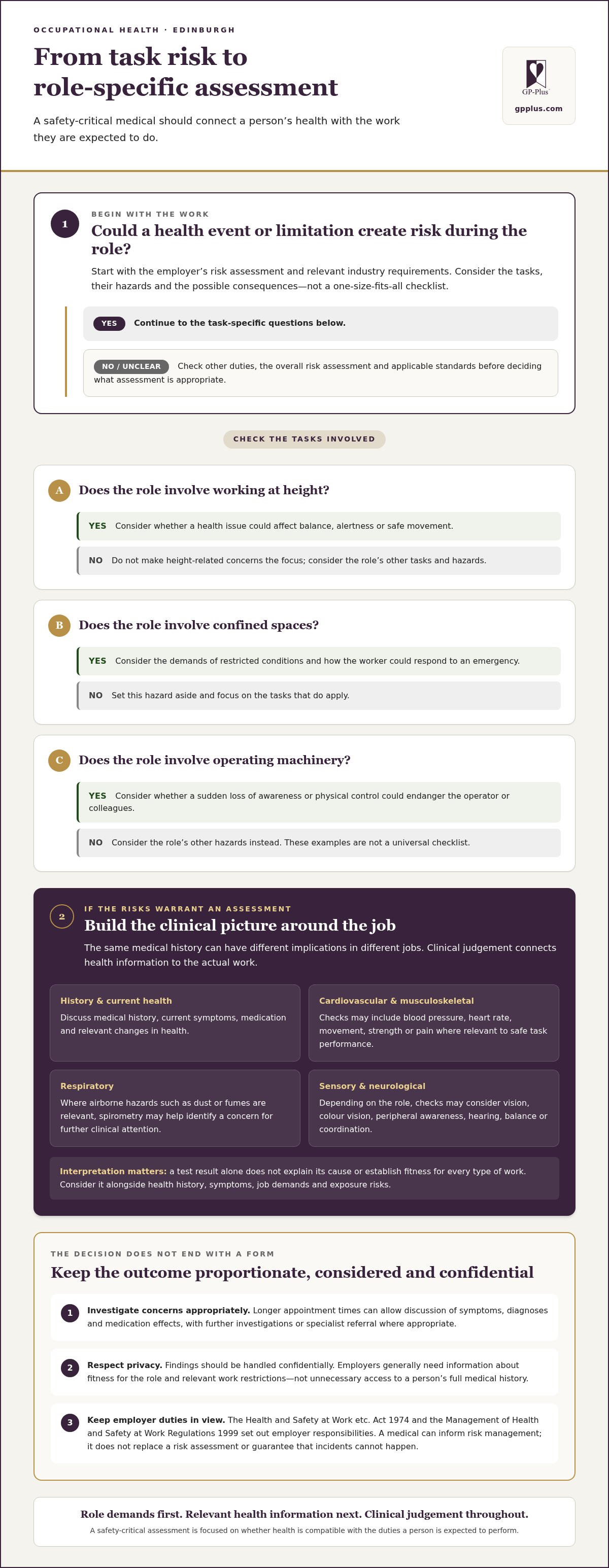
A safety-critical medical is a focused assessment of whether a person’s health is compatible with the duties they are expected to perform. The question is not simply whether someone is generally well, but whether a health event or limitation could put them or others at risk while they work. This makes the assessment a practical part of risk management, not a routine formality.
This work sits within the wider field of Occupational Safety and Health, where protecting people means considering how individual health, workplace conditions and specific tasks interact. Unlike a broad occupational health review, a safety-critical assessment focuses closely on the demands and consequences of a defined role. The questions should follow the risks, rather than rely on a one-size-fits-all checklist.
The Scope of Safety Critical Roles
These assessments may be relevant in construction, rail, maritime and plant operation. The focus depends on the task and its hazards. Someone operating heavy machinery, entering a confined space or working at height may need a different assessment from someone whose role has none of these immediate risks.
- Working at height: consider whether a health issue could affect balance, alertness or safe movement.
- Confined spaces: consider the demands of working in restricted conditions and responding to an emergency.
- Operating machinery: consider whether a sudden loss of awareness or physical control could endanger the operator or colleagues.
These examples show why clinical judgement matters. The same medical history can have different implications in different jobs, so the assessment needs to connect health information with the work involved.
The Legal and Ethical Imperative
The Health and Safety at Work etc. Act 1974 places duties on employers to protect employees’ health, safety and welfare so far as is reasonably practicable. The Management of Health and Safety at Work Regulations 1999 also require employers to assess workplace risks and put appropriate controls in place. A medical can inform this process, but it doesn’t replace a risk assessment or remove the employer’s wider responsibilities.
A clear, role-relevant clinical assessment can help an employer document how fitness concerns were considered and what action followed. It can contribute to a more legally defensible approach, but no certificate guarantees that incidents cannot happen. Clinical vigilance means taking reported symptoms seriously, investigating concerns appropriately and making considered recommendations rather than simply ticking boxes.
There is also a responsibility to treat employees with respect. Health information is personal, and assessment findings should be handled confidentially. Employers generally need information about fitness for the role and any relevant work restrictions, not unnecessary access to a person’s full medical history. A careful process balances privacy with the need to manage risks to the individual and wider workforce.
The Clinical Components of a Rigorous Medical Assessment
A useful safety-critical medical connects clinical findings to the actual demands of a person’s job. It usually begins with a discussion of medical history, current symptoms, medication and relevant changes in health. This context helps the clinician decide which checks are appropriate and whether a finding needs further investigation. No single set of tests suits every role, so the assessment should be proportionate to the risks involved.
The physical examination may include checks of cardiovascular and musculoskeletal health. Blood pressure and heart rate provide information about circulation, while symptoms such as dizziness, chest discomfort or breathlessness can inform clinical judgement. A musculoskeletal assessment may consider movement, strength or pain where these could affect safe task performance. The aim is not just to record measurements, but to understand their relevance to the work.
Cardiovascular and Respiratory Vigilance
Respiratory function can matter where a role involves exposure to dust, fumes or other airborne hazards. Spirometry measures aspects of lung function and may help identify a concern that warrants further clinical attention. It cannot, by itself, explain the cause of a result or establish fitness for every type of work. The clinician interprets it alongside health history, symptoms and the job’s exposure risks.
Longer appointment times make room to discuss that context. A careful consultation can explore relevant symptoms, previous diagnoses and medication effects as well as record measurements such as blood pressure. If something needs attention, appropriate investigations or a specialist referral can help clarify the next steps, rather than leaving an unexplained result on a form.
Sensory and Neurological Integrity
Vision screening may assess visual acuity, colour vision and peripheral awareness, with the relevance of each check shaped by the role. Distinguishing colours can matter where safety signs or signals use colour coding. Audiometry measures hearing, which can be important for detecting alarms, instructions or warnings in noisy environments. These checks provide useful information, but results should be considered in relation to the worker’s tasks and any required protective equipment.
For work at height, balance and coordination may also warrant clinical consideration, particularly if a worker reports symptoms that could affect steadiness. A urine dip test may screen for glucose, protein or blood. These findings aren’t a diagnosis. If an abnormal result appears, the clinician can explain its limits and whether follow-up is appropriate.
For a safety critical medical edinburgh, as for any role-specific assessment, results need to be interpreted in the context of the work and the employer’s risk assessment. A clinically led review helps distinguish a result that needs further attention from one that can be understood in context. GP Plus occupational health medicals include time to discuss findings and consider appropriate follow-up.
Navigating Regulatory Standards and Accreditation
Safety-critical medicals sit within a framework of employer risk assessments and, in some sectors, specific industry standards. There isn’t one universal test or certificate that establishes fitness for every high-risk role. An assessment needs to reflect the work, relevant hazards and applicable sector requirements, with clear records showing how clinical findings informed the outcome.
For employers arranging safety-critical medicals, the principle is consistent: use a clinically considered process, not a certificate-led shortcut. Standards and accreditation can support confidence in a service, but they don’t replace professional judgement or an employer’s responsibilities.
SEQOHS and Clinical Governance
SEQOHS stands for Safe Effective Quality Occupational Health Service. It is a recognised UK quality standard for occupational health providers, focusing on the systems and governance that underpin a service. For an employer, sound governance should support clear, consistent reports and appropriate handling of clinical information. Accreditation is a quality framework, not proof that every assessment is suitable for every job.
Confidentiality matters throughout. Employers need relevant conclusions about fitness for work and any restrictions, while the worker’s detailed medical history remains private. A well-managed process explains what information is shared, with whom and for what purpose. This respects the employee’s privacy and helps the employer make decisions using information relevant to workplace safety.
Industry-Specific Frameworks
Requirements can differ between sectors and roles. In rail, the Office of Rail and Road sets medical fitness standards, and train drivers are subject to requirements under the Train Driving Licences and Certificates Regulations 2010. Construction employers may also work with frameworks such as Constructing Better Health (CBH). The appropriate assessment depends on the relevant standard and the employer’s risk assessment, rather than an assumption that one certificate fits every worker.
A “Fit to Work” certificate is most useful when its scope is clear: which role or standard it relates to, what conclusion it records and whether any limitations apply. It should not be treated as universal legal clearance. Where a medical identifies a concern, clinical follow-up can explain the finding, recommend further investigation or involve a specialist before the employer makes a considered decision.
For organisations with a workforce across multiple sites, consistency comes from applying the same relevant criteria and reporting approach to comparable roles, while accounting for individual health and job demands. The Faculty of Occupational Medicine (FOM) contributes professional guidance and benchmarks for occupational medicine; it is distinct from statutory regulators and industry-specific authorities. Used thoughtfully, these frameworks can help employers avoid a tick-box approach and support assessments that are careful, transparent and proportionate.
How to Prepare for Your Safety Critical Medical
Preparing for your appointment can help the clinician build an accurate picture of your health and consider it in the context of your role. You don’t need to rehearse answers or memorise every detail. Bring useful records, describe your health honestly and allow enough time to attend without rushing.
Documentation and History
Before your appointment, make a note of ongoing conditions, previous surgeries, current symptoms and treatments. Include the names and doses of your prescriptions, and details of any specialists involved in your care. Bring relevant medical letters or test results if they’re readily available. A clear history helps the clinician understand changes over time and tailor the assessment, rather than drawing conclusions from a single measurement.
Be open about symptoms, even if they seem minor or intermittent. Dizziness, breathlessness, hearing changes or pain may be relevant to particular tasks. Sharing them allows the clinician to explore their significance. An assessment is not a test of whether you can give the “right” answer. Accurate information supports a fairer, more personalised clinical view.
Physical and Mental Preparation
Follow any specific instructions provided for your appointment, especially if a particular test is planned. Unless you’ve been told otherwise, don’t stop prescribed medication or fast in preparation. Drink normally so you’re not dehydrated, particularly if a urine sample may be requested. Avoiding excessive caffeine beforehand may help prevent a temporary rise in pulse or blood pressure, while avoiding loud noise before hearing testing can help protect the usefulness of the result.
Allow time to arrive without rushing if you can. Feeling anxious is understandable, and telling the clinician how you’re feeling can help them interpret measurements such as blood pressure in context. An unhurried consultation gives space to explain the process, ask questions and repeat a measurement if there’s a clinical reason to do so. Longer appointment times support a calmer discussion, not just a sequence of checks.
Bring photo identification and any documents or medication details you’ve gathered. If you use glasses or contact lenses, take them with you; bring hearing aids if applicable, too. The clinician can consider your usual corrective aids where relevant to the assessment. Follow the instructions given for your appointment rather than changing your routine unnecessarily.
Honesty is central to a useful assessment. Concealing a diagnosis, medication or symptom can make it harder to interpret findings and advise on safe next steps. If a concern emerges, a thorough clinical review can help clarify whether further investigation or a specialist referral is appropriate. GP Plus provides occupational health medicals with time to understand your health and the demands of your work.
The GP Plus Approach: Meticulous Investigation for Peace of Mind
A safety-critical medical should give the clinician time to understand the person behind the form and the demands of their work. At GP Plus, longer appointment times create space to listen carefully, explore relevant health history and interpret findings in context. The purpose is not simply to complete checks quickly, but to make a considered assessment that supports informed decisions about fitness for task.
Quality Over Speed
A short appointment may leave little room to discuss a complex medical history, clarify symptoms or understand how a role’s demands affect the clinical picture. Not every concern requires additional tests, but the clinician needs scope to ask follow-up questions when something warrants attention. Rushing can make it harder to distinguish a relevant risk from an isolated detail.
Dr. Peter Copp founded GP Plus with a focus on extended consultation times and a patient-centred experience. In a calm clinical setting, employees can explain concerns openly while the clinician considers what a finding means for their particular duties. This approach reflects the principles discussed in GP Plus: A Comprehensive Guide to Private Medical Excellence, where quality of care depends on attentive, individual assessment rather than speed alone.
This distinction matters to employers as well as employees. A certificate records an outcome, but thoughtful clinical reasoning helps make that outcome meaningful. Where a finding needs clarification, the clinician can explain the concern and recommend appropriate next steps, rather than leaving the employee uncertain about what it means.
Integrated Clinical Support
If an assessment identifies a possible health concern, care needn’t stop at recording it. GP Plus provides investigations and specialist referrals where appropriate, helping clarify findings and plan next steps. This connects the medical assessment with a practical route forward while keeping the employee’s wellbeing and the demands of their work in view.
For an employer, considered follow-up can provide clearer information for managing workplace risk. For the employee, it means a concern has been heard and can be assessed further where appropriate. The approach to occupational health referrals and professional assessments explains how clinical input can support appropriate decisions without reducing a person’s health to a pass-or-fail result.
Workforce health is not a one-off administrative task. It calls for clear communication, appropriate clinical follow-up and an understanding that health can change over time. By combining occupational health assessments with unhurried medical consultations, GP Plus supports careful decisions for employers and employees.
Make Clinical Confidence Part of Your Next Step
Workforce safety depends on decisions that are thoughtful, well-informed and responsive to people’s changing health. Treating a medical as a meaningful clinical review, rather than simply a form to complete, can help employers and employees move forward with greater clarity. When arranging a safety critical medical edinburgh, choose an assessment that considers both the individual and the responsibilities of their role.
GP Plus provides occupational health assessments and private GP consultations, with longer appointment times to support a careful discussion of health concerns and work demands. Investigations and specialist referrals are available where appropriate, helping employees and employers understand relevant findings and next steps.
Arrange a role-focused assessment with GP Plus. Book a safety-critical medical and give clinical judgement the time it needs.
Frequently Asked Questions
What exactly is a safety-critical medical certificate?
It’s a written record of the clinician’s fitness assessment for a particular role or standard. Depending on the scheme, it may state that an employee is fit, fit with restrictions, or needs further assessment. Check that the document identifies its scope and any limitations: a certificate for one type of duty shouldn’t automatically be treated as clearance for another. It doesn’t guarantee that a worker will remain fit indefinitely.
How long does a safety-critical medical assessment typically take?
There isn’t one standard appointment length. The time depends on the role, required checks, medical history and whether a finding needs clarification. A straightforward assessment may differ from one involving additional tests or a more detailed discussion. Allow time to give a full account of your health and ask questions, rather than assuming the appointment will take a fixed amount of time. GP Plus uses longer consultation times to support thorough assessments.
What happens if an employee fails their safety-critical medical?
An unfavourable result doesn’t automatically mean dismissal. Depending on the finding and applicable standard, the clinician may recommend restrictions, temporary removal from particular duties, or further assessment. The employer then considers that advice alongside workplace risks and its employment procedures. A concern affecting one task may not affect every duty. The employee should receive a clear explanation of the outcome and any recommended follow-up.
Is a safety-critical medical the same as a general health check?
No. A general health check offers a broad view of health, while a safety-critical assessment considers fitness in relation to defined work duties and relevant industry criteria. A normal result on a general check doesn’t necessarily address a role-specific requirement, such as a particular hearing or vision standard. Conversely, a safety-critical assessment isn’t a complete health screen and shouldn’t be treated as a substitute for ordinary healthcare.
How often should safety-critical medicals be renewed?
Renewal intervals depend on the industry standard, role, employer’s risk assessment and, in some schemes, age. General guidance commonly gives three years for workers aged 54 and under, two years for those aged 55 to 64, and one year from age 65. These intervals aren’t universal. Train drivers have separate requirements, including examinations at least every three years up to age 55 and annually thereafter.
Can my own GP perform a safety-critical medical for my employer?
Possibly, but a routine GP consultation isn’t automatically equivalent to an employer’s required occupational assessment. The clinician needs to understand the role’s demands and apply the relevant standard; some employers or schemes specify the type of assessment or reporting they accept. Your usual GP may contribute useful medical history, but the employer’s requirements determine what assessment is needed. Clinical details should remain confidential, with work-related conclusions shared appropriately.
What industry standards do safety-critical medicals follow in the UK?
There’s no single standard covering every occupation. Employers use their risk assessment alongside applicable sector requirements. Rail medical fitness is overseen by the Office of Rail and Road, with train driver examinations governed by the Train Driving Licences and Certificates Regulations 2010. Construction employers may use Constructing Better Health guidance, while SEQOHS is a recognised quality standard for occupational health services. The relevant framework depends on the role.
Do I need to fast before my safety-critical medical assessment?
Usually, don’t fast unless your appointment instructions specifically ask you to do so for a planned test. Fasting unnecessarily can leave you feeling unwell and may not help the assessment. Take prescribed medicines as normal unless a clinician has advised otherwise, and drink water normally. If you’ve received test-specific instructions, follow them. If you’re uncertain, clarify them before changing your usual eating, drinking or medication routine.


